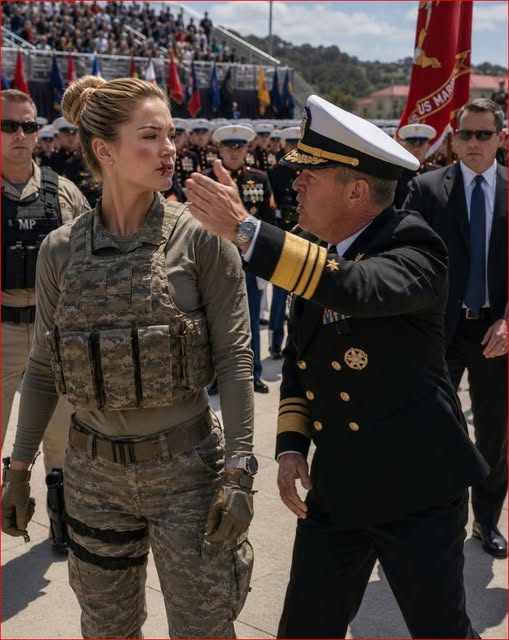
The first thing I heard after Rear Admiral Richard Blackwell slapped me was not the gasp of two thousand Marines.
It was the flag halyard clicking against a metal pole.
Clink.
Clink.
Clink.
A tiny sound in the enormous silence that followed.
My face had snapped sideways from the blow. The inside of my lip split against my teeth, and warm blood slipped toward my chin.
For perhaps half a second, the old instincts returned.
Distance.
Angle.
Threat assessment.
His right shoulder was exposed. His weight was forward. His left knee was locked. If he moved again, I knew exactly how to put him on the concrete before anyone around us understood what had happened.
But I did nothing.
Because the most dangerous lesson I had ever learned was that power did not mean striking back. Sometimes power meant standing perfectly still while another person destroyed himself.
I slowly turned my head toward him.
Rear Admiral Richard Blackwell stared at me with the furious certainty of a man who had spent too many years believing rank made him untouchable.
He was sixty-two, broad through the shoulders, silver-haired, immaculate in his dress uniform.
Four rows of ribbons.
Command insignia.
Gold braid.
A chest full of accomplishments.
And absolutely no idea who I was.
“Security!” he shouted.
The microphone near the reviewing stand caught his voice and threw it across the entire parade ground.
“Remove this woman.”
Two military police officers moved toward us.
Then stopped.
I knew both of them had already scanned my temporary credentials at the east entrance.
Neither knew my complete background.
They knew enough.
One of them, a young staff sergeant named Collins, looked as if somebody had asked him to arrest a live grenade.
“Sir,” he said carefully, “her access authorization came directly through the Pentagon.”
Blackwell turned on him.
“I don’t care if God signed it.”
A murmur moved through the ranks.
Blackwell pointed at me.
“This civilian disrupted a restricted ceremony, refused a direct order, and falsely represented herself as military personnel.”
I glanced down at myself.
Olive-drab long-sleeved shirt.
Weathered tactical trousers.
Dust-colored boots.
No rank.
No ribbons.
No name tape.
Nothing visible except a small black case clipped inside my belt.
He had seen exactly what he expected to see.
A woman in her early forties.
Civilian clothes.
No insignia.
Someone easy to humiliate.
“You’re making a mistake,” I said.
His eyes narrowed.
“No. Your mistake was walking onto my parade deck acting like you belonged.”
I wiped the blood from my lip with my thumb.
“I do belong.”
His face reddened.
“Who are you?”
That was the question.
The one I had spent seventeen years avoiding.
I looked past him toward the formations.
Thousands of Marines stood motionless beneath the California sun.
Behind them sat families, veterans, contractors, politicians, and senior officers attending the commissioning ceremony for Camp Pendleton’s newly reorganized expeditionary training command.
Children held miniature flags.
Television cameras recorded from elevated platforms.
My presence was never supposed to become part of the ceremony.
I was supposed to observe.
Assess.
Leave.
And perhaps, if everything went according to plan, expose a traitor before sunset.
Instead, Richard Blackwell had turned me into the center of attention.
“My identity isn’t relevant,” I said.
He laughed.
It was harsh and humorless.
“Oh, I think it’s extremely relevant.”
He stepped closer.
“You come onto my installation dressed like some private security contractor, refuse to identify yourself, ignore my staff, and expect special treatment?”
“I identified myself to the appropriate authorities.”
“You identified yourself to a frightened gate guard.”
“No.”
I looked directly into his eyes.
“I identified myself to the Secretary of Defense forty-eight hours ago.”
A few officers standing near the podium went rigid.
Blackwell’s expression flickered.
Only briefly.
Then pride buried caution.
“You expect me to believe that?”
“I don’t care what you believe.”
That was when something changed in his face.
Not anger.
Humiliation.
He had struck me publicly.
Now he needed me to become small enough to justify it.
Men like him rarely feared being wrong.
They feared being seen as wrong.
“You people are all the same,” he said quietly.
The microphone no longer carried his words, but those nearest us heard.
“Pentagon investigators. Contractors. Political appointees. You show up after real warriors have done the work and pretend you’re important.”
Something cold moved through me.
Not because he insulted me.
I had been called worse by better men.
But because of three words.
You people are all the same.
I had heard Richard Blackwell say something almost identical seventeen years earlier.
In a room he believed had no survivors.
Before I could answer, an engine roared near the edge of the parade deck.
A black government SUV cleared the security barricade.
Then another.
Then three more.
Every senior officer turned.
Doors opened almost simultaneously.
Men and women in dark suits stepped out first.
Defense Protective Service.
Naval Criminal Investigative Service.
Then military aides.
Then Lieutenant General Marcus Hale.
Four stars.
Commander of a joint task force whose official description was vague enough to mean almost anything.
Blackwell froze.
Hale walked directly toward us.
He was seventy now, but age had not softened him.
Tall.
Lean.
Gray hair cut close.
A face carved by sleepless years.
He saw me.
Then he saw the blood.
Something inside him visibly changed.
He stopped six feet away.
Raised his hand.
And saluted.
Not casually.
Not ceremonially.
A full, precise salute.
“Ma’am.”
Two thousand Marines watched a four-star general salute a woman with no visible rank.
You could feel confusion ripple through the air.
I returned the salute.
Blackwell looked between us.
“General Hale?”
Hale ignored him.
“What happened?”
“No issue,” I said.
His eyes moved to my lip.
“That is clearly an issue.”
Blackwell attempted to recover.
“This woman breached—”
Hale turned toward him.
“Admiral, I strongly recommend that you stop talking.”
Blackwell actually stepped back.
I had never seen Richard Blackwell retreat from anything.
Not even when he should have.
Hale’s voice dropped.
“Do you know who you just hit?”
Blackwell said nothing.
Hale looked at me.
I shook my head once.
Don’t.
But some truths cannot remain classified forever.
Especially when the lie protecting them has begun killing people again.
Hale faced Blackwell.
“You’ve heard the designation Specter Six.”
All color drained from Blackwell’s face.
Around us, senior officers reacted instantly.
Some stared at me.
Others whispered.
One Marine colonel actually muttered, “Impossible.”
Blackwell’s mouth opened.
Then closed.
Specter Six was not technically a person.
That was the first lie.
For seventeen years, military records described Specter Six as a temporary operational call sign attached to a classified counterterrorism program conducted during the final years of the wars in Iraq and Afghanistan.
Officially, the operator attached to that call sign had died overseas.
Unofficially, most people who knew the name assumed the person behind it had been a man.
An older SEAL.
Probably dead.
Maybe imaginary.
Only seventeen living people knew the truth.
Until that morning.
Hale looked at Blackwell.
“This is Commander Claire Bennett, United States Navy Reserve, former Naval Special Warfare Development Group.”
The parade ground ceased breathing.
“Her operational identity,” Hale continued, “was Specter Six.”
Blackwell stared at me.
“No.”
His denial came automatically.
Hale’s jaw hardened.
“She conducted twenty-three classified operations across five countries. She recovered American personnel from locations we publicly denied entering. She dismantled two insurgent financing networks. She led the operation that brought home four Marines held outside Mosul.”
I heard movement in the formation.
A decorated master sergeant near the front lowered his eyes.
Everyone in his generation knew about those four Marines.
America had been told they had escaped during a transfer.
They hadn’t.
We had gone through twenty-two hostile fighters to reach them.
Two of my men never came home.
Hale wasn’t finished.
“She received the Navy Cross under a sealed citation.”
Blackwell whispered, “She’s a woman.”
Hale stared at him.
“Yes, Admiral. Outstanding observation.”
Somebody near the press platform coughed to hide a sound that might have been laughter.
I didn’t smile.
Because I was watching Blackwell’s hands.
They were trembling.
Not from embarrassment.
From recognition.
He knew.
Maybe not my face.
But the name.
Specter Six.
And suddenly I understood something I had spent seventeen years trying to prove.
Richard Blackwell wasn’t afraid because he had assaulted a famous operator.
He was afraid because he knew exactly what Specter Six had survived.
I stepped closer.
“Do you remember Kandahar?”
His pupils widened.
There it was.
The smallest possible reaction.
Enough.
Hale saw it too.
So did the NCIS agents approaching behind him.
Blackwell regained control quickly.
“I’ve served in dozens of theaters.”
“Kandahar. October 14, 2009.”
“No.”
“Warehouse Nine.”
His mouth tightened.
“Never heard of it.”
I watched him.
“Interesting.”
I reached inside my shirt.
Every security officer around us tensed.
Then I removed a small silver object hanging from a chain.
A battered identification tag.
One corner burned black.
Stamped into the metal were four characters.
R-19.
Blackwell’s eyes locked onto it.
He stopped breathing.
Seventeen years vanished.
And suddenly I could smell diesel smoke again.
Burned insulation.
Blood.
Sand.
In 2009, I was thirty years old and still officially assigned to a naval intelligence support unit.
That was the second lie.
I had already spent four years attached to special operations teams whose existence was buried beneath layers of classified paperwork.
My team had six people.
Daniel “Doc” Mercer, medic.
Luis Ortega, communications.
Nathan Cole, breacher.
Samir Haddad, intelligence liaison.
Owen Briggs, sniper.
And me.
Specter Six.
People imagine elite teams as emotionless machines.
We weren’t.
Nathan sang terrible country songs during helicopter flights.
Luis collected refrigerator magnets from countries he was technically never in.
Owen had a daughter named Sophie and carried her kindergarten drawing in a waterproof pouch.
Doc Mercer always brought peppermint gum because he claimed bad breath had “killed more relationships than bullets.”
We were family.
Then came Operation Hollow Point.
Our intelligence indicated that a contractor network was selling American patrol schedules to insurgent groups.
The betrayal came from inside.
We were sent to an abandoned logistics facility outside Kandahar to recover a ledger identifying the source.
The mission should have lasted nineteen minutes.
At minute eleven, our extraction route exploded.
At minute thirteen, our communications died.
At minute fourteen, men who knew our exact positions surrounded the warehouse.
Someone had given them everything.
Our approach route.
Equipment.
Call signs.
Even our emergency frequencies.
It was not an ambush.
It was an execution.
Nathan died first.
Owen was shot trying to reach him.
Samir disappeared during the fire.
Luis took shrapnel through his abdomen.
By sunrise, only Doc and I were moving.
Then the radio came alive.
Not our secure network.
An auxiliary channel.
A male American voice.
Calm.
Controlled.
“Terminate recovery.”
I remember staring at the radio.
Doc was beside me, pressing both hands against Luis’s wound.
I keyed the microphone.
“This is Specter Six. We have survivors.”
The voice responded.
“Negative. No survivors.”
Doc looked at me.
We both understood.
Whoever was speaking believed they were addressing the hostile team outside.
I transmitted again.
“Identify yourself.”
Silence.
Then five words.
“You people are all the same.”
The transmission ended.
Thirty seconds later, the building exploded.
I woke beneath concrete fourteen hours later.
Doc Mercer was dead.
Luis was gone.
The ledger had vanished.
And according to Navy records, I was dead too.
Hale had made that decision.
At the time, I hated him for it.
Later, I understood.
Somebody inside senior command had betrayed us.
If the world knew Specter Six survived, the traitor would finish the job.
So Claire Bennett died in Afghanistan.
My parents received a folded flag without a body.
My younger sister attended an empty funeral.
I watched it through a classified video feed from a hospital room in Germany.
That day destroyed something inside me that bullets never could.
My mother collapsed beside my casket.
My father placed one hand on polished wood containing nothing but sandbags.
My sister Rachel screamed at the Navy representative.
And I was ordered not to contact them.
Not for six months.
Then a year.
Then longer.
Because the investigation widened.
Contractors.
Officers.
Intelligence personnel.
Money disappeared through shell companies.
Witnesses died.
Files vanished.
Finally, the case was buried.
Not solved.
Buried.
I spent the next decade operating under new identities.
When I eventually returned legally to civilian life, my family had already learned to live without me.
My father died believing I had been killed overseas.
My mother never recovered.
Rachel forgave me.
Eventually.
But forgiveness never gives back stolen years.
And I never stopped asking one question.
Who transmitted that order?
Back on the Camp Pendleton parade deck, Blackwell stared at the burned tag around my neck.
R-19 had belonged to Nathan Cole.
We found it inside the ruins.
The strange part was that Nathan never wore R-19.
His identifier had been N-41.
The tag had been planted.
For years, investigators assumed it belonged to one of the attackers.
Three months earlier, a forensic technician reviewing archived evidence discovered the truth.
R-19 wasn’t an operator ID.
It was a contracting authorization code.
And the approving officer attached to that code in 2009 was Commander Richard Blackwell.
The same man now standing in front of me.
That was why I was at Camp Pendleton.
Not for the ceremony.
Not because of some Pentagon inspection.
We had reopened Hollow Point.
Blackwell was bait.
His public retirement announcement had triggered activity inside a dormant financial network linked to the betrayal.
Someone was moving money.
Someone feared old secrets might surface once Blackwell left active service.
We expected him to contact his accomplices.
We did not expect him to slap the lead investigator in front of two thousand Marines.
Hale turned toward the NCIS agents.
“Secure Admiral Blackwell.”
The words detonated through the crowd.
Blackwell raised both hands.
“This is insane.”
Two agents approached.
He backed away.
“You have no authority to arrest me on a parade ground.”
“Actually,” I said, “they do.”
His eyes returned to me.
“You think that code proves anything?”
“No.”
For the first time, I smiled.
“That isn’t what proves it.”
He went still.
I held up the tag.
“This was just to see whether you’d recognize it.”
Blackwell’s face collapsed.
Only slightly.
But enough.
“What proves it,” I continued, “is your voice.”
His mouth opened.
I nodded toward a man standing beside the SUVs.
A civilian technician raised a tablet.
“Three months ago,” I said, “we recovered an archived recording from a damaged signal relay used during Hollow Point. The audio was corrupted, but modern reconstruction recovered eighty-seven percent of the transmission.”
Blackwell looked at Hale.
Then me.
“You can’t identify someone from a seventeen-year-old recording.”
“Usually, no.”
I stepped closer.
“But we weren’t relying on the recording.”
I glanced toward the microphones around the reviewing stand.
“You’ve been speaking publicly for twenty minutes.”
His eyes moved toward them.
Realization came slowly.
“The system has been comparing your live voice against the Hollow Point transmission since you began your speech.”
His lips parted.
Hale said, “Ninety-nine point seven percent match.”
The first NCIS agent reached for Blackwell’s arm.
Blackwell jerked away.
“No.”
People in the crowd gasped.
“Do not touch me!”
“Admiral—”
“I said don’t touch me!”
Suddenly he looked older.
The uniform no longer made him powerful.
It made him trapped.
He turned toward the Marines.
“You have no idea what this woman is!”
Nobody answered.
“She is lying!”
His voice rose.
“Everything about Specter Six is classified. You can’t verify a word she says.”
I watched him unravel.
Then he said something unexpected.
“You think Hollow Point was my operation?”
I felt my pulse slow.
Hale’s eyes sharpened.
Blackwell laughed.
A broken sound.
“You’ve chased the wrong man for seventeen years.”
“Then tell us the right one,” I said.
He stared at me.
“I can’t.”
“Why?”
His gaze flicked toward the grandstands.
Not randomly.
Toward one specific section.
Families of senior officers.
Hale noticed.
So did I.
“Richard,” I said softly.
He looked back at me.
“Who are you protecting?”
His face changed.
For the first time that day, I saw something human there.
Fear.
Not for himself.
“Get these people out of here,” he whispered.
“What?”
“Clear the parade deck.”
“Why?”
Blackwell’s eyes filled with panic.
“Because if I talk here, people will die.”
Then the first shot rang out.
It came from the grandstands.
Training took over before thought.
I grabbed Hale by the collar and dragged him behind the reviewing platform.
Marines dropped.
Families screamed.
MPs drew weapons.
A second shot shattered the microphone stand where Blackwell had been standing.
Not aimed at me.
Not Hale.
At Blackwell.
He dove behind a concrete barrier as security officers rushed the stands.
“Shooter north bleachers!” someone yelled.
Crowds surged.
Officers shouted commands.
Within seconds, the shooter was tackled by three Marines before he could fire again.
I moved toward Blackwell.
Blood covered his sleeve.
“Are you hit?”
“Grazed.”
“Who was that?”
He looked toward the bleachers.
“I don’t know.”
“Don’t lie.”
He grabbed my wrist.
His grip was desperate.
“Claire, listen to me.”
It was the first time he had used my name.
“I’m not the man who ordered your team killed.”
“Your voice was on the transmission.”
“Yes.”
“Your authorization code was in the warehouse.”
“Yes.”
“Then start explaining.”
His eyes met mine.
“I transmitted the order because someone had a gun against my daughter’s head.”
Everything around me seemed to disappear.
“What?”
“In 2009, I was deputy operations liaison for the regional contracting command.”
His breathing was ragged.
“They took my daughter. Rachel.”
My chest tightened.
“Your daughter was named Rachel?”
He nodded.
“She was twenty-three. Working with a medical NGO in Islamabad.”
The coincidence crawled across my skin.
My own sister was Rachel.
Blackwell continued.
“They sent me a photograph. She was bound to a chair. They told me to approve R-19 and relay one message.”
“Terminate recovery.”
His eyes closed.
“Yes.”
“You sacrificed my team.”
“I believed the warehouse was empty.”
My anger finally broke through.
“Five people died!”
“I know!”
He shouted it with such pain that I stopped.
“I found out afterward.”
His voice cracked.
“I tried to expose them.”
“Who?”
He stared at Hale.
Then something in my stomach turned cold.
Blackwell’s lips barely moved.
“Ask him.”
I looked over my shoulder.
General Marcus Hale stood twenty feet away.
Security surrounded him.
His face gave nothing away.
Blackwell whispered, “Ask him who decided you needed to remain dead.”
I slowly stood.
Hale saw the question in my eyes.
“Claire.”
“Who controlled Hollow Point?”
“We can discuss this privately.”
“No.”
“Not here.”
I walked toward him.
Marines and officers were watching again.
The chaos had settled into a tense containment.
The shooter was in custody.
Families were being evacuated.
But nobody near us moved.
“Who controlled Hollow Point?”
Hale exhaled.
“It was compartmentalized.”
“That’s not an answer.”
“Claire—”
“Seventeen years.”
My voice trembled for the first time.
“I buried five friends. I watched my father die without knowing I was alive. I let my mother grieve a daughter who wasn’t dead because you told me the person responsible could reach my family.”
His face softened.
“I was protecting you.”
“From whom?”
He said nothing.
Behind me, Blackwell laughed bitterly.
“Tell her.”
Hale looked past me.
“Be quiet, Richard.”
That sentence changed everything.
Not Admiral.
Not Blackwell.
Richard.
Familiar.
Personal.
Blackwell leaned against the barrier.
“You always did think you could control the ending.”
I felt suddenly sick.
“You knew each other.”
Hale didn’t deny it.
Blackwell pulled something from inside his uniform.
An old photograph.
He held it toward me.
I took it.
Three young officers stood outside a command building overseas.
One was Blackwell.
One was Hale.
And the third—
I stopped breathing.
The third man was my father.
Preview
Thomas Bennett.
The man whose empty funeral I had missed because he believed I was dead.
“No,” I whispered.
The photograph shook in my hand.
My father had been a high school history teacher.
At least that was what I had always believed.
Hale closed his eyes.
Blackwell said, “Your father was Naval Intelligence.”
I looked at him.
“He retired before you were born.”
“That’s what you were told.”
Blackwell shook his head.
“He recruited both of us.”
The parade ground tilted beneath me.
“My father?”
“He built the original network that later became Hollow Point.”
I turned toward Hale.
“Is that true?”
Hale’s silence answered.
Blackwell continued.
“Thomas discovered contractors were trafficking weapons and operational intelligence through a logistics program. He spent years collecting evidence.”
“Why didn’t he expose it?”
“Because the network went higher than anyone imagined.”
“How high?”
Hale said quietly, “Claire.”
I looked at him.
And suddenly understood.
“You.”
“No.”
His answer came too quickly.
Blackwell laughed again.
“Oh, Marcus. Stop lying.”
Hale’s security detail shifted.
I noticed one agent place his hand near his weapon.
Not because of Blackwell.
Because of me.
Every instinct screamed.
I stepped sideways.
Hale noticed.
“Don’t.”
“Who’s giving your security orders?”
“Claire—”
The agent drew.
I moved first.
My left hand trapped his wrist.
I drove my elbow into his forearm.
The pistol fell.
A Marine major tackled him from the side.
Other agents raised weapons.
Chaos erupted again.
“Stand down!” Hale shouted.
Nobody knew whom to obey.
Then the captured shooter in the bleachers began screaming.
“He’s lying!”
Everyone turned.
The shooter was young.
Maybe thirty.
Blood ran from his nose where the Marines had tackled him.
He stared directly at Hale.
“You killed my mother!”
Hale’s face changed.
The shooter shouted, “Rachel Blackwell was my mother!”
Blackwell went white.
“What did you say?”
The young man looked toward him.
For a moment, confusion replaced rage.
“Who are you?”
Blackwell stumbled forward.
“Rachel Blackwell. Where is she?”
The shooter stared.
“My mother died six months ago.”
Blackwell’s knees buckled.
I caught him before he hit the ground.
“My daughter,” he whispered.
The young man’s face twisted.
“She told me my grandfather was dead.”
Blackwell began sobbing.
A United States admiral, in front of thousands, suddenly looked like a broken father.
The shooter continued.
“She said General Hale destroyed our family.”
Hale looked as if he might be sick.
I faced him.
“Marcus.”
He lowered his eyes.
And I knew.
Not the full truth.
But enough.
“Tell me.”
Hale whispered, “Your father wasn’t trying to expose the Hollow Point network.”
I waited.
“He created it.”
The words hit harder than Blackwell’s hand.
Blackwell stared at him.
“What?”
Hale looked at me.
“Thomas Bennett built the network as a covert channel to move funds, weapons, and intelligence into denied operations during the Cold War. At first it served the country.”
“At first?”
“He lost control.”
I could barely speak.
“My father ordered Hollow Point?”
“No.”
Hale looked toward Blackwell.
“Rachel did.”
Silence.
Blackwell stopped crying.
See more on the next page

