Be Loud
At 5:02 in the morning, I woke up to a sound like the world was grinding its teeth.
A deep, rumbling roar. A beeping that wouldn’t stop. The whole house was humming with it. The glass of water on my nightstand was shivering in little circles.
I sat up in bed. The sky outside my window was still gray. Not even really morning yet.
I went to the window and pulled back the curtain.
And I froze.
There was a concrete truck in my backyard.
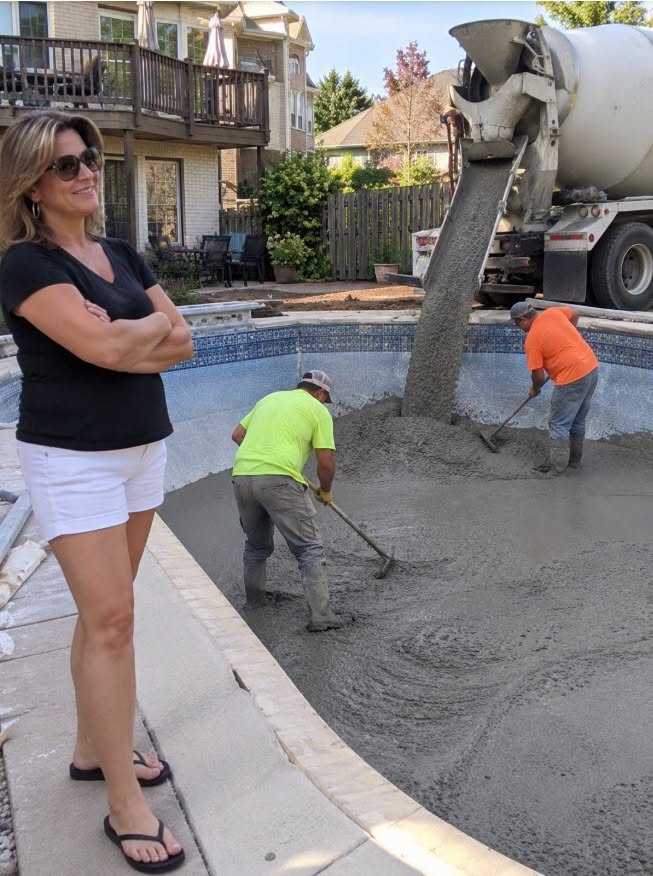
Not on the street. Not in a driveway. In my backyard. It had driven straight across the strip of grass along the side of my house, crushing my hydrangeas, and backed right up to the edge of my pool. Its big drum was turning, slow and steady. Its long metal chute was swung out over the water.
And gray concrete was pouring out of that chute into my pool.
Thick, heavy, endless. Like oatmeal. Like lava. It slid into the clear blue water with a horrible wet sound and sank, and the water around it turned the color of dishwater, and the concrete just kept coming.
Standing next to the truck, in a pink quilted bathrobe with her arms crossed, was my neighbor. Katherine Vance.
And behind the wheel of that truck was her husband, Dale.
I don’t remember going down the stairs. I remember the cold of the wet grass under my bare feet. I remember the smell, like wet stone and diesel. I remember screaming her name.
Katherine turned around and looked at me. She was smiling.
“Now,” she said, “there’ll finally be some peace and quiet.”
I stood there in my nightgown and stared at my pool. At the gray sludge rising up the sides. At the beautiful blue tiles disappearing one row at a time.
My husband built that pool with his own hands.
It was the last thing he ever finished before he died.
My husband’s name was Mark Ellison.
He was a high school shop teacher, which tells you most of what you need to know about him. He had big rough hands and a terrible sense of humor and a laugh that made dogs bark. He could fix anything. A lawnmower. A leaky faucet. A broken heart. He fixed mine about fifteen years ago, at a friend’s barbecue, by handing me a burnt hot dog and saying, “I made this especially for you. I burned it on purpose because you look like a burnt hot dog kind of girl.”
I was. I still am.
We had four kids in nine years. Ethan, who’s thirteen now. Lily, who’s ten. And the twins, Noah and Mia, who just turned seven and who never stop moving, not even in their sleep.
Every single one of them is a fish. I don’t know where they got it. I can barely swim. Mark could swim a little. But our kids would get in any body of water they could find. Lakes. Creeks. Bathtubs. Puddles. When Mia was three, I found her sitting in the dog’s water bowl. She said she was “swimming small.”
“We need a pool,” Mark said one night, about four years ago, while we were lying in bed listening to the twins argue about who had more water in the bathtub.
“We can’t afford a pool,” I said.
“We can’t afford to buy a pool,” he said. “I can build one.”
“Mark.”
“I teach shop. I’ve built a garage. I built the back deck. I built that ridiculous treehouse.”
“The treehouse leans.”
“It leans with character.”
I laughed. Then I looked at him and saw he was serious.
“How long would it take?”
He shrugged. “A summer. Maybe two. If I do it right.”
He started the next spring. He didn’t do it alone. His best friend Tony, who owns a landscaping business, brought over a little excavator on weekends. Mark’s students came over on Saturday mornings for extra credit. The kids helped too, as much as kids can help. They carried buckets of dirt. They held the tape measure. They got in the way constantly and Mark never once told them to go inside.
He did everything by the book. He pulled permits from the city. He had inspections. He kept every receipt and every drawing and every inspection report in a fat blue three-ring binder he called the Pool Bible. He wrote the date on every page.
“If you’re going to do something,” he told Ethan, who was nine then, “do it right. And write it down. That way, when somebody asks you how you did it, you can show them.”
Ethan rolled his eyes. But he helped Mark label every page.
It took two summers. Just like Mark said.
The pool was beautiful. Not huge. Twenty-four feet long, with a shallow end for the twins and a deeper end for Ethan to cannonball into. Blue and white tiles along the waterline in a pattern Lily picked out. Wide concrete steps going down into the shallow end, so the little ones could sit and splash.
On the day he poured those steps, Mark called all four kids over before the concrete set.
“Hands,” he said.
One by one, they pressed their hands into the wet concrete on the top step. Ethan. Lily. Noah. Mia. Four little handprints in a row. Then Mark pressed his own big hand next to theirs. Then he made me do it too, even though I complained that I’d just gotten a manicure.
Then he took a nail from his pocket and wrote something underneath, in the soft gray concrete, in his blocky shop teacher letters.
BE LOUD. LOVE, DAD.
“Be loud?” I said. “Mark, the neighbors are going to hate us.”
“That’s the point,” he said. He wiped his hands on his jeans. “Kids should be loud. Kids should yell and splash and scream and laugh until their faces hurt. That’s what being a kid is. I want them to remember that. Every time they get in this pool, I want them to remember their dad told them to be loud.”
I didn’t know then why he said it like that. Like he was leaving instructions.
I found out three months later.
He’d been having back pain for almost a year. He thought it was from the pool. From all the digging and lifting. He kept saying he’d get it checked after the pool was done.
The pool was done in August. He went to the doctor in September.
Pancreatic cancer. Stage four. It was already everywhere.
The doctor said six months. Maybe.
Mark got eleven. He fought like a lion. And when he couldn’t fight anymore, he sat in a lawn chair by the edge of that pool, wrapped in a blanket, in the spring sunshine, and watched his kids swim.
I remember one afternoon in April. He was so thin by then. His cheeks were hollow. His big rough hands looked too big for his wrists. He was sitting in his chair by the shallow end, and the twins were playing a game where they jumped off the steps and screamed as loud as they could before they hit the water.
“AAAAAAAAH!” Splash.
“AAAAAAAAAAAH!” Splash.
The neighbor at the time, an old man named Mr. Kessler who’s since moved to Florida, leaned over the fence and laughed and gave Mark a thumbs-up.
Mark closed his eyes and smiled. The sun was on his face.
“That’s the best sound in the world,” he said to me. “You know that? That right there. That’s the whole point of everything.”
He died in May. In our bedroom, with the window open, so he could hear the kids in the pool.
That was two years ago.
After Mark died, the pool was the only place my kids seemed like themselves.
Ethan stopped talking for almost three months. He’d come home from school and go straight to his room and shut the door. But in the afternoons, he’d go out back and swim laps. Back and forth. Back and forth. For an hour. Two hours. Until it got dark. I’d stand at the kitchen window and watch him, and I knew he was talking to his dad in there, in whatever way he could.
Lily cried every night for a year. Except on the nights she’d been swimming. On those nights, she slept straight through.
The twins didn’t really understand. They were five. They kept asking when Daddy was coming back from the hospital. But they’d sit on the top step of the pool, right on those handprints, and trace Mark’s letters with their wet fingers.
BE LOUD.
“Daddy wrote that,” Noah would tell anyone who came over. “Daddy said we have to.”
And they were. In the beginning, anyway. They screamed and splashed and laughed. It hurt to hear, sometimes. But it was the good kind of hurt.
I kept going. That’s what you do. I went back to my job as a dental hygienist. I learned how to fix the garbage disposal from a YouTube video. I learned how to test the pool chemicals from Mark’s binder, with his handwritten notes in the margins. Jen, if the pH is over 7.8, use the stuff in the green bucket. NOT the red bucket. The red bucket is for emergencies. I’m serious. Don’t make me haunt you.
I laughed so hard at that note that I cried for an hour afterward, sitting on the edge of the pool with the test strips in my lap.
Katherine and Dale Vance moved in next door about a year after Mark died, when Mr. Kessler went to Florida.
They were in their sixties. Dale owned a mid-sized construction company called Vance & Sons, though as far as I could tell there weren’t any sons. He was a big, quiet man with a gray mustache and a farmer’s tan, who drove a white pickup with the company logo on the side and waved at me every morning without ever really looking at me.
Katherine was something else.
She was small and sharp and always perfectly put together. Short silver hair. Pressed slacks. A different cardigan every day of the week. Her lawn was mowed in perfect diagonal stripes. Her flower beds were edged so straight you could have used them as a ruler. She had a little sign by her front door that said Please Remove Shoes, even though nobody ever went inside her house.
She introduced herself to me the day they moved in by walking over to my front porch, where my kids had drawn hopscotch squares on the sidewalk in pink chalk, and saying, “Will that wash off?”
“Hi,” I said. “I’m Jenna. Welcome to the neighborhood.”
“Katherine,” she said. She looked at the chalk again. “Will it wash off?”
“When it rains,” I said.
“Hm,” said Katherine. And went back to her house.
That was the beginning.
I started writing things down about four months after that. I know that sounds strange. But Mark always said if you’re going to do something, do it right and write it down. And after a while, I started feeling like I was going a little crazy.
So I bought a cheap spiral notebook at the drugstore and kept it in the kitchen drawer with the takeout menus. And I wrote down every time Katherine complained about something.
September 12. K. came over to say our recycling bin was “facing the wrong direction” on the curb.
October 3. K. called to say the kids’ bikes in the driveway were “an eyesore.”
October 30. K. asked if our jack-o’-lanterns were “going to rot on the porch like last year.” We didn’t live here last year. She didn’t either.
At Christmas, I put out a little family of garden gnomes on the front porch. Mark had bought them years ago as a joke because I said I hated gnomes. Every year he’d add one more. There were nine of them now. They wore little Santa hats. The kids loved them.
December 4. K. came over and said the gnomes were “tacky” and “lowered the property values on the whole street.” She asked if I’d consider “something more tasteful, like a wreath.”
I didn’t take down the gnomes.
In April, I planted rosebushes along the fence on the right side of the backyard. Mark’s mother had given me cuttings from her garden right after he died, and I’d been growing them in pots for a year, waiting until they were strong enough.
April 22. K. leaned over the fence and told me I’d planted the roses on the wrong side of the yard. Said roses “belong on the left, not the right.” I asked why. She said, “Because that’s where they go.”
I left the roses where they were.
I want to be clear about something. I was always polite to her. Always. I waved every morning. I brought her a plate of cookies at Christmas, which she accepted at the door without inviting me in, and returned the plate the next day, washed, with no note. I asked the kids to keep their voices down in the front yard. I made sure our trash cans were back from the curb by noon on Tuesdays.
And she still found something. Every single week.
“Why is she so mean?” Lily asked me once, after Katherine told her to stop “skipping so loudly” on the sidewalk.
“Some people are just unhappy, sweetheart,” I said. “It’s not about you.”
“Then what’s it about?”
I didn’t know. I didn’t have time to find out. I had four kids and a full-time job and a pool to clean and a husband who wasn’t there anymore. Katherine Vance was just one more thing I didn’t have the energy to deal with.
So I wrote it down. And I let it go.
The first time Katherine came into my backyard was on a Saturday in late June.
It was hot. Ninety-four degrees. The kind of heat that sits on your chest. The kids had been in the pool since lunchtime. Ethan was supposed to be watching the twins while I made dinner.
I want to be honest about that, because it matters later. I was inside. In the kitchen. I could see the pool through the window over the sink if I leaned to the left, but mostly I was looking at the stove. I was making spaghetti. I had the radio on. I was tired.
I hadn’t heard anything from the backyard in a while. I remember thinking how nice and peaceful it was.
Then I heard yelling.
Not the kids. An adult. A woman.
I dropped the wooden spoon in the sauce and ran outside.
Katherine was standing right beside my pool.
She’d come through the gate in the side fence. The one that connects our yards. Mr. Kessler had put it there years ago so he could bring us tomatoes from his garden without walking around the block. Nobody had used it since he left. I’d forgotten it didn’t have a lock.
She was standing at the edge of the shallow end in her pressed slacks and her lavender cardigan, in ninety-four degree heat, with her face red and her finger pointing at my children.
“Out!” she was shouting. “All of you! Out of the water, right now!”
The twins were standing on the top step, frozen, dripping, staring up at her with huge eyes. Lily was in the middle of the pool, treading water. Ethan was at the deep end, holding onto the edge.
“Katherine,” I said. “What’s going on? Is something wrong?”
She whirled around to face me.
“Your kids are TOO LOUD,” she snapped. “I want some peace and quiet. Is that too much to ask? In my own home?”
I looked at my kids. At the twins on the step, shivering even though it was ninety-four degrees. At Lily, whose chin was starting to wobble.
I hadn’t heard them. That was the thing. I’d been inside the kitchen the whole time and I hadn’t heard a single sound. Not one scream. Not one shout.
My kids know they’re not allowed to scream anymore. That started after Katherine moved in. I told them we had to be good neighbors. That we had to keep it down. That not everybody liked noise.
They’d listened. Of course they still splashed. They’re kids. But they’d been quiet. So quiet I hadn’t heard them for half an hour.
“I’m sorry,” I said. I said it because I didn’t want a scene. Because the kids were watching. Because I was so tired. “I’m sorry, Katherine. We’ll keep it down.”
She looked at me for a long moment. Her face was a strange color. Not just red from the heat. Something else. Her hands were shaking.
Then she looked at the pool. Just stared at it. At the water. At the twins on the steps.
“You were inside,” she said. Her voice was different. Low. “You were in the house.”
“I was making dinner. Ethan was watching them.”
Katherine looked at Ethan. At my thirteen-year-old son, who was clinging to the side of the deep end with his face gone pale.
She didn’t say anything. She just turned around and walked back through the gate and slammed it so hard the whole fence shook.
That night, I wrote it in the notebook.
June 24. K. came into the backyard through side gate without permission. Yelled at the kids to get out of the pool. Said they were too loud. They were NOT loud. I couldn’t hear them from the kitchen. Something was strange about her. Her hands were shaking.
I underlined the last part. I don’t know why.
Then I went out and put a padlock on the side gate.
The next day was Sunday. Even hotter. Ninety-six.
The kids asked if they could swim. I almost said no. I almost said let’s go to the library, let’s go to the movies, let’s go anywhere that isn’t here.
But it was their dad’s pool. And it was ninety-six degrees.
“Okay,” I said. “But quiet. Really quiet. Okay? For Mrs. Vance.”
They swam for two hours that afternoon. And I swear on Mark’s grave, the backyard was silent. I sat in a lawn chair on the deck and watched them the entire time. Nobody yelled. Nobody screamed. Nobody even laughed out loud. The twins whispered to each other in the shallow end. Lily floated on her back with her eyes closed. Ethan swam slow laps, back and forth.
It was the saddest thing I’d ever seen. Four kids in a pool, being so careful.
At one point, Noah climbed out and sat on the top step, right on his own little handprint. He traced his father’s letters with his finger.
BE LOUD.
“Mom,” he whispered. “Is Daddy mad at us? For being quiet?”
I had to look away.
“No, baby,” I said. “Daddy would understand.”
Katherine’s curtains were closed the whole afternoon. I didn’t see her once.
I thought that was the end of it.
At 5:02 the next morning, the concrete truck came.
You already know how that started. The roar. The beeping. Katherine in her pink bathrobe. Dale behind the wheel.
Now there’ll finally be some peace and quiet.
I ran at the truck. I don’t know what I thought I was going to do. Stand in front of the chute? Pull Dale out of the cab? I was barefoot, in a nightgown, screaming.
“Stop! STOP! What are you doing? Turn it off! TURN IT OFF!”
Dale saw me coming. I’ll never forget his face through the windshield. He didn’t look angry. He didn’t look triumphant. He looked sick. Gray. Like a man watching himself do something from very far away.
He reached for a lever. The drum slowed. The chute stopped pouring.
But it was too late. Most of it was already in.
The pool was gone. Or what was left of it was a gray, lumpy, half-filled pit, with dirty water sloshing on top of the wet concrete at the deep end and a few blue tiles still showing at the very top along one wall. The shallow end was completely buried.
The steps were gone.
The handprints were gone.
BE LOUD was gone.
I fell down on my knees on the deck. I couldn’t breathe. I couldn’t do anything. I just knelt there making a sound I didn’t know I could make.
Behind me, the back door opened. I heard small bare feet on the deck.
“Mom?” Lily’s voice. Shaking. “Mom, what happened to the pool?”
Then Ethan. “Oh my God. Oh my God. Mom.”
Then the twins, running out in their pajamas, stopping dead.
Mia started screaming. Not words. Just screaming. Noah ran to the edge of the deck and tried to climb down into the pit, toward where the steps used to be, and Ethan caught him by the back of his shirt and held him while he kicked and sobbed.
“The hands!” Noah was wailing. “Where are the hands? Where’s Daddy’s hand? WHERE’S DADDY’S HAND?”
I looked up at Katherine.
She was standing beside the truck with her arms still crossed. But she wasn’t smiling anymore. She was looking at Noah. At the little boy screaming for his father’s handprint. And her face had gone completely white.
For one second, I thought she was going to say something. Her mouth opened.
Then she closed it. She turned around and walked back toward her house, through the gap in the fence where Dale had cut the padlock off my gate. She didn’t look back.
Dale sat in the cab of the truck with both hands on the steering wheel, staring straight ahead. He didn’t move.
I got up off my knees. I went to my children. I held them, all four of them at once, in a big wet tangled pile on the deck, while Noah sobbed into my nightgown and Mia screamed and Lily shook and Ethan, my thirteen-year-old, held on to all of us with his jaw clenched so tight I could hear his teeth.
And I realized, right then, holding them, that there was no point in arguing with Katherine Vance.
I’d been polite for a year. I’d apologized. I’d moved my recycling bin. I’d told my children to be quiet in their own backyard, in their dead father’s pool.
And she’d poured concrete over his handprint.
People like Katherine only understand one language.
I just had to make sure I spoke it better than she did.
The first thing I did was call the police.
Two officers came. A young one named Officer Reyes and an older one named Sergeant Gaines, with gray hair and a tired face. They stood at the edge of the deck and looked at what used to be my pool for a long time.
“In thirty years,” Sergeant Gaines finally said, “I have never seen anything like this.”
Dale was still sitting in the truck. He hadn’t moved. When Officer Reyes knocked on the window, he rolled it down very slowly and said, “Yes. I did it. My wife asked me to. I did it.” Then he put his forehead down on the steering wheel.
Katherine wouldn’t come to the door. Sergeant Gaines knocked for ten minutes.
“Ma’am,” he said to me, back in my kitchen, “I can take a report for criminal mischief and trespass. That’s a felony at this level of damage. But you’re going to want a lawyer for the rest of it. This is going to be a civil matter too. A big one.”
“I know,” I said.
“Do you have any proof of the condition of the pool before? Photos? Anything?”
I went to the hall closet. I came back with the blue binder.
The Pool Bible.
I put it on the kitchen table in front of him. Every permit, every inspection report, every receipt for every bag of cement and every box of tile. Every drawing Mark ever made, dated and labeled in Ethan’s careful nine-year-old handwriting. Photos of every step of the construction. A photo of all six of us pressing our hands into the wet concrete on the top step. A photo of Mark writing BE LOUD with a nail.
See more on the next page

