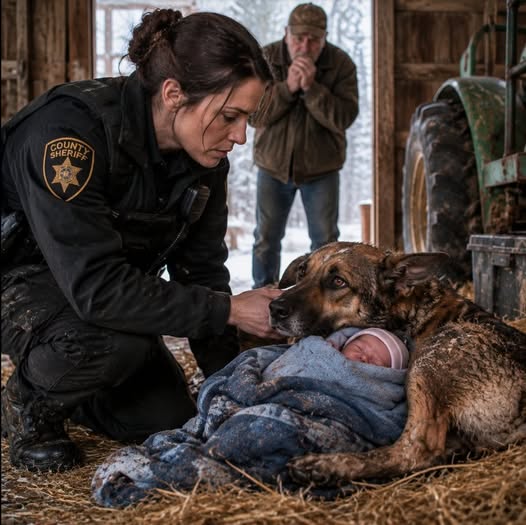
I heard the dog before I saw her.
A low, broken breath came from the darkest corner of the tractor shed, followed by a sound so faint I almost mistook it for a bird trapped in the rafters.
Then the blue bundle beneath the dog’s chin moved.
And a newborn baby cried.
My name is Claire Morgan, and I was a sheriff’s deputy in northern Michigan when that call came in.
I had been in law enforcement for eleven years. I’d walked into wrecked cars, domestic fights, overdoses, barns on fire, and houses where nobody wanted a uniform showing up.
But nothing prepared me for what I found on the Benton farm.
Earl Benton was seventy-one and had worked that land longer than I’d been alive. He met me beside the shed clutching his baseball cap with both hands.
“There’s blood,” he said.
Earl wasn’t a man who frightened easily.
That scared me before I even went inside.
The shed smelled like diesel, wet soil and old straw.
In the far corner lay a hound-shepherd mix, maybe forty pounds when healthy.
She was nowhere near healthy.
Mud covered most of her body.
Her ribs showed beneath tangled fur.
One ear stood upright while the other bent sideways.
She had positioned herself tightly around a faded blue fleece blanket.
I moved slowly.
The dog did not growl.
She simply watched my hands.
Then I heard the cry again.
Thin.
Weak.
Human.
My stomach dropped.
I keyed my radio.
“Dispatch, start EMS. Possible newborn. Severe cold exposure.”
Earl stared at me.
“Newborn?”
“Clear the driveway.”
I lowered myself onto one knee.
“Hey, girl.”
The dog’s upper lip tightened.
“I know. I know.”
I slid my emergency blanket toward her.
Then I offered the back of my hand.
She sniffed once.
Her body trembled.
But after several seconds, she slowly lifted her head.
I pulled back the soaked fleece.
Inside was a baby girl.
She couldn’t have been more than a few days old.
Her skin was pale.
Her lips had a faint bluish tint.
Her breathing came in small, irregular jerks.
Every instinct I had went into motion.
I removed the wet fabric.
Opened my uniform shirt enough to place the baby against my chest.
Then wrapped us both in my jacket and emergency blanket.
She was so cold it frightened me.
“Stay with me, sweetheart.”
The dog tried to stand.
Her legs folded.
Then she dragged herself across the straw until her nose touched my knee.
Only then did she stop.
The ambulance arrived minutes later.
Paramedics took the baby.
The second they moved toward the door, the dog forced herself up again.
She was going after them.
I caught her beneath the ribs.
That was when I saw her paws.
Every pad was split open.
Two nails had torn nearly to the quick.
Blood had dried between her toes.
And lodged behind her back teeth was a thin strip of the same blue fleece that had wrapped the newborn.
I stared at it.
Whatever that dog had done, she hadn’t simply found the baby in the shed.
She had carried her there.
A neighbor came running across the farmyard.
“I saw her!”
Her name was Melissa Carter.
She pointed toward the road.
“She came up from the ditch dragging something. I thought it was garbage until I heard a crying sound.”
I followed her toward the tree line.
The farm sloped downhill toward a county road.
Between the wet grass was a clear groove.
Something had been dragged uphill.
Beside it were broken pawprints.
Blood in places.
The line bent around rocks.
Deepened where roots had caught the blanket.
A thread of blue fleece hung from a blackberry branch.
I followed it all the way down.
At the bottom was a concrete drainage culvert.
Its opening was black with rainwater stains.
Beside it, the soft shoulder held a fresh tire impression.
And one adult shoe print.
I stood there looking back uphill.
The distance to the shed was nearly a quarter mile.
That injured dog had dragged a newborn baby up the slope.
She had chosen the shed.
Chosen shelter.
Then wrapped herself around the child and waited.
But somebody else had put the baby beside that road.
I called crime scene investigators.
Within an hour, deputies were searching ditches and reviewing cameras from nearby homes and gas stations.
I returned to the farm.
The dog was still there.
Animal control had arrived, but she refused to leave the shed entrance.
Not aggressively.
She simply planted herself and stared down the driveway where the ambulance had disappeared.
“She’s waiting for the baby,” Earl said.
I crouched beside her.
“You saved her.”
The dog looked at me.
I noticed something around her neck beneath the mud.
Not a collar.
A frayed length of rope.
And attached to it was a broken plastic tag.
Only part of the writing remained.
…LLOW
We took her to an emergency veterinary clinic.
I went with her.
The vet estimated she was about four years old.
Underfed.
Dehydrated.
Paws badly injured.
A deep abrasion across her chest from pulling something heavy.
But no fractures.
The staff began calling her Willow because of the partial tag.
I called the hospital every twenty minutes asking about the baby.
Finally, a pediatric nurse told me she was warming up.
Breathing more steadily.
Glucose improving.
Still fragile.
But alive.
I sat beside Willow’s kennel.
“You hear that?”
Her ears moved.
“She made it.”
Willow closed her eyes.
For the first time, she slept.
The case moved quickly after that.
Security footage from a small gas station five miles away showed a dark SUV traveling toward the Benton farm shortly before dawn.
Another camera caught it heading back twenty minutes later.
The plate was unreadable.
But the vehicle had a distinctive broken left taillight.
Then investigators found something else.
A hospital bracelet inside the blue fleece.
Not the baby’s.
An adult woman’s.
EMILY HARPER.
I searched the name.
Twenty-six years old.
Resident of Grand Rapids.
Reported missing two days earlier by her mother.
My skin went cold.
At nearly the same moment, my phone rang.
It was the hospital.
The baby’s blood tests had returned.
And the doctor had discovered something strange.
She had traces of medication in her system that a newborn should never have been exposed to.
Before I could process that, dispatch called.
A dark SUV with a broken taillight had just been found abandoned near an old hunting access road.
See more on the next page

