Chapter 1: The Wish
When my husband, Danny, passed away four years ago, I honestly believed I had already lived through the worst thing that would ever happen to me.
He was forty-one. He kissed me goodbye on a Tuesday morning, climbed into his work van with ASHBY ELECTRIC painted on the side, and never came home. A heart that had seemed perfectly fine simply stopped. For months afterward, I would wake up and reach for his side of the bed before I remembered.
I told myself the universe had taken its share from me. I told myself it was done.
Then my twelve-year-old son, Wesley, started getting bru!ses he couldn’t explain and fevers that wouldn’t break.
Watching his whole childhood shrink down to the size of a hospital room hurt in a way I still don’t have words for.
For one entire year, my son had been fighting cancer.
I would have done anything to pull him through it. I sold Danny’s van. I picked up extra shifts at the dental office until my manager made me stop. I learned to sleep sitting up in a vinyl chair. Wes was all I had left of the life Danny and I had built, and I was not going to lose him too.
And somehow, through every scan and every needle, he never lost his sense of humor.
He always found a way to drag a smile out of me, even on the days I was sure I had none left.
Some mornings he’d look up from his pillow with that crooked grin he got from his father and say:
« Mom, I’ve gotta get better. Who else is gonna leave dirty socks all over the house for you to find? »
For the past few weeks, I had barely left the chair beside his bed at St. Ansel’s Children’s Hospital in Corliss Ridge. His doctors had admitted him for another round of tests, and I couldn’t stand the idea of him waking up alone in that room.
I had brought Danny’s old canvas work jacket from home, the brown one with the faded name patch over the pocket. Wes liked to sleep under it instead of the thin hospital blanket. He said it still smelled like sawdust and coffee. I never told him I sometimes held it to my face in the parking garage before I came upstairs.
Then, about two months ago, the jacket disappeared.
« A nurse took it to the laundry, » Wes told me, not quite looking at me.
I asked at the nurses’ station twice. Nobody remembered it. I let it go because I had bigger things to worry about, but it sat in my chest like a stone.
There were other small things, too. Wes had started asking for extra dinner rolls and pudding cups. He’d tuck them into the drawer of his nightstand « for later. » I told myself it meant his appetite was coming back. I wanted so badly for something to be getting better.
One afternoon, a woman named Marisol from the Bright Lantern Wish Foundation knocked on his door. They grant wishes to children who are seriously ill. She had kind eyes and a clipboard covered in star stickers.
She pulled a chair up close to Wes and smiled.
« If you could wish for anything in the whole world, honey, what would it be? »
I thought I already knew.
Wes had wanted to go to Starlight Kingdom since he was four years old. He had a poster of the castle taped above his bed at home.
He had also always dreamed of standing on a real beach and seeing the ocean with his own eyes. Danny had promised to take him. They had never gotten the chance.
There was a whole list of things my son wanted to do.
I was sure he would pick one of them.
But his answer stunned both of us.
« I want to feed people who don’t have money for food, » he said. « I want every hungry person to get a really good dinner. Even if it’s just for one day, I don’t want anybody to go hungry. »
Marisol’s pen stopped moving.
« Are you sure, sweetheart? This wish can be anything at all. Anything you want. »
Wes nodded without a second’s pause.
« I’m sure. Everybody’s been doing so much for me. I want to do something good for somebody else. »
I looked at my little boy, pale and thin under a hospital blanket, and the tears came before I could stop them.
I had never been so proud of anyone in my life.
But as Marisol wrote it down, I noticed something I didn’t understand until much later.
While he spoke, Wes wasn’t looking at her.
He was looking out the window, down at the bus shelter across the street.
Chapter 2: Three Hundred Plates
Over the next few weeks, the foundation planned a community dinner at the Haddon Street Community Hall, about ten minutes from the hospital.
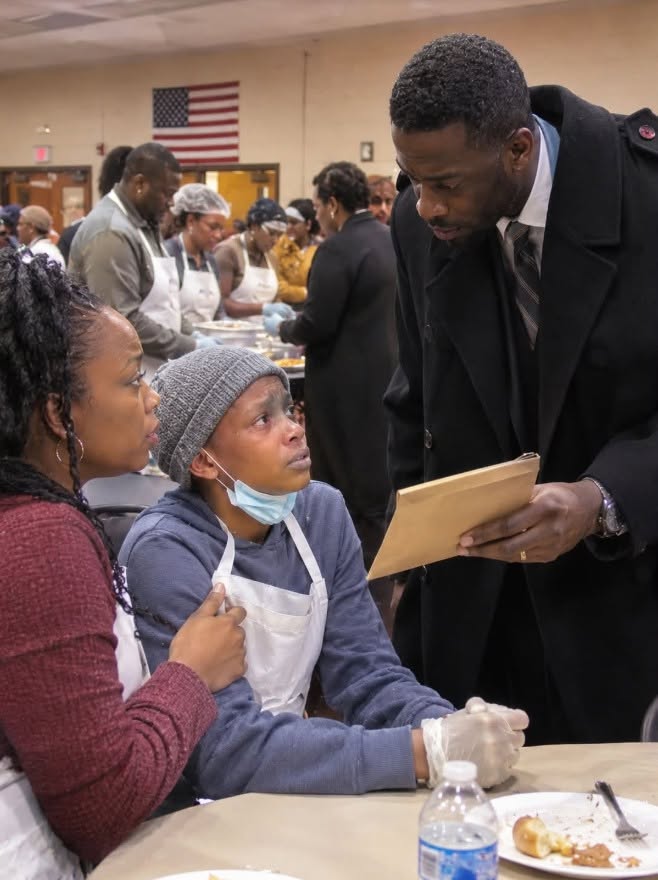
They turned the old gymnasium into a temporary dining room. Long tables covered in white paper. Folding chairs in neat rows. Mason jars of wildflowers someone’s grandmother had picked that morning. A hand-painted banner hung over the stage that read EVERYONE EATS TONIGHT.
Anyone who needed it could walk in, sit down, and receive a free, freshly cooked meal.
Volunteers came from every corner of Corliss Ridge.
Some worked in the kitchen, stirring pots of beef stew and pulling trays of cornbread out of the ovens.
Others set the tables, carried plates, and stood at the doors welcoming people inside.
Nobody asked for a name. Nobody asked for a reason. People could come in out of the cold, sit somewhere warm, and eat dinner without worrying about how they would pay for it.
Of course, Wes and I were there.
He had been counting down the days for weeks. He talked about it to his nurses, to the boy in the next room, to the man who mopped the hallway at night. He made me promise three different times that nothing would keep us from going.
There was no way he was going to miss it.
His doctors gave him permission for four hours, a mask, and a strict list of rules. He was still in treatment, and his body was still fragile, but he wanted to help wherever they would let him.
He handed out napkins. He lined up baskets of bread rolls like soldiers. He passed out water bottles and helped the volunteers carry plates to the tables, walking slowly so he wouldn’t spill.
The smile never left his face, even under the mask. I could see it in his eyes.
Watching him that evening, I understood how much this meant to him.
For a few hours, he wasn’t a patient. He wasn’t a chart number or a set of blood counts. He was just a boy getting to make other people happy.
But there was something else, too.
Every time the front doors opened, Wes looked up.
He did it again and again, quick as a bird. He’d check the face of whoever came in, and then his shoulders would drop a little, and he’d go back to work.
« Who are you waiting for, bud? » I asked once.
« Nobody, » he said, too fast.
Around six-thirty, an older man in a gray knit cap came in and sat alone at table nine, near the back. His beard was trimmed short, and his hands shook a little as he unwrapped his silverware.
Wes saw him and lit up like a Christmas tree.
He grabbed a plate before any volunteer could, filled it with stew, two pieces of cornbread, and the biggest slice of apple pie on the tray, and carried it to that table himself.
I watched the man look up at my son. I couldn’t hear what they said. But the man put his hand over his face for a moment, and Wes patted his shoulder the way a grown-up would.
When I looked again ten minutes later, table nine was empty. Only the clean plate was left.
By the time the evening ended, we had served 300 people.
My feet ached, and my back was screaming, but Wes looked prouder than I had ever seen him.
Most of the guests had finished eating, and people were starting to drift toward the doors, buttoning their coats and thanking the volunteers.
Then a man I had never seen before walked through the doors.
He wore an elegant charcoal suit beneath a long black overcoat. His shoes were polished. He looked like he had stepped out of a bank lobby.
At first I assumed he had walked into the wrong building.
But he didn’t hesitate.
He looked around once, spotted Wes and me wiping down tables near the back, and came straight toward us.
He stopped in front of me and cleared his throat.
« Ma’am, I’m here about your son. »
I glanced over at Wes.
Every bit of color had drained from his face. His hand froze on the rag.
He looked frightened, and I couldn’t understand why.
« Excuse me? » I said.
The man looked from me to Wes and back again.
« I have something I need to give Wes, » he said. « But there’s also something you deserve to know. »
He paused.
« Your son could have told you all of this himself. You need to understand what he did. »
Then he looked straight into my eyes.
« He hasn’t told you the truth, has he? »
Chapter 3: What Wes Did
For a moment, nobody said anything.
Somewhere behind us, a volunteer was stacking chairs, and each one landed with a metal clang that seemed far too loud.
I stepped in front of my son without thinking. It was the same thing I’d done in a hundred hospital hallways, every time a doctor walked toward us with a folder.
« I don’t know who you are, » I said, « but whatever this is, you can say it to me. »
The man nodded slowly, as if he’d expected that.
« My name is Graham Tolliver, » he said. « I’m not here to cause trouble, Mrs. Ashby. I promise you that. I’m here because I owe your son something I can never repay. »
He knew my name. I hadn’t told him my name.
I turned around.
Wes was staring at the floor, twisting the wet rag in both hands until water dripped onto his sneakers.
« Wesley, » I said quietly. « Look at me. »
He didn’t.
« Wes. »
See more on the next page

