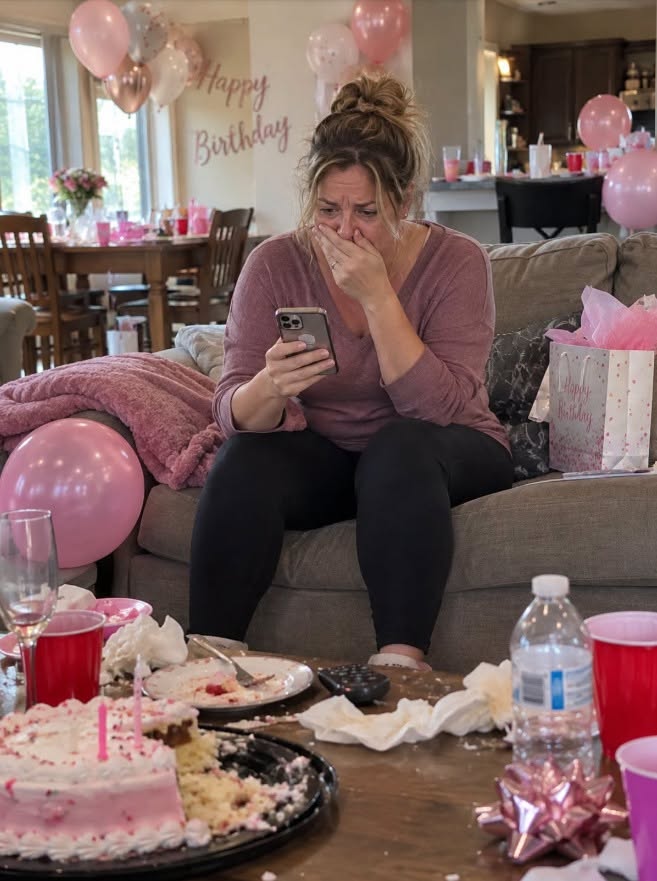
The notification arrived every Friday morning at nine o’clock, as reliable and unforgiving as a bill collector. Transfer complete: $550.00 to Margaret and Robert Chen. For three years I watched that money leave our account with a feeling I could never quite name accurately, something between obligation and dread, layered over with enough guilt that I never let myself examine it too closely. Examining it would have meant asking questions I was not yet ready to answer.
My name is Sarah Chen-Thompson. I am twenty-seven years old, and for most of my adult life I operated under the belief that being a good daughter meant being an inexhaustible one. Not the heroic, self-sacrificing kind that gets written about in certain kinds of stories. The grinding, invisible kind. The kind measured out in five hundred and fifty dollar increments while buying store-brand cereal and secondhand shoes for my daughter and telling myself it was temporary, that things would get better, that I just had to hold on a little longer.
On a Wednesday evening in early October, Marcus sat across from me at our kitchen table, the one that wobbled on one uneven leg and had been given to us by his parents when we moved in. The fluorescent light above us flickered in that intermittent way that our landlord kept promising to address. Marcus was studying our bank statement with his brow furrowed, his finger moving slowly down the column of numbers, and he had the look on his face that he always got in these conversations, the one that was careful and sad at the same time, because he had never once made me feel attacked over the money, even when he probably had every right to.
“We’re three hundred short on rent,” he said. “Groceries went on the credit card again. The car payment is due next week.” His finger stopped at the recurring transfer line and rested there.
I felt my stomach tighten in a way that had become familiar. “They need it,” I said, hearing the defensiveness already assembled in my own voice. “You know how things are for them right now.”
“I know,” Marcus said, and reached across the table to take my hand. His fingers had developed calluses that had not been there when we first met, from the weekend construction work he had taken on to supplement his regular job. “But things are tight for us too, babe. We have Lily.”
As if she had been waiting for her name to appear in the conversation, our daughter knocked over a tower of blocks in the next room and laughed with a delight so pure it cut through everything. I looked at her through the doorway, four years old and sitting cross-legged on our worn carpet, her dark pigtails coming loose from the elastic I had done that morning. Her pajamas were from the Target clearance rack, bought one size too large so she could grow into them. Everything we purchased for her followed that logic. Everything was calibrated to last a little longer, cost a little less, stretch a little further.
“I’ll pick up extra shifts,” I said, which was what I always said. “Janet asked if anyone could cover the weekend rush.”
Marcus did not argue. He never argued. He knew how deeply the obligation ran in me, how completely my understanding of what it meant to be a daughter had been built around the idea of endless giving. What I did not understand then, or would not let myself understand, was that the obligation had been carefully constructed by people who benefited from it.
My parents, Margaret and Robert Chen, had called two years earlier with a story about financial hardship that landed precisely on the part of me that was most vulnerable to it. My mother’s voice on the phone had been fragile in a way I rarely heard from her, talking about the mortgage, about my father’s reduced hours at the hardware store, about the frightening possibility of losing the house. I had not hesitated. I asked how much they needed and did not question the answer when four hundred dollars a week quietly became five hundred and fifty once they realized I would not push back.
“Just for a little while,” my mother had said. Just until we get back on our feet.
Three years later they had not gotten back on their feet, or rather they seemed perpetually positioned just at the edge of stability, always within reach of it but never quite arriving. There was always another crisis, another unexpected expense, always a reason why this month was particularly difficult. I never questioned it. Questioning felt like doubt, and doubt felt like the kind of daughter I had been raised to be ashamed of becoming.
Lily’s fifth birthday was three weeks out when I began planning the party. She had been talking about it with the intensity of someone overseeing a significant state occasion, requesting an all-princess theme with the absolute certainty of a child who has not yet learned that wanting something and getting it are not the same thing. We were planning it on almost no budget, which meant I was making the cake myself and buying decorations from the dollar store and staying up late cutting out paper crowns for party favors while old television episodes played on the free streaming app. Marcus helped me address the small stack of invitations. Six children from Lily’s kindergarten class, their parents, and my parents.
I called my mother three weeks in advance, which Marcus had suggested, gently, in the way he suggested things when he knew I needed to do them but was not sure I would remember.
“Lily’s birthday is October fifteenth,” I told her. “A Saturday, two in the afternoon. Can you and Dad make it?”
There was the sound of pages turning, a brief pause. “October fifteenth. Yes, that should work. We’ll be there.”
“Lily keeps asking when Grandma and Grandpa are coming.”
My mother’s voice warmed in the way it sometimes did when grandchildren came up. “Tell her we’re bringing something special.”
I called again two days before the party, just to confirm. My mother sounded mildly annoyed at the check-in, told me they were not senile, that they would be there at two, that I worried too much. I hung up feeling slightly embarrassed about having called at all. They were coming. Of course they were coming.
The morning of October fifteenth was the kind of autumn day that Portland occasionally produces as if apologizing for all the gray ones: crisp air, warm sun, leaves just beginning to turn gold at the edges. I was in the kitchen at seven in the morning making the cake, already covered in flour, humming along to the radio. By noon the apartment looked like something from a children’s party catalog, insofar as a modestly furnished two-bedroom can look like that. Pink and purple streamers crossed the ceiling. A banner I had hand-lettered hung over the couch. The cake sat in the refrigerator with pink frosting and purple flowers I had piped around the edges with a bag and tip I had borrowed from a coworker, not perfectly, but with a care that I thought Lily would recognize.
She emerged from her room at one in the afternoon in the purple dress we had bought new for the occasion, one of the few times we had spent money on something that was not on sale. Her eyes went wide when she saw the decorations. She spun in a slow circle, taking it all in.
“It’s the best party ever,” she said.
“The party hasn’t started yet,” Marcus told her.
“I know, but it’s already the best.”
The first guests arrived just after two. Then more, until all six kindergarten friends were running through the living room with the specific chaotic energy of small children who have been told they are celebrating something. Lily was in the middle of all of it, laughing, directing games, presiding over the whole occasion with five-year-old authority. But every few minutes she glanced at the front door.
At two-thirty I checked my phone. No messages. I told Lily they were probably just stuck in traffic. She accepted this and ran back to the game Marcus had organized, but I watched her look at the door again between rounds, her smile dimming slightly each time it did not open.
By three o’clock we had cut the cake. The kids were sticky with frosting and riding the sugar high that would become their parents’ problem within the hour. Presents had been opened and thanked for with the politeness we had worked hard to teach. The apartment was warm and loud and everything a birthday party should be, except that Lily kept looking at the door.
I tried my mother’s phone. Four rings, voicemail. I tried my father. Same.
By three-thirty the other families were collecting their children and saying their goodbyes. Emma’s mother complimented the cake. Sofia’s father said Lily seemed like a wonderful kid. They filed out one by one until it was only the three of us, sitting in a room full of deflated balloons and crumpled wrapping paper and the particular quiet that follows a party that has ended.
Lily sat on the couch in her purple dress, her patent leather shoes not quite reaching the floor. Her eyes were red and she was working very hard not to let them get redder.
“They forgot me,” she said, her voice very small.
“No, baby, something must have come up, an emergency maybe, they would never just—”
“They forgot,” she said again, and the tears came before she could stop them. “They don’t love me.”
See more on the next page

