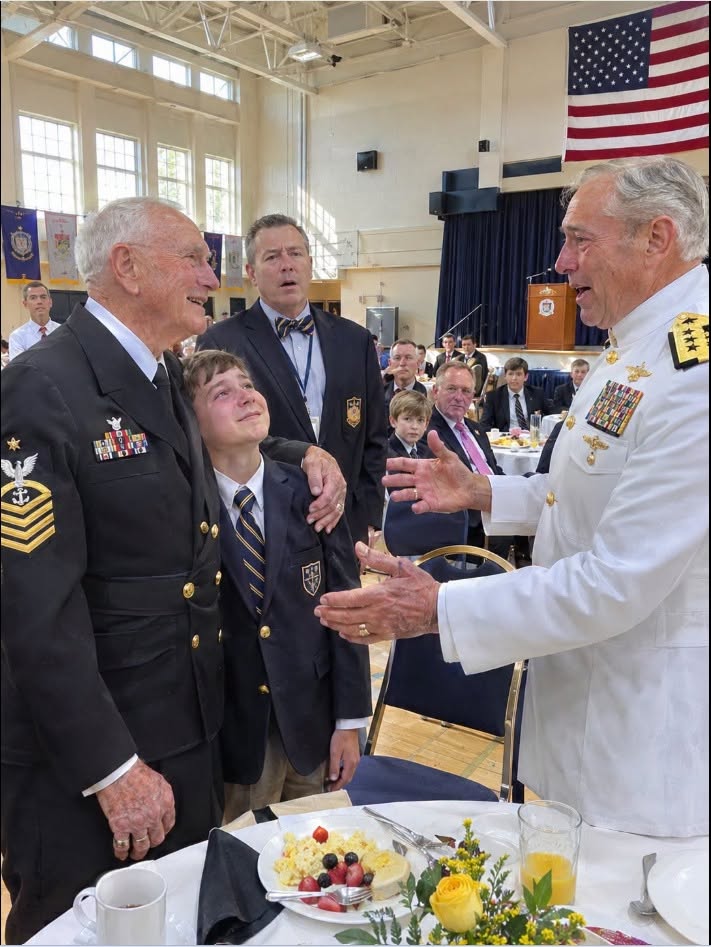
There was a buffet along the side wall. Scrambled eggs and bacon and fruit and stacks of pancakes. Pitchers of orange juice.
A string quartet was playing in the corner. Students from the upper school orchestra.
The volume in the room dropped to an immediate halt.
It happened like a wave. The tables closest to the door went quiet first. Then the ones behind them. Then the whole room.
Two hundred faces turned and looked at us.
At an eighty-one-year-old man in Navy dress blues. Seven rows of ribbons. Seven gold service stripes. A white cap under his arm.
And a nine-year-old boy in a navy blazer, holding his hand.
The string quartet stopped playing.
I didn’t look at anybody.
I walked across the gymnasium floor. My shoes clicked on the polished hardwood. Caleb walked beside me.
I found an empty table. Way in the back, in the far corner, by the bleachers. Nobody was sitting there. It was the one nobody wanted. Too far from the stage.
I pulled out a chair for Caleb. He sat down.
I pulled out a chair for myself. A metal folding chair. I sat down.
I set my white cap on the table in front of me. Brim forward.
Then I looked at Caleb.
“You want pancakes?” I asked.
He didn’t answer. He was looking around the room. At all the faces staring at us.
“Grandpa,” he whispered. “Everybody’s looking.”
“Let them look,” I said. “Pancakes or eggs?”
He looked at me.
“Pancakes,” he said.
Part Eight: Dr. Prentiss
Dr. Prentiss intercepted us within two minutes.
He came striding across the gymnasium from the front of the room. A young man. Late thirties, maybe. Slim. Clean-shaven. Wearing a perfectly tailored gray suit and a silk bow tie with little gold anchors on it.
He had the kind of polish you get from a lot of expensive schools. Princeton, I found out later. Then a doctorate in education from Columbia.
He stopped beside our table.
“Mr. Halloran,” he said.
He said it quietly. Pleasantly. With a smile that didn’t reach his eyes.
“I respect the emotional sentiment here,” he said. “I truly do. But this is a father-son event. I communicated those parameters to your family.”
“You did,” I said.
He waited for me to say something else. I didn’t.
“So I’m going to have to ask you to escort Caleb to the library,” Dr. Prentiss said. “There are refreshments there. Juice. Muffins. He’ll be very comfortable.”
He glanced at the stage.
“Our speaker is preparing to begin,” he said. “And frankly, Mr. Halloran, your uniform is—”
He paused. Choosing his words.
“—a bit of a visual distraction,” he said.
I looked at him for a long moment.
Then I looked around the room.
At the tables of men in expensive suits. At their sons in navy blazers.
Several of the men refused to meet my gaze. They looked down at their plates. At their coffee cups. At their phones.
One or two of them looked visibly ashamed.
There was one man at a table near us. Mid-forties. A gray suit. A boy about Caleb’s age sitting beside him.
He was looking at my ribbons. At the top row. At the blue one with the white stripe.
His face had gone pale.
He looked away.
I turned back to Dr. Prentiss.
“I’ll leave,” I said, “when my grandson has finished eating his breakfast.”
I picked up my coffee cup. Somebody had already filled it.
“Not one second before,” I said.
Dr. Prentiss’s jaw tightened.
He looked at me. He looked at Caleb, who was staring up at him with wide eyes.
He looked at the two hundred people watching.
“Very well,” he said quietly.
He turned and walked away. Toward the front of the room. Toward a woman in a red suit standing by the stage. The chair of the academy’s board of trustees, I found out later.
Caleb was looking at me.
“Grandpa,” he whispered. “Are we going to get kicked out?”
“Probably,” I said. “Go get your pancakes.”
He got up. He walked to the buffet table. Every head in the room turned and watched him go.
He picked up a plate. He put two pancakes on it. Then a third. He poured syrup over all of them.
He walked back to our table with his plate. He sat down. He started eating.
Part Nine: The Speaker
At 7:45, a man in a dark suit walked up to the podium.
The chair of the board. A tall man with silver hair. He tapped the microphone.
“Good morning, fathers and sons,” he said. “Welcome to the fifty-third annual Hampton Roads Preparatory Academy Father-Son Breakfast.”
Polite applause.
He talked for a few minutes. About tradition. About the importance of fathers. About the academy’s proud history of producing leaders.
Then he introduced the guest speaker.
“It is my great honor,” he said, “to introduce a man who embodies leadership and service. Admiral James R. Carrick.”
A man stood up from the head table.
He was tall. Broad-shouldered. Gray hair cut short. He was wearing a dark civilian suit, but he walked like a man who’d worn a uniform for most of his life. Back straight. Chin up. Every step measured.
He was about seventy, I guessed.
The board chair kept reading from his notes.
“Admiral Carrick served thirty-eight years in the United States Navy,” he said. “He enlisted as a seaman apprentice in 1971 and rose through the ranks to become one of only a handful of enlisted sailors in Navy history to reach four-star rank.”
The room murmured.
“He commanded two carrier strike groups. He served as Commander of United States Pacific Fleet. He briefed three presidents. He retired in 2009 and now lives here in Virginia Beach.”
He looked up from his notes.
“His grandson is in our fifth grade,” he said.
The admiral walked to the podium.
He shook the board chair’s hand. He set a small stack of note cards on the podium. He adjusted the microphone.
He looked out over the room.
“Thank you,” he said. His voice was deep and steady. “Thank you to the board. Thank you to Dr. Prentiss. And thank you to all of you fathers and sons for having me this morning.”
He began his speech.
“When I was asked to speak to you today about fatherhood,” he said, “I thought about my own father. He was a steelworker in Youngstown, Ohio. He worked double shifts for thirty years. He wasn’t around much. But he taught me—”
He stopped.
Mid-sentence. In the middle of a word.
He was looking at the back of the room.
At first, I didn’t understand what he was looking at.
Then I realized.
He was looking at our table. In the far corner. By the bleachers.
At me.
At the dark uniform. At the gold buttons.
At the rows of ribbons on my chest.
The whole room turned to see what he was staring at.
Two hundred heads. Turning. Following his gaze.
To the back table.
The admiral stood at the podium for a long moment. Not moving. Not speaking.
The board chair leaned over and whispered something to him. The admiral didn’t seem to hear.
Then he set his note cards down on the podium.
He stepped away from the microphone.
He walked to the edge of the stage. He stepped off it. Down the three wooden steps to the gymnasium floor.
Part Ten: The Walk
Dr. Prentiss rushed to intercept him.
He met the admiral at the bottom of the stage steps. He leaned in close. He was whispering. Fast. Panicked. Gesturing toward our table and then toward the stage.
I couldn’t hear what he was saying. I didn’t need to.
I’m so sorry, Admiral. I’ve already asked him to leave. I’ll take care of it. Please, go back to the podium.
The admiral did not break his stride.
He walked right past Dr. Prentiss. Like Dr. Prentiss wasn’t there.
He walked between the crowded tables. Past two hundred fathers and sons. Past the men in tailored suits and the boys in navy blazers. Past the string quartet in the corner, who’d put down their bows.
Every head in the room turned and watched him go.
He walked all the way across the gymnasium.
Straight to the back wall.
Straight to the empty table in the far corner, by the bleachers.
He halted directly in front of our table.
Caleb stared up at him.
His fork was halfway to his mouth. A bite of pancake dripping syrup. His mouth was completely open.
The admiral didn’t look at Caleb. Not yet.
He was looking at me.
At my ribbons. Row by row. Like he was reading them.
His eyes stopped at the top row. At the blue ribbon with the thin white stripe.
The Navy and Marine Corps Medal.
See more on the next page

