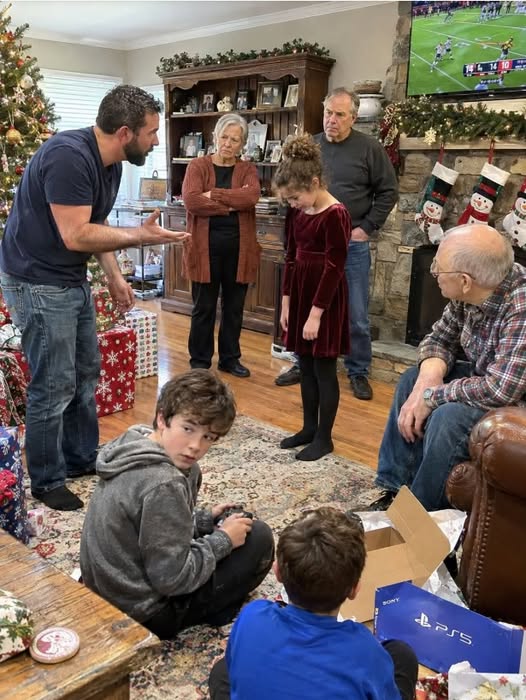
She sat on our couch. Kayla sat in the armchair across from her with her new doll in her lap. Kendra and I stood in the kitchen doorway.
My mother looked at her granddaughter for a long time.
“Kayla,” she said. “I took your name. I used it to buy things for other people. I threw away your star. I told you I couldn’t afford a present for you, and that was a lie. All of it was wrong.” Her voice broke. “I’m sorry. I’m sorry for every bit of it. You didn’t deserve any of it. Not one thing.”
Kayla listened. She was quiet for a while.
“Why did you throw away my star?” she asked.
My mother closed her eyes.
“Because I was ashamed,” she said. “I’d done something terrible with your name, and then you walked in and handed me something you made with your own hands. With my name on it. And I couldn’t look at it.” She opened her eyes. “So I threw it away. So I wouldn’t have to see it.”
Kayla thought about that.
“That’s not a good reason,” she said.
“No,” my mother said. “It’s not.”
Kayla got up from the armchair. She walked to the Christmas tree in the corner of the living room. We’d put it up the week before. She reached up to the top branch, right under the angel, and took something down.
The blue star. Her blue star. With the broken point and the gold dots and the word GRANDMA. She’d hung it there every day for a year, through Christmas and spring and summer and fall. We’d never taken it down.
She walked back to the couch. She held it out to her grandmother.
“I said you could have it back,” Kayla said. “When you said sorry.”
My mother took the star in both hands. She held it against her chest. She didn’t say anything for a long time. She couldn’t.
“Thank you,” she whispered finally.
“You have to keep it,” Kayla said seriously. “You can’t throw it away again.”
“I won’t,” my mother said. “I promise. Never.”
Kayla nodded. Then she went back to the armchair and picked up her doll.
“Okay,” she said. “You can stay for cookies.”
Part Twenty-One: Christmas
We had Christmas at our house that year.
Kendra didn’t work. For the first time in five years, she requested Christmas Day off, and she got it. She slept until eight. She made cinnamon rolls. She sat on the couch in her pajamas watching our kids open presents, and she cried a little, the good kind.
We’d used part of the restitution money for a down payment. We were moving in March, to a bigger house in Royal Oak with a dry basement and a backyard and a bedroom for each of the kids. But we wanted one more Christmas in the little brick bungalow in Ferndale.
Kayla got exactly what she wanted. A set of art supplies. A real paint set with thirty-six colors, and brushes, and an easel. She asked for it because she wanted to make better stars.
Simon got a dump truck and was perfectly happy.
At two o’clock, the doorbell rang.
Brian came in first, with Tyrese and Marcus. They were each carrying one small wrapped present. Tyrese walked straight to Kayla and held his out.
“I bought it myself,” he said. “With my lawn-mowing money. It’s not an iPhone.” He shuffled his feet. “Dad told me about last year. I’m sorry about your name.”
Kayla opened it. It was a sketchbook. A nice one, with a hard cover.
“For your stars,” Tyrese said.
My father came next, leaning on his cane, in his Tigers windbreaker. He had a coffee can full of homemade cookies from the senior center bake sale.
And my mother came last.
She stood in the doorway in her plain gray coat. She wasn’t carrying anything. She looked at me, uncertain.
“Come in, Mom,” I said.
She came in. She sat on the couch. She didn’t say much. She watched the children play. And when Kayla came over and showed her the new paint set, all thirty-six colors, my mother looked at it for a long time and said, “Those are beautiful, honey. You’re going to make beautiful things.”
Then she reached into the pocket of her gray coat.
She took out a small velvet box. Inside, nestled on the velvet, was the blue clay star. Kayla’s star, with the broken point and the gold dots. She’d had a jeweler in Garden City put a little loop of gold wire through the top so it could hang from a ribbon.
“I take it everywhere,” my mother said quietly. “So I’ll remember.”
Kayla looked at it. Then she smiled.
That night, after everyone had gone home and the kids were asleep and the wrapping paper was in the recycling bin, Kendra and I sat on the couch in the light of the tree.
On the top branch, right under the angel, hung a new star. Kayla had made it that afternoon with her new paint set. Bright blue, with gold dots all around the edges, painted carefully with the tip of a brand-new brush. It wasn’t clay this time. It was cardboard, cut from the box the paint set came in.
Across the middle, in her careful second-grade printing, it said one word.
US.
“Lance,” Kendra said quietly, leaning her head on my shoulder. “Do you think we did the right thing? Not sending her to prison?”
I looked at the star on top of our tree.
“I think we did the thing that put our kids first,” I said. “Kayla got her name back. She got her star back to the person she made it for. And she got to decide when the sorry was good enough.”
I put my arm around my wife.
“For six years,” I said, “I understood. Everybody’s needs but ours. This year, I finally understood something else.”
“What’s that?” Kendra asked.
I looked at the little cardboard star, blue and gold, under the angel.
“That being the one who understands,” I said, “doesn’t mean you’re the one who always has to pay.”

