The Red Dress
Part One: Just the Two of Us
Throughout the first twelve years of my life, my mother and I were all each other had.
Our home was a modest yellow duplex at the end of a quiet dead-end road in Columbus, Georgia, about twenty minutes from Fort Benning’s main entrance. A chain-link fence enclosed our little yard, where a peach tree grew without ever producing a peach worth eating. In the living room, an old window air conditioner shook and roared like a passing freight train throughout the summer nights. Mom nicknamed it the Beast. She even spoke to it. Come on, Beast, one more night, she’d plead, giving its side a firm smack. Somehow, that always seemed to do the trick.
I grew up without knowing my father. Whenever I asked about him as a little girl, Mom would perch on the edge of my mattress and give me her familiar answer. It’s just us, Mia-bird. You and me against the world. Afterward, she’d pull my quilt snugly beneath my chin and tickle me until the question slipped from my mind.
My mother’s full name was Kathleen Reynolds, although everyone knew her as Kate. She stood five feet four inches tall, had a dusting of freckles over her nose, and kept her rust-colored hair in a ponytail pulled so tightly that her eyebrows seemed permanently lifted. During the week, she worked as an emergency medical technician for the Columbus Fire Department. She was also a combat medic in the Army Reserve, serving one weekend each month and two weeks every summer.
Mom could start an IV while an ambulance bounced down the road, immobilize a fractured leg in four minutes, and somehow transform boxed macaroni and cheese into something restaurant-worthy using only black pepper and a melted slice of American cheese.
Music followed her everywhere. Her singing was usually off-key, and Patsy Cline and Reba were her favorites. She sang at the stove, behind the steering wheel, and while brushing my hair before school. Her laughter filled rooms. Television advertisements could bring her to tears. And throughout my childhood, she never allowed me to believe that our little family lacked anything.
Everything changed when I turned twelve and her Army Reserve unit received orders to deploy to Afghanistan.
She broke the news one Sunday evening in January. We were sitting at our kitchen table, each with a bowl of chocolate ice cream. Because it was winter, the Beast was silent, leaving the room so still that I could make out the ticking clock on the stove.
“Twelve months, Mia-bird,” she said. “That’s all. I’ll be home next January. You’ll stay with Grandma Pearl.”
I kept my eyes on the ice cream in front of me. “What if something happens to you?”
Mom stretched her arm across the table and wrapped her fingers around mine. “I’m a medic,” she said. “I’m the one who makes sure nothing happens to anybody. That’s my whole job.”
Part Two: Grandma Pearl
While Mom was overseas, I moved into Grandma Pearl’s small brick ranch house across Columbus. It had a carport, a swinging bench on the porch, and a kitchen that seemed permanently filled with the comforting aroma of freshly baked biscuits.
Grandma Pearl was sixty-eight. Before retiring, she’d managed a school cafeteria. Every Saturday evening, she rolled her silver hair into pink foam curlers, and her commanding voice could have silenced a cafeteria food fight from the opposite end of a gymnasium.
She understood raising a child alone. My grandfather had been killed in an accident at a mill when Mom was only six, leaving Grandma Pearl to bring her up by herself.
She insisted on saying grace before eating, finishing schoolwork before watching television, and threatened a switch cut from her forsythia bush whenever someone talked back. But she never actually used one on me.
Each morning, she got me to school and made sure I had a packed lunch. Every evening, she stayed beside me at the kitchen table as I struggled through math assignments. Whatever fears she carried, she carefully hid them from me.
Mom telephoned every chance she got, even if she only had a few minutes. Calls sometimes arrived at three in the morning or halfway through the school day. Grandma Pearl would either wake me from sleep or contact the school’s front office so I could speak with her.
Our conversations were interrupted by awful reception, strange echoes, static, and long delays. We’d accidentally speak at the same time and end up laughing at the confusion.
But I missed her with an intensity that felt like a constant ache deep inside my stomach.
During that first year, I often broke down crying while we talked. Mom always tried to cheer me up with the same little joke.
“Don’t worry, sweetheart,” she’d say, her voice crackling over seven thousand miles of satellite. “I’ll be home before you know it. I’ve got to be there for your wedding, after all. I’m going to wear a bright red dress, so you’ll spot me right away. In the front row. Waving like a crazy woman.”
“Mom,” I’d say, sniffling, “I’m twelve. I’m not getting married.”
“Not yet,” she’d say. “But someday. And I’ll be there. Red dress. Front row. You can’t miss me.”
Part Three: Daniel
One name appeared in nearly every conversation with Mom: Daniel.
Specialist Daniel Mercado was a twenty-four-year-old combat engineer from San Antonio, twelve years younger than Mom, stationed at the same forward operating base in Afghanistan’s Kandahar Province.
According to her, their friendship began during his first week there, when he accidentally dumped an entire plate of spaghetti over her boots in the dining hall. He then desperately attempted to wipe up the mess with a napkin while apologizing in two different languages.
“He’s like the little brother I never had,” she said on the phone. “He makes me laugh every single day, Mia. Even on the bad days. Especially on the bad days.”
And there were plenty of difficult days.
Mom never described those experiences outright. Still, I occasionally heard something unfamiliar in her voice: a drained, distant weariness that hadn’t existed before her deployment.
During those conversations, another voice would sometimes drift through the background. A man would be telling jokes, imitating their sergeant, or loudly performing some spectacularly awful karaoke.
Then I’d hear Mom laughing.
“That’s Daniel,” she’d say. “Ignore him. He’s an idiot.”
“Hi, Mia!” he’d shout in the background. “Your mom is the bossiest woman in Afghanistan!”
“He’s not wrong,” my mother would say. And then she’d laugh again, really laugh, and I’d feel better.
That August, a roadside explosive struck their convoy near Arghandab.
Daniel was traveling in the second vehicle. The explosion ripped through its floor, crushed his left leg, and inflicted a wound along his side that military surgeons later believed should have killed him within four minutes.
Mom was riding in the fourth vehicle.
Despite enemy fire continuing around them, she ran through the smoke toward him. She dropped to her knees in the dirt, pressed her bare hands into the wound to pack it, and maintained pressure for twenty-two minutes until the medical evacuation helicopter arrived.
For saving his life, she received the Bronze Star.
She never brought up the award during our conversations. I learned about it only after the official citation arrived at Grandma Pearl’s home.
From that day forward, Mom said, she and Daniel were practically inseparable.
Part Four: The Knock
Mom’s return had originally been scheduled for January. Then the Army extended her unit’s deployment by another three months, pushing her homecoming to April.
On Thursday, March 9, two uniformed soldiers appeared at Grandma Pearl’s front door.
By then, I was thirteen.
I had been working on pre-algebra at the kitchen table when their knock interrupted me. Grandma Pearl was carrying a dish towel as she headed down the hallway to answer.
Through the small window in the door, I could see two green military uniforms.
Grandma Pearl froze before reaching the entrance.
The dish towel slipped from her fingers and landed on the floor.
She understood what their visit meant before opening the door.
And somehow, I understood too.
On March 7, Mom had been killed in Kandahar Province when attackers opened fire on a medical evacuation convoy.
She was inside an armored ambulance, caring for an injured Afghan police officer, when the attack began.
The man she was treating lived.
My mother did not.
She was only thirty-seven.
Everything familiar in my world shattered.
There isn’t a gentler way to explain it.
One day, my mother was the woman who sang badly along with Patsy Cline, argued with an aging air conditioner, and swore she’d wear a bright red dress when I married.
Then suddenly all I had were a neatly folded American flag, the Bronze Star I’d never once seen pinned to her uniform, and the gold star pin presented to Grandma Pearl during Mom’s funeral at Fort Benning’s main post chapel.
Grandma Pearl was the only family I had remaining.
She was seventy years old, devastated by losing her daughter, and spent night after night at her kitchen table clutching Mom’s final letter.
She read those pages so many times that the paper eventually became soft beneath her fingers.
Part Five: The Doorstep
Another visitor knocked on Grandma Pearl’s door three weeks after the funeral.
It was a Saturday morning in April. I almost ignored the sound because, since the soldiers’ visit, every unexpected knock left me feeling sick.
Waiting outside was a young man, perhaps twenty-five.
His dark eyes were framed by short black hair, and there was stubble along his jaw. A cane supported his weight. A bulky black brace stretched along his left leg, running from his hip almost to his ankle.
He held a bunch of inexpensive daisies from a grocery store in one hand, while a shoebox was tucked beneath his opposite arm.
For several seconds, he simply stared at me.
“You’re Mia,” he said finally. His voice cracked. “You look just like her.”
“Daniel?” I said.
He nodded.
He explained that he’d spent the previous seven months at Walter Reed in Maryland, recovering in the hospital and relearning how to walk. Doctors had finally discharged him two weeks earlier.
Instead of going somewhere comfortable to recuperate, he’d boarded a Greyhound bus in Washington, D.C., and traveled seventeen hours to Columbus, Georgia.
He’d made the journey with his injured leg still in its brace.
There was a promise he’d made to Mom, and he’d come to honor it.
“What did you promise her?” Grandma Pearl asked. She’d come up behind me in the doorway with her hand on my shoulder.
Daniel met her eyes, then turned back toward me.
“That if anything happened to her,” he said, “I’d look after her girls.”
For a moment, Grandma Pearl studied the young soldier in silence.
Her gaze traveled from his walking cane to the heavy leg brace, then to the humble bouquet of daisies.
Finally, she moved out of the doorway and invited him inside.
“Come in, son,” she said. “I’ll make biscuits.”
Part Six: Uncle Daniel
From that visit onward, Daniel was part of our family.
The Army granted him medical retirement later that summer. The damage to his leg meant that returning to combat engineering wasn’t possible.
Instead, he used his GI Bill benefits to enroll at Columbus State University, where he began studying civil engineering.
He found a little apartment only ten minutes from Grandma Pearl’s house and became a regular visitor.
It began with Sunday dinners.
Around five-thirty, Daniel would arrive carrying a store-bought pie, his cane in his other hand. Grandma Pearl usually prepared fried chicken or pot roast, and the three of us gathered around her small kitchen table.
Over dinner, he’d share memories of Mom’s time in Afghanistan.
He made sure to tell us the funny stories.
There was Thanksgiving, when she’d arranged a pie-eating competition using apple turnovers from military MREs. Another time, she’d beaten a two-hundred-pound Alabama sergeant in an arm-wrestling match.
And on the Fourth of July, she’d grabbed the base loudspeaker and belted out “Coal Miner’s Daughter,” inspiring everyone to sing with her.
One Sunday evening, one of Daniel’s stories made me laugh for the first time since Mom’s funeral.
Grandma Pearl heard it and began to cry.
Soon, Daniel’s visits weren’t limited to Sundays.
He repaired my old bicycle, a faded pink Huffy with a crooked front wheel that Mom had intended to fix for almost a year.
He spent an entire Saturday working on it beneath Grandma Pearl’s carport, using a borrowed wrench and muttering Spanish curses under his breath.
When he finally finished, he insisted that I ride back and forth along the driveway five times.
Leaning against his cane, he applauded and shouted as enthusiastically as if I’d just won the Tour de France.
He also made breakfast pancakes on Saturday mornings.
They were spectacularly bad.
Each one came out thick, scorched on the surface, and nearly uncooked in the center. Grandma Pearl repeatedly tried showing him how to make them properly, but nothing changed.
I ate every pancake anyway.
Daniel showed up at my school events, too.
He attended my eighth-grade choir performance, where I forgot half the words during my four-line solo in “Silent Night.”
He came to our ninth-grade staging of Our Town, when I played Emily. During the cemetery scene, his sobbing grew so loud that audience members actually turned to stare.
Whenever something went wrong, Daniel was the person Grandma Pearl could rely on.
One January night, a pipe burst beneath her kitchen sink at two in the morning. Within fifteen minutes, he arrived with his toolbox.
When tenth-grade geometry became my worst subject, he spent three evenings every week teaching me with a protractor and seemingly endless patience.
When Grandma Pearl needed surgery to remove her gallbladder, he handled her transportation to every medical appointment and spent a week sleeping on the living room couch.
He simply kept showing up.
Without ever having a formal conversation about it, we developed something remarkably close to a father-daughter relationship.
I never addressed him as Dad.
He was always Uncle Daniel.
But I think we both understood what he had become to me.
Part Seven: What He Carried
Some subjects remained too painful for Daniel to discuss, and I gradually came to understand why.
March 7 was one of them.
He hadn’t been with Mom when she died. By then, he’d already been sent to Walter Reed to undergo treatment for his shattered leg.
Yet he had been her closest friend, the younger-brother figure she’d looked after, the soldier whose life she’d rescued.
Daniel was alive because of her.
And she was gone.
One night when I was fifteen, I discovered him sitting by himself on Grandma Pearl’s back porch long after Sunday dinner.
It was nearly midnight.
He held a Coke can and stared toward the peach tree in the yard.
That tree had once grown outside our yellow duplex, producing its usual disappointing fruit. After Mom’s death, Grandma Pearl had dug it up and moved it to her own backyard.
I lowered myself onto the porch step beside him.
“Uncle Daniel,” I said. “Do you think about her?”
“Every day,” he said. He didn’t look at me.
“Do you think it should’ve been you?” I asked. I don’t know why I asked it. I think I’d been wondering for a long time.
Silence stretched between us for so long that I began to think he wouldn’t respond.
“Yeah,” he said finally. “I think about that every day too.”
He placed the Coke can beside him.
“She knelt in the dirt in the middle of a firefight,” he said, “and kept her hands inside my side for twenty-two minutes. She was singing. Did you know that? She was singing Patsy Cline the whole time. ‘Walkin’ After Midnight.’ So I’d have something to listen to instead of the gunfire.”
With the back of one hand, he brushed tears away.
“She saved my life,” he said. “And I couldn’t save hers. I wasn’t even there.”
Words failed me.
Instead, I rested my head against his shoulder, exactly as I’d done with Mom when I was younger.
We stayed together on those porch steps until Grandma Pearl appeared in her robe and hair curlers, ordering both of us to get some sleep.
Part Eight: Growing Up
Eventually, I grew older.
That’s one of grief’s strangest truths. You expect losing someone to bring the entire world to a halt. But life continues, and grief settles into it like another permanent piece of furniture.
I finished high school in Columbus.
At graduation, Daniel and Grandma Pearl sat among the crowd in the stadium bleachers. They shouted my name with such enthusiasm that the principal briefly stopped before giving me my diploma.
A scholarship for the children of fallen service members allowed me to attend the University of Georgia in Athens.
I chose nursing as my major.
Looking back, how could I have chosen anything else?
Daniel eventually earned his engineering degree and accepted a position designing bridges for the Georgia Department of Transportation.
Every few weeks, he’d drive to Athens, buy me dinner, and remind me to take my studies seriously.
Whenever Grandma Pearl’s aching hip allowed her to travel, he’d bring her along.
During the spring semester of my senior year, when I was twenty-two, Grandma Pearl passed away.
She suffered a stroke while sleeping in her own bed, in the little brick house with the carport.
She was seventy-nine.
Daniel discovered her after arriving one Saturday morning to repair a dripping faucet. When she didn’t answer his knock, he knew something was wrong.
At 9:15 that morning, he called me in Athens.
Before he managed to speak, I could already hear him weeping.
Once again, Daniel took responsibility for everything.
He arranged the funeral, coordinated with the church, and organized her headstone.
When I couldn’t face sorting through her belongings, he cleared out the house.
He saved Grandma Pearl’s recipe box for me. Her biscuit recipe was written on a stained index card at the front, in the rounded handwriting she’d developed during her school-cafeteria years.
Inside her dresser, he discovered Mom’s Bronze Star, carefully wrapped in tissue.
In the cedar chest, he found the folded funeral flag and the gold star pin.
But there was another discovery.
One he kept to himself for four more years.
Part Nine: Nate
During my second year as an emergency room nurse at Piedmont Columbus Regional Hospital, I met Nate Alvarez.
Nate was employed as a firefighter with the Columbus Fire Department, the very department where Mom had worked as an EMT nineteen years before.
We met one October evening after he came into the ER with a gash on his forearm.
He’d cut himself on broken window glass while responding to a house fire.
As I stitched the injury, he kept cracking jokes from his hospital gurney.
He invited me on a date three separate times before I finally agreed.
On our fourth date, Nate told me something unexpected.
He knew about Kathleen Reynolds.
Veteran firefighters at his station still remembered Kate, he explained. Her picture remained on a wall at the Victory Drive fire station.
In the photograph, she wore her EMT uniform, her familiar rust-red ponytail tightly secured.
Beneath the frame was a small brass inscription:
Kathleen Reynolds. EMT. Army Medic. Bronze Star. Gave everything.
Until that conversation, I hadn’t known the tribute existed.
I started crying right there in a Mexican restaurant on Macon Road.
Nate reached over the table, took my hand, and sat quietly beside me.
Two years afterward, he proposed on the back porch of Grandma Pearl’s old brick house.
I’d inherited the property after her death and couldn’t bring myself to sell it.
Together, Nate and I had repainted the house and replaced the roof over the carport.
Now he was kneeling in the grass beneath the peach tree, which still hadn’t produced one decent peach, holding an engagement ring toward me.
I accepted before he could finish asking.
Daniel was the first person I telephoned.
For a while, he said nothing.
Then I heard him blowing his nose.
“Your mom would be so happy,” he said, and his voice cracked. “She’d be over the moon, Mia-bird.”
Nobody else in the world still used that childhood nickname.
Part Ten: The Mirror
We planned our wedding for May at a small white Methodist church just outside Columbus.
The reception would take place beneath a large white tent set up in the church’s backyard garden.
We invited 120 people.
Nate’s enormous, boisterous family came from Phenix City. My hospital friends attended, along with what seemed like half the Columbus Fire Department dressed in formal uniforms.
I prepared for the ceremony in a cramped bridal room at the rear of the church.
It had a full-length mirror, an old pink velvet loveseat, and tissue boxes scattered across practically every available surface.
Jasmine, my closest friend and maid of honor, applied my makeup while the bridesmaids chatted, laughed, and snapped photographs.
At 1:45, fifteen minutes before the wedding was scheduled to begin, they left to take their places.
For the first time that afternoon, I was alone.
I turned toward the mirror.
My wedding gown was uncomplicated and elegant.
Made of ivory satin, it hugged my waist before widening into a flowing skirt. I’d paid three hundred dollars for it at an Atlanta consignment shop.
My hair was swept up, with several soft curls framing my cheeks.
Its color was rust-red, just like Mom’s, even though I’d spent years claiming it was closer to brown.
In my ears were her little gold hoops.
She’d worn them almost every day when I was growing up.
Following her death, the Army had returned them in a plastic bag alongside her other personal possessions.
As I studied my reflection, tears suddenly overwhelmed me.
My mother should have been there.
She had promised me she would.
I’ll be there for your wedding, in a bright red dress, so you’ll spot me right away. Front row. Waving like a crazy woman.
More than anything, I wanted that door to swing open and reveal her standing there.
I longed to see her tightly pulled rust-colored ponytail, the freckles scattered over her nose, and the wonderfully ridiculous smile that had always accompanied her off-key singing.
Most of all, I wanted her to see the woman I’d become.
Alone in that hot, airless room, I cried until my knees weakened and I had to sit on the pink velvet loveseat.
Part Eleven: Red
A gentle knock interrupted my tears.
“Mia?” It was Jasmine. “Mia, honey, are you okay? It’s almost time. And, um…” She hesitated. “Daniel’s here. He wants to see you before you go out.”
I dried my cheeks and attempted to repair my makeup.
One glance at the mirror told me it hadn’t helped.
“Okay,” I said. “Let him in.”
The door swung inward.
Uncle Daniel stood on the threshold.
He was forty by then, with flecks of gray near his temples and a slightly fuller figure than when I’d first met him.
The damage from his military injuries remained visible in his walk. Titanium rods and screws installed by surgeons at Walter Reed had rebuilt his leg, but he still limped a little.
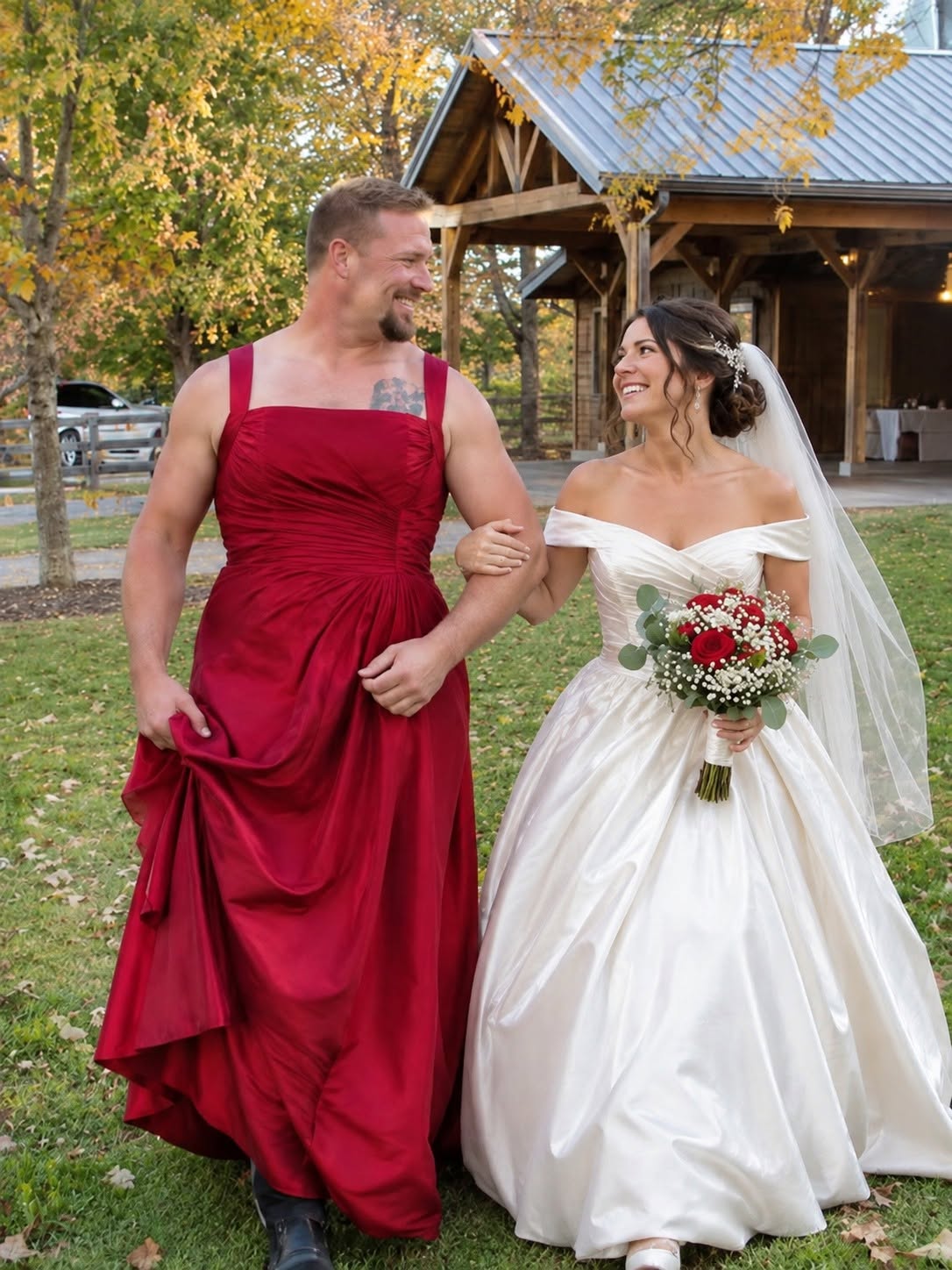
And somehow, Daniel was standing there in a red dress.
I was completely speechless.
The dress was a striking fire-engine red.
It ended at his knees, with short sleeves and a wide, flowing skirt. It looked like the sort of outfit someone might choose for a summertime wedding in Georgia.
On Daniel, however, it was an awkward fit.
The shoulders strained, and the waist sat too high because the bodice was too short for him.
He wore a white undershirt beneath it, along with his regular black dress shoes and dark socks.
His face had been carefully shaved.
In his hand was a modest bunch of daisies from a grocery store.
They looked just like the flowers he’d brought when he first appeared at Grandma Pearl’s door thirteen years earlier.
“Uncle Daniel,” I whispered. “What are you wearing?”
He gave me a smile, although tears were gathering in his eyes.
“Do you remember,” he said, “how your mom always said she’d wear a red dress to your wedding? So you’d spot her right away?”
My hand flew to my mouth.
“I can’t bring her back, Mia-bird,” he said. His voice was shaking. “God knows I’d give anything. But I wanted you to know that she’s here with you today. She promised she’d be in the front row in a red dress.” He looked down at himself and laughed through his tears. “So I figured somebody’d better keep her promise.”
I couldn’t hold back another wave of tears.
Still wearing my ivory wedding gown, I stood from the loveseat and wrapped my arms around a forty-year-old disabled combat veteran dressed in brilliant red.
I buried my face against his shoulder and sobbed.
Daniel held me securely.
He held me the same way he’d comforted me on Grandma Pearl’s back porch when I was fifteen, at her funeral years afterward, and through countless difficult moments in between.
For a fleeting moment inside that stuffy bridal room, I felt as though Mom were right there.
I could almost sense her familiar smell: Ivory soap, gun oil, and the strawberry-flavored lip balm she always kept with her.
“Daniel,” I said into his shoulder. “Will you walk me down the aisle?”
He eased back and stared at me.
“In this?” he said.
“Especially in that,” I said.
Part Twelve: The Aisle
At precisely two o’clock, the organ began playing Pachelbel’s Canon.
The double doors at the rear of the little white church swung open.
All 120 guests rose and turned to watch my entrance.
There I stood, wearing my ivory satin gown and Mom’s gold hoop earrings, holding the arm of a forty-year-old man whose walk was uneven and whose buzz-cut hair was threaded with gray.
He wore a vivid fire-engine-red dress.
In his free hand was a small bouquet of grocery store daisies.
Together, we began walking toward the altar.
Not a single person laughed.
There were no whispers.
I’d worried someone would make fun of him.
Maybe Nate’s relatives from Phenix City, my coworkers from the hospital, or one of the firefighters in uniform would snicker.
I had even imagined somebody secretly photographing him to share online, accompanied by a cruel comment.
But nothing like that happened.
Everyone seemed to recognize what Daniel was doing.
Without needing an explanation, the people gathered in that church understood the meaning behind his red dress.
As we reached the middle of the aisle, I noticed an elderly firefighter sitting in the third row.
He wore the Columbus Fire Department’s dress uniform, had a white mustache, and looked to be around seventy.
He straightened his posture and placed one hand over his heart.
Later, I learned he was Captain Earl Haskins.
For nine years, he’d supervised Mom at the Victory Drive fire station. He was also the man responsible for hanging her portrait on the wall.
The firefighter seated next to him followed his lead.
Then another did the same.
Within moments, the entire row of uniformed firefighters stood at attention, hands pressed over their hearts, as Daniel escorted me past them.
At the altar, Nate waited in his formal uniform.
He had watched Daniel enter the church, and before we were even halfway down the aisle, tears were already streaming over his cheeks.
When we reached him, Daniel paused.
He faced me and gently raised my veil with his large, scarred hands.
After kissing my forehead, he carefully placed my hand into Nate’s.
“Take care of her,” he said quietly. “She’s the bravest girl I know. She gets it from her mom.”
Nate nodded, unable to form a response.
Then Daniel walked to the first pew on the bride’s side of the church.
He settled into the aisle seat.
The very front row.
Throughout the ceremony, whenever I glanced toward that side, I could see him.
A brilliant patch of red in the front row.
Exactly where Mom had promised I would find her.
Part Thirteen: The Envelope
Our reception continued until ten that night.
Beneath the white garden tent, guests danced and enjoyed barbecue catered by a Phenix City smokehouse.
Nate’s mother had baked our wedding cake herself, filling it with peaches.
Daniel and I danced together to “Coal Miner’s Daughter,” Mom’s favorite song.
He was still dressed in red, and everyone beneath the tent clapped along.
By 10:30, most guests had departed.
The catering crew had begun stacking the chairs, while Nate helped his brothers load leftover cake into their trucks.
I sat alone beneath the tent at one of the tables, barefoot and exhausted.
My wedding shoes rested beside my chair.
Holding a glass of sweet tea, I watched the hanging lights sway gently in the warm May air.
Daniel approached and took a seat next to me.
He had replaced the dress with jeans and a button-down shirt.
He seemed weary, and for some reason, older than I’d ever noticed before.
Something was clasped between his hands.
He cleared his throat.
“Sweetheart,” he said. “I have something for you.”
He passed me an envelope.
It was worn and slightly wrinkled, with age-yellowed edges. A strip of old tape sealed the flap, brittle after so many years.
Across the front, faded blue ink formed familiar, slanted loops.
I recognized that hurried handwriting immediately.
I’d seen it on every note Mom had tucked into my childhood lunchbox.
For Mia. On her wedding day.
For a moment, my lungs seemed to forget how to work.
“Where did you…” I started.
“She gave it to me,” Daniel said quietly. “In Kandahar. Two days before she died.”
His gaze dropped toward the envelope I was holding.
“She made me promise,” he said. “She said, Danny, if anything happens to me, you give this to my girl on her wedding day. Not before. Not one day before. Promise me.” He swallowed. “So I promised.”
“Thirteen years?” I whispered. “You’ve had this for thirteen years?”
“I almost gave it to you a hundred times,” he said. “When you graduated high school. When Grandma Pearl died. When you were so sad that night on the back porch.” He shook his head. “But I promised her. Not one day before.”
Then he spoke again, and the words made my fingers tremble.
“There’s something she kept from you, Mia,” he said. “Your whole life. Something she wanted you to know. But only when you were ready to start your own family.”
Part Fourteen: The Letter
My hands were trembling so badly that peeling away the aging tape was almost impossible.
Daniel made no attempt to assist.
He remained quietly beside me beneath the glowing string lights, allowing me to do it myself.
The envelope contained two separate items.
One was a four-page letter, written on thin ruled sheets ripped from a spiral-bound notebook.
Mom’s distinctive handwriting covered each page, and the papers had been folded into thirds.
The other was a tiny square of paper that looked much older.
It had softened from age, with deep creases suggesting it had been opened and refolded countless times.
It was a piece torn from a yellow legal pad, bearing a few penciled words in an unfamiliar hand.
I began with Mom’s letter.
My darling Mia-bird,
If you’re reading this, it’s your wedding day, and I’m not there.
I’m so sorry, baby. I’m sorry I broke my promise. I wanted to be in the front row in a red dress more than I have ever wanted anything. If you’re reading this, it means I couldn’t keep that promise. But I made Danny promise to give you this, and Danny always keeps his promises.
I need to tell you something now. Something I should have told you a long time ago. I was going to tell you when you turned eighteen. Then I thought maybe when you graduated college. Then I got deployed, and I sat on my bunk in Kandahar thinking, what if I never get the chance?
So here it is.
I didn’t give birth to you, Mia.
Everything around me seemed to stop.
The hanging lights, the chairs being stacked, the caterers moving around the tent.
Even the sound of Nate laughing with someone near the trucks seemed to disappear.
It felt as though the entire world had been paused.
My eyes returned to that sentence.
I didn’t give birth to you.
I read it once more.
Then, somehow, I continued.
Part Fifteen: The Fire Station
Twenty-six years ago, on a cold night in February, I was working a night shift at Fire Station 4 on Victory Drive. I was twenty-four years old. I’d been an EMT for two years.
At 3:40 in the morning, somebody rang the bell at the side door of the station. When I opened it, nobody was there. Just a laundry basket on the step. Inside the basket, wrapped in a pink towel and an old flannel shirt, was a newborn baby girl.
You, Mia. You were maybe three hours old. Your cord was tied off with dental floss. You were cold and hungry and so tiny, and you were crying so loud.
Georgia has a Safe Haven law. A mother who can’t care for her baby can leave it at a fire station or a hospital, no questions asked, and the baby will be safe. Somebody loved you enough to bring you to us.
I picked you up out of that basket, and you stopped crying. You looked right up at me with these big, serious gray eyes. And I swear to you, baby, my whole life changed in that second.
Tucked into the flannel shirt was a note. I’ve kept it all these years. It’s in this envelope. It’s the most precious thing I own, besides you.
I lowered the letter onto the table.
Then I reached for the small scrap of yellow paper.
The pencil marks were faint and the handwriting unsteady.
With shaking fingers, I gently opened its folds.
Please love her. I can’t take care of her. I’m only 16 and I’m so scared. Her name is Mia. Please keep her name. Please tell her I’m sorry.
My vision dissolved behind tears.
I could barely distinguish the words anymore.
Beside me, Daniel rested a comforting hand against my back.
He remained silent.
Part Sixteen: She Chose Me
Eventually, I found the strength to lift Mom’s letter again.
The state took custody of you, the way they’re supposed to. They put you in a foster home while they searched for your birth mother. I couldn’t stop thinking about you. I called the caseworker every day. Every single day for two weeks, until she finally told me, Kate, if you care this much, why don’t you become a foster parent?
So I did. I took the classes. I passed the home study in that little yellow duplex with the Beast rattling in the window. I was twenty-four and single and I made twenty-six thousand dollars a year. Everybody told me I was crazy. Your Grandma Pearl told me I was crazy. Then she met you, and she cried for an hour and went out and bought a crib.
You came home with me when you were five weeks old. Nobody ever came forward. Nobody ever looked for you. When you were fourteen months old, a judge at the Muscogee County Courthouse made me your mother forever.
I kept your name. Mia. Because the girl who left you asked me to. And because it was the only thing she had to give you, and I wanted you to have it.
I never told you because I was afraid. Afraid you’d feel like you didn’t belong. Afraid you’d feel like somebody threw you away. Afraid you’d go looking for her and find a stranger, and feel like a stranger to me.
But here’s what I want you to know, Mia. Read this part twice.
Nobody threw you away. A scared sixteen-year-old girl wrapped you in her own flannel shirt and walked to a fire station in the middle of a February night and rang the bell, because she wanted you to live. She gave you the best thing she had. She gave you a chance.
And then I got to be the one who opened the door.
I didn’t give birth to you, baby. But I chose you. Every single day for twelve years, I chose you. And if I’m gone, I’m still choosing you, wherever I am.
Part Seventeen: The Red Dress
There was still one final sheet.
Mom’s writing looked more hurried on this page, the letters less carefully formed.
Danny’s sitting across from me right now, eating a MRE and complaining about the chili. He knows all of this. I told him last week, on a bad night, and he cried like a baby. Don’t tell him I said that.
I asked him to do something for me, Mia. If anything happens. I asked him to keep looking.
I tried to find her, your first mother. For years. I wanted to tell her that you were safe and loved and smart and stubborn and that you have her gray eyes. I wanted her to know she didn’t have to be sorry. I never found her. But I have a feeling Danny might.
If he does, it’s your choice whether to meet her. Not his. Not mine. Yours. You don’t owe her anything, and you don’t owe me anything. You just get to choose. The way I got to choose you.
And baby, one more thing.
I’m sorry I’m not in the front row. I’m sorry about the red dress. I really was going to wear it. I bought it already. It’s in a garment bag in the back of my closet at the duplex. Bright red. Size 6. I was going to look ridiculous.
Wear it someday, Mia-bird. Not to your own wedding. To someone else’s. Somebody you love. So they’ll spot you right away.
I love you more than all the stars over Kandahar. And there are a LOT of stars over Kandahar.
Mom
When I finished, I carefully refolded the pages.
I pressed both Mom’s letter and the tiny yellow note against my heart.
Sitting barefoot beneath the reception lights in my wedding gown, I cried more intensely than I had since those two soldiers appeared at Grandma Pearl’s house.
Daniel wrapped his arms around me and stayed that way.
Part Eighteen: What Daniel Found
Once I was finally able to speak, I turned toward him.
“The red dress,” I said. “The one you wore today. Was that…”
Daniel nodded. “It was hers,” he said quietly. “Size 6. I found it when I cleaned out Grandma Pearl’s house. She’d moved your mom’s things into the back bedroom closet after the funeral. The garment bag was still there. The tags were still on it.”
He lowered his eyes to his hands.
“I had to let out every single seam to get it on,” he said. “A seamstress in Midtown did it for me. She didn’t ask why.” He almost laughed. “I think she thought I was in a play.”
There was another question I needed answered.
“And the other thing,” I said. “She asked you to keep looking. For my first mother.”
He fell silent, and the pause stretched on.
“Mia,” he said finally. “I found her. Four years ago.”
I could only stare.
“When Grandma Pearl died,” he said. “When I cleaned out her house. I found your mom’s file. The Safe Haven paperwork, the foster care records, everything. She’d kept it all in a box in her closet.” He swallowed. “I did one of those DNA tests. I sent in a sample from your hairbrush. I’m sorry. I know that’s a violation of something.”
“Daniel.”
“I know,” he said. “I’m sorry. But your mom asked me to keep looking. And I’d promised her.”
Then he told me what he’d discovered.
“Her name is Teresa Oduya,” he said. “She’s forty-two. She lives in Macon. She’s a pediatric nurse at Navicent Health. She has two sons, eleven and fourteen. She’s married to a high school chemistry teacher.”
I struggled to draw a breath.
“I didn’t contact her,” Daniel said quickly. “I swear. I found her name, and her address, and I wrote it all down, and I put it in a sealed envelope, and I waited. Because your mom said it had to be your choice. Not mine.”
He slipped his hand into the pocket of his shirt and withdrew another envelope.
This one was newer, plain white, and carefully sealed.
On the front, in his unmistakable blocky engineer’s handwriting, he’d written:
MIA — WHEN YOU’RE READY
“It’s here,” he said. “Whenever you want it. Tomorrow. Or next year. Or never.” He put it in my lap, on top of my mother’s letter. “Your call, Mia-bird.”
Part Nineteen: Teresa
For the next six months, Daniel’s envelope remained unopened.
I wasn’t prepared.
I needed space to absorb everything Mom had written.
I didn’t give birth to you.
I chose you.
Please tell her I’m sorry.
There were long conversations with Nate, who held me through my tears nearly every evening for a month.
And there were visits to Fort Benning’s main post cemetery.
For thirteen years, I’d gone there almost every Sunday to sit in the grass beside Mom’s white marble headstone.
Now I returned to tell her what I’d learned.
“You should have told me,” I said to the headstone. “I would have loved you exactly the same.”
The breeze stirred the oak branches above me.
A mockingbird called from a nearby fence post.
“I know you know that now,” I said.
Finally, in November, I opened the second envelope.
I decided to write Teresa Oduya a letter.
Finding the right words required eleven separate drafts.
I introduced myself as Mia and explained how, twenty-six years earlier, Kate Reynolds had opened the side entrance at Fire Station 4 on Victory Drive at 3:40 a.m.
I told her that Kate had discovered a newborn girl in a laundry basket.
I also described the handwritten note tucked into the flannel shirt.
You asked her to tell me you were sorry, I wrote. She did. In a letter she left me before she died. And I want you to know that you don’t have to be sorry. I had a wonderful life. I was loved every single day. You gave me that, by ringing that bell.
I added my telephone number and mailed the letter on Tuesday.
That Friday evening, my phone rang.
I was standing in Grandma Pearl’s old brick-house kitchen, following her handwritten biscuit recipe.
The incoming number had a Macon area code.
For a second, I almost let it ring unanswered.
When I picked up, there was only the sound of someone breathing.
Then a woman spoke.
Her voice shook so violently that I struggled to make out the words.
“Is this Mia?”
“Yes,” I said.
Silence followed.
Then I heard her begin crying.
“I’ve been praying for you,” she said, “every single night for twenty-six years.”
Part Twenty: Macon
We arranged to meet on a Saturday morning in December.
The location was a Waffle House near Interstate 75 in Macon, roughly halfway between our homes.
Nate accompanied me.
When we walked inside, Teresa was already sitting at a window booth.
A full cup of untouched coffee rested in front of her.
She was tall and slender, with deep brown skin, closely cropped hair beginning to gray, and a navy cardigan.
The moment she noticed me, she stood.
And I saw something that made my heart stop.
Her eyes were exactly like mine.
Large, gray, and serious.
They were the eyes Mom had described looking up at her from a laundry basket.
At first, neither of us moved closer.
We stood facing one another in the middle of the Waffle House, taking in the sight of each other.
Finally, Teresa raised a hand to cover her mouth.
“Your eyes,” she whispered. “You have my mother’s eyes.”
For the next four hours, we talked.
Nate gave us privacy by sitting at the counter with his coffee, pretending to follow a college football game playing on the television above the grill.
Teresa shared the story she’d carried alone for so long.
At sixteen, she’d been a sophomore attending Spencer High School in Columbus.
Her parents were deeply religious and extremely strict, and she had been terrified of what they might do if they discovered her pregnancy.
She concealed it for all nine months beneath oversized sweatshirts.
At two in the morning, while her parents slept down the hallway, she delivered me alone on their bathroom floor.
Afterward, she wrapped me in a pink towel and an old flannel shirt belonging to her father.
She placed me in a laundry basket and carried me eleven blocks through the darkness to Fire Station 4 on Victory Drive.
“I rang the bell,” she said, “and I hid behind a car across the street. I watched the door open. I watched a woman with a red ponytail pick you up.” She wiped her eyes. “You stopped crying. I saw you stop crying. And I thought, Okay. She’ll be okay now. And I walked home.”
For twenty-six years, Teresa had kept her secret.
Her parents never knew.
Neither did her husband or her two sons.
She’d eventually attended nursing school and become a pediatric nurse.
She explained that she’d chosen that profession because she wanted to dedicate her life to caring for babies when she’d been unable to care for her own.
“Every February,” she said, “on your birthday, I go to a fire station. A different one every year. In Macon, Atlanta, Savannah. And I leave a box of donuts on the step and ring the bell. And I walk away.”
Part Twenty-One: The Picture
Before we said goodbye at the Waffle House, I pulled out my phone.
There was a photograph I wanted Teresa to see.
Grandma Pearl had taken it when I was eight, on the Fourth of July, outside our yellow duplex at the end of the dead-end road.
Mom and I sat together on the front steps.
We wore matching red, white, and blue T-shirts, held Popsicles, and laughed at something happening outside the camera’s view.
There was Mom’s rust-red ponytail.
The familiar freckles.
That wonderful, ridiculous smile I’d missed for so many years.
Teresa studied the screen without speaking.
Finally, she whispered.
“That’s her,” she whispered. “The woman with the red ponytail. Who opened the door.”
“That’s her,” I said. “Kate Reynolds. My mom.”
Teresa lifted one finger and gently touched Mom’s face on the phone screen.
“Thank you,” she whispered to the photograph. “Thank you for opening the door.”
Part Twenty-Two: Daniel’s Wedding
The following October, Uncle Daniel married the man he loved.
His partner’s name was Marcus.
Marcus worked as a physical therapist at the VA hospital in Tuskegee, where Daniel had received treatment for his injured leg six years earlier.
Their first meeting had taken place in the rehabilitation gym.
Marcus bluntly informed Daniel that his walking gait was terrible and instructed him to return for therapy three times each week.
Daniel began showing up five times.
They had been together for six years before Daniel finally proposed.
Later, he admitted he’d hesitated out of fear.
He was afraid to allow himself happiness.
More than that, he struggled with the idea that he had been granted an entire lifetime when Mom hadn’t.
“That’s exactly what she’d want you to have,” I told him. “A whole life. She knelt in the dirt for twenty-two minutes so you could have one.”
The next week, Daniel proposed.
They chose a small venue beside a lake near Auburn, Alabama.
The ceremony took place on a pleasant October Saturday afternoon, just as autumn colors were beginning to appear in the leaves.
Eighty guests came to celebrate.
Marcus’s large family traveled from Montgomery.
Daniel’s colleagues from the Department of Transportation attended, along with about a dozen veterans from his former Army unit.
Their hair had turned gray over the years.
Some now used wheelchairs, while others had prosthetic legs.
Nate and I drove from Columbus and took our seats in the front row on the groom’s side.
For the occasion, I wore Mom’s red dress.
I’d returned it to the Midtown seamstress who had expanded every seam to make it fit Daniel for my wedding.
She restored it to its original measurements.
The bright fire-engine-red fabric, knee-length skirt, short sleeves, and full shape looked exactly as Mom had chosen them.
It was a size 6.
And it fit me as though it had been made for me.
Until that day, I’d never realized Mom and I wore the same dress size.
Daniel entered the aisle with Marcus beside him.
Then he noticed me sitting in the first row.
He stopped in his tracks.
Right there, halfway into the aisle, he stared at the dress.
Marcus initially looked puzzled.
Then he followed Daniel’s gaze, noticed me, and understood immediately.
I’d explained the entire story to him at the rehearsal dinner the previous evening.
Daniel’s expression crumpled.
He brought his hand to his mouth.
I raised my arm high and waved enthusiastically.
Like a crazy woman.
From the front row.
Daniel began laughing, even as tears ran down his face.
Standing in the aisle at his own wedding, he laughed with the same unmistakable sound I’d heard years earlier through Mom’s satellite phone calls from Kandahar.
Back then, his voice had traveled more than seven thousand miles.
“Hi, Mia! Your mom is the bossiest woman in Afghanistan!”
“I spotted you right away,” he whispered as he passed me.
“That was the whole point,” I whispered back.
Part Twenty-Three: Chosen
It’s February now, and three years have passed since my wedding.
I’m thirty years old.
Last night was my birthday.
Nate and I brought a box of donuts to Fire Station 4 on Victory Drive.
Mom’s photograph still hangs inside, beside the side entrance.
She’s wearing her EMT uniform, her rust-red hair pulled into that familiar ponytail.
The plaque beneath the picture still reads:
Kathleen Reynolds. EMT. Army Medic. Bronze Star. Gave everything.
Captain Haskins retired last year.
But the new captain knows who she was.
In fact, everyone working at Station 4 knows our family’s story now.
Teresa made the drive from Macon to join us.
Her sons came along.
Jordan is fourteen, and Elijah is seventeen.
They’re my half-brothers.
They call me Mia, while I affectionately call them pests.
Elijah has even asked me to teach him how to bake Grandma Pearl’s biscuits.
Daniel and Marcus traveled from Auburn, too.
All seven of us gathered on the freezing sidewalk at 3:40 in the morning.
It was the exact hour Mom had opened that door twenty-nine years earlier.
Teresa held the donut box.
I noticed her hands trembling.
“Do you want to ring it?” she asked me. “The bell?”
I turned toward the side entrance of Fire Station 4.
There was nothing remarkable about it.
Just a plain steel door with a little glass window and a white doorbell button beside it.
Above the button was a sign:
SAFE HAVEN — NO QUESTIONS ASKED.
As I stood there, I imagined a frightened sixteen-year-old girl on those steps in the darkness, clutching a laundry basket.
I pictured a twenty-four-year-old EMT with a rust-red ponytail opening the door and discovering me.
I remembered a young soldier lying wounded in the dirt of Kandahar, listening to Patsy Cline while Mom fought to keep him alive.
Then I saw Daniel again, wearing that bright red dress as he escorted me toward my wedding altar.
I thought of everyone who had chosen to love me.
People who had continued choosing me, day after day, year after year.
“No,” I said. “You ring it. You’ve been ringing it every year for twenty-nine years. Tonight, I want to be the one who opens the door.”
Teresa lowered the donut box onto the doorstep.
Then she reached out and pushed the button.
The bell echoed through the fire station, clear and loud against the cold February darkness.
I moved beside her and pulled the steel door open with my own hands, just as Mom had done twenty-nine years earlier.
Then I looked down at everything waiting there.
A simple box of donuts.
The hand of my first mother clasped inside mine.
My brothers.
My husband.
And the uncle who had worn a red dress to my wedding.
My entire family stood together on that doorstep at 3:40 in the morning.
Every one of us connected by love, by promises, and by the choices that had brought us together.
Waiting for someone to open the door and welcome us inside.

