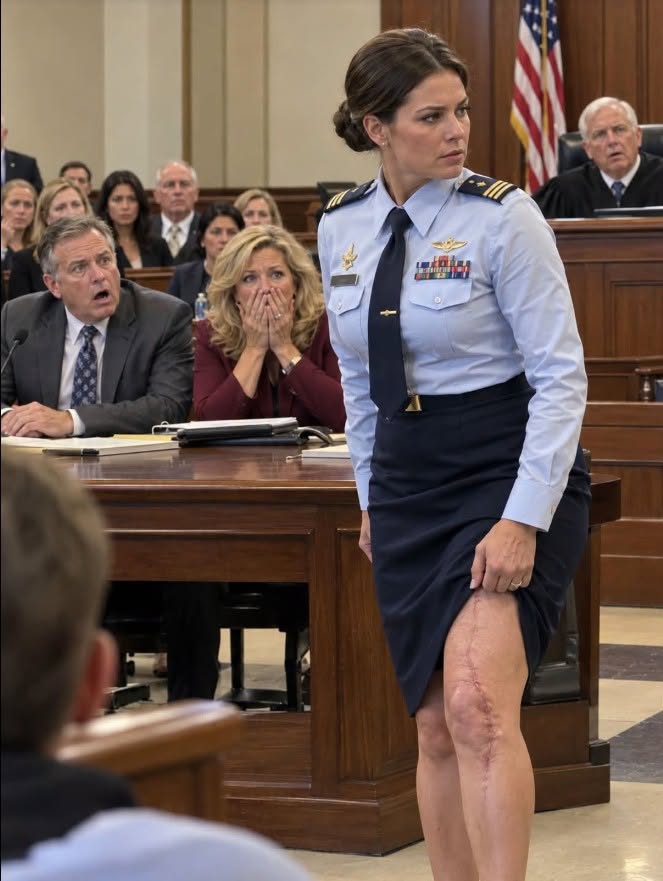
“Several.”
“Probably.”
“Specific ones work better,” Mom said, leaning on the car.
Dad gave her a tired look. Then he turned to me.
“I shouldn’t have filed that complaint without talking to you first. I shouldn’t have claimed I paid the taxes without checking what the bills actually were.” He took a breath. “And I should have called you myself twelve years ago. Not through Dad. I thought respecting your silence was the same as respecting you.”
“It wasn’t.”
“I know. I’m sorry.”
There was no judge there, no audience, no uniform. Just an aging man in a county parking lot, holding a folder.
I had waited twelve years for that apology. When it came, it didn’t erase anything. It just gave me a choice about what came next.
“I accept it,” I said.
His shoulders dropped maybe half an inch.
“I’m not ready to pretend everything’s fixed.”
“I don’t expect that.”
Mom spoke before I could look at her.
“My apology is longer.”
“I suspected.”
“I said something unforgivable.”
I knew the sentence. We raised a daughter, not a soldier.
“You said something that hurt.”
“I’ve replayed it for years,” she said. “I thought you’d answer angry. Days went by. I told myself you needed time. Then weeks went by, and I got ashamed. Every year it got harder to reach out, because every year meant explaining the year before.”
I understood that better than I wanted to. Silence gets heavier the longer it goes. First it’s one unanswered message. Then a month. Then a Christmas. Then birthdays. Then years.
“I should have written anyway,” she said. “I should have visited. I should have learned about the life you chose instead of mourning the one I made up for you.”
My eyes burned. I looked away. When I looked back, I said, “I don’t know what forgiveness looks like yet.”
She nodded. “Neither do I.”
That was the right answer.
So I hugged her.
Her body went stiff with surprise. Then her arms came around me. She still smelled the same. Lavender hand cream. For one dizzy second I was seventeen.
Then I stepped back. Mom wiped under one eye.
Dad looked very interested in the drainage assessment.
“Don’t,” I told him.
“I didn’t say anything.”
“You were about to.”
“You absolutely were,” Mom said.
The hearing lasted twenty-two minutes. This time I wore a navy-blue civilian suit.
Dad noticed. “No uniform?”
“You know who I am now.”
His face softened. “Yes.”
Judge Simmons looked over the corrected land records, my tax payments, and Dad’s repair and drainage receipts.
“I understand the plaintiffs wish to dismiss?”
Dad stood. “Yes, Your Honor. With prejudice.”
That meant for good.
“Any objection, Commander Carter?”
“No, Your Honor.”
He signed it.
I’d expected to feel relief. What I felt was quieter than that. I don’t trust the word closure anymore. Some things don’t close. They become part of the structure.
Judge Simmons stood up to leave. Then he looked at us.
“I take it you found the rest of the records.”
“We did,” Dad said. “We’re still figuring out what they mean.”
The judge almost smiled. “That’s usually the harder part. Take care of that house.”
“We intend to,” I said.
Six months later, the porch was finished.
Not restored. Finished. There’s a difference.
We replaced what couldn’t be saved and kept what could. Dad insisted on reusing the original beams. I insisted on wheelchair-accessible entrances. Mom insisted the kitchen needed more windows. We argued about all three and compromised on all three.
The farmhouse became Carter House.
Not the Samuel Carter Memorial Veterans Residence. Grandpa would have hated anything that sounded like a ceremony.
Just Carter House. A place for veterans and military families to stay during rehab, training programs, moves, and long medical treatments. Four bedrooms. A shared kitchen. A reading room. One big porch.
There were no plaques about my medals and no pictures of me in uniform. There was one framed photo of Grandpa holding a hammer, and under it, copied from his letter: Houses are for living.
Mr. Mercer came to see it.
“Samuel would complain about the frame.”
“It cost twelve dollars,” Dad said.
“Exactly.”
People came slowly.
The first was a Navy mechanic named Thomas, whose wife was getting long-term treatment at the medical center. He stayed nine days. The second was a Marine finishing a welding certification. Then a Coast Guard family waiting on permanent housing.
None of it was glamorous. Faucets leaked. Keys got lost. There was paperwork. One guest burned toast so badly the smoke alarm woke the entire house at five in the morning.
Grandpa would have loved every minute of it. It was messy and it was useful.
Dad and I used the grant part of the trust to start a small scholarship in Grandpa’s name. Plumbing, electrical, carpentry, welding.
“He’d complain that college is overpriced,” I said.
“And then he’d pay for somebody’s welding class,” Dad said.
Things between us changed slowly, and that mattered.
There was no magic reset. Dad and I still had conversations that went badly. Mom asked questions about my personal life that made me regret teaching her to text. Sometimes I disappeared for a few days instead of just saying I needed space.
Old habits don’t vanish because people apologize. They just become visible. And then, if you’re lucky, you can work on them.
One Sunday, Dad and I were fixing a loose gate hinge near the barn. He held the gate. I tightened the bolts.
“You’re doing that wrong,” he said.
I stopped.
He smiled. “Joking.”
“You value your life.”
“I’m learning.”
A minute later he said, “Does your knee always hurt?”
“Some days.”
“Today?”
“Yes.”
He nodded. That was all. No pity, no questions.
A few minutes later, he quietly moved the toolbox closer so I wouldn’t have to kneel again.
I noticed, and I didn’t mention it.
That’s how we learned each other. Not with speeches. With small adjustments.
Mom wanted stories.
For months I refused most of them. Then one night, washing dishes at Carter House, she asked about Lewis. She didn’t ask how he died or what happened over there. She asked who he’d been.
That mattered.
“He hated tomatoes,” I told her. “No reason. He said they were unfinished vegetables.”
She smiled. “That’s ridiculous.”
“He was ridiculous.” I dried a plate. “He could imitate every instructor we ever had. One rainy weekend in California, he convinced six exhausted sailors he knew how to make gumbo. He didn’t. It tasted like spicy wallpaper paste.”
Mom laughed so hard she had to hold onto the counter. Then she saw my face.
“You miss him.”
“Every day.”
She just nodded. She didn’t give advice or try to fix it. She stood there with me.
I realized she had changed too. Or maybe that softness had always been there, and fear had buried it.
People are rarely just one thing.
On the first anniversary of the lawsuit, I found Dad sitting alone on the porch with two envelopes.
“Please tell me Grandpa didn’t make another trust.”
He laughed. “No.”
He handed me the first one. It was addressed to me in his handwriting, from my parents’ old house. The date was twelve years ago.
It had never been mailed.
“I wrote it after Lewis called,” he said.
I opened it.
Evelyn,
I don’t know where you are. Your grandfather won’t tell me, and maybe he shouldn’t. Lewis says you’re going to recover. I don’t know what that means. I don’t know if I have the right to ask.
I was angry when you left. I still am sometimes. I thought fathers were supposed to teach their children to make wise choices. Nobody tells you what happens when your child grows up and decides wisdom looks different from what you taught her.
I don’t know how to do this. Your mother doesn’t either.
We miss you.
I stopped reading.
“Why didn’t you send it?”
“I thought it sounded weak.”
“It does.”
He nodded. “That’s why I didn’t.”
“No,” I said. “It sounds human.”
He looked out at the yard. “That was worse.”
My father had spent his whole life believing that love was something you showed with work. Fix the roof. Pay the bill. Change the tire. Show up early. Never admit you’re afraid.
“What’s the other envelope?” I asked.
He handed it to me.
It was in my handwriting, addressed to my parents, from the same year. It had never been mailed either.
“Where did you get this?”
“Your grandfather’s folder.”
Then I remembered. A hospital room. Pain medication. A pen at three in the morning. Three pages. Handing the envelope to Grandpa when he visited.
There was a yellow sticky note on it in Grandpa’s writing.
She told me to mail this tomorrow. Tomorrow she told me not to. Keeping it in case she changes her mind.
I laughed once. Then I covered my mouth.
I opened it. Most of it I read silently. There was anger in it, and fear, and loneliness. The last paragraph I read out loud.
“I want you to call me. I don’t want to call you first. I know that’s childish. I don’t care. Be my father and figure it out.”
Dad spoke quietly. “You wanted me to call.”
“Apparently.”
“And I did. Through Grandpa.”
“And he told you not to, because I told him to tell you that.”
Dad laughed softly. So did I. Not because it was funny, but because the alternative was too big to name.
Twelve years. Two letters. Two people waiting for the other one to go first. And Grandpa in the middle, trying to keep two promises that contradicted each other.
“We were idiots,” I said.
“Absolutely.”
“Do you blame Grandpa?”
He thought about it. “No. He was trying.”
“So were we.”
“Poorly.”
“Very.”
The old oak moved in the wind. The arborist had trimmed out the dead branches and said it might survive after all. Maybe it would, maybe not. Nothing lasts just because we want it to. That isn’t the point. The point is taking care of what’s still here.
“What should we do with these?” Dad asked, holding up the letters.
“Keep them.”
“Why?”
“As evidence.”
“Of what?”
“That silence lies.”
His smile turned into something warmer. “That’s good.”
“Don’t put it on a plaque.”
“I was thinking T-shirts.”
“Then I’m selling the farmhouse.”
“You can’t. We just renovated it.”
“I own it.”
“Technically.”
I stared at him. He laughed.
“Joking. Still learning.”
“Slowly.”
That Christmas, Carter House was full. Not with guests. With family.
Mom’s sister drove in from Richmond. Dad’s cousin brought two pies and forgot the pie server. Mr. Mercer came with a bottle of wine and announced that he planned to bill Grandpa’s trust for his mileage. Nobody believed him.
Knox stationed himself next to the kitchen table in case any ham fell. My second cousin’s toddler found his basket of toys and spent an hour handing them to him one at a time. Knox accepted each one like it was holy.
The house was noisy again. Not with memories. With actual noise. Voices, dishes, someone changing the thermostat without asking, Mom yelling at people for opening the oven, Dad pretending he wasn’t enjoying himself.
After dinner, I stepped out onto the porch. The screen door creaked behind me. Dad came out.
“Escaping?”
“Temporarily.”
Through the window, Mom was laughing with her sister.
“She likes having you here,” Dad said. “So do I.”
He said it awkwardly, which made it worth more.
“I like being here,” I said.
After a while he asked, “Do you regret leaving?”
“No. I wouldn’t change my career.”
“Good.”
“I regret some of the silence.”
“Me too.”
Then he asked, “Are you happy?”
I think it was the first time in my life he’d asked me that without suggesting an answer first.
I thought about it honestly. My knee hurt. Some nights were still hard. Lewis was still gone. Twelve years couldn’t be gotten back. There would always be a seam in my relationship with my parents where it had broken.
But a seam isn’t always a weakness. Sometimes it’s proof that something was repaired.
“Yes,” I said. “What about you?”
He looked out across the dark yard.
“I’m getting there.”
That felt true.
Later, after everyone else had gone, Mom gave me a small box.
Inside was the little brass key from Grandpa’s cashbox.
“You should have it,” she said. “You remembered where he hid things.”
“And your mother doesn’t want me reorganizing the workshop,” Dad added.
“Correct.”
I put it on my key ring.
This time Mom hugged me first. Dad hesitated. We still weren’t practiced at it.
So I hugged him.
His arms were stiff at first. Then they held on firmly.
“Good night, Commander,” he said.
“You can call me Evelyn.”
“Good night, Evelyn.”
They walked to their car. Halfway there, Mom turned around.
“Sunday dinner?”
Years ago, invitations from my parents sounded like orders. Now it sounded like a choice I was free to make.
“Six?”
“Five-thirty.”
“Six.”
She looked at Dad. He shrugged. “Six.”
“Don’t be late,” Mom said.
“No promises.”
Their taillights disappeared down Willow Creek Road.
Knox leaned against my leg. The farmhouse settled behind me. Old wood and new wiring. Fresh paint. Scratches still in the floors. The rebuilt porch, where Grandpa’s original beams met the new ones.
I finally understood why Grandpa wouldn’t let the house become a monument. Monuments preserve something that’s finished. Homes have to keep changing.
So do families.
Through the window I could see his photograph. The hammer in his hand. That half-smile, like he knew something the rest of us would take years to figure out.
“You could have made this easier,” I told him.
The house, naturally, didn’t answer.
Maybe that was fitting. Grandpa left us property, and money, and letters, and questions. He didn’t leave instructions for forgiveness. That part was ours.
Maybe that was his last gift. He didn’t force us to fix what had broken. He just left enough doors unlocked that when we were finally ready, we could find our way back inside.

