Part One: Thursday Night
The first thing my sister told me that Thursday night was that my beach house was empty.
She didn’t ask whether Brooks and I were using it. She didn’t ask whether somebody had booked it. She just sent me a photograph of her car trunk, packed to the ceiling with suitcases and a beach umbrella and a cooler, and a message underneath.
Lance and I are heading to Bethany! Three weeks!
I was standing at my kitchen sink in our rowhouse in Baltimore, eating cold lo mein straight out of the carton with a fork. It was nine o’clock at night in late July. I had a dish towel over my shoulder because I’d meant to scrub a frying pan before bed and hadn’t gotten to it.
My husband, Brooks, was sitting at the kitchen table behind me, grading safety quizzes from the summer woodworking class he teaches for teenagers at the community center. He had a red pen and a stack of papers and the expression of a man who’d been reading teenagers’ thoughts about table saws for an hour.
My phone buzzed again.
Mom said we could stay. You won’t even know we’re there.
I wiped my thumb on the dish towel. I typed back.
I’m not hosting anyone.
Three little dots appeared right away.
Dad knows where you keep the keys. We’re already on 50.
I read that twice. Route 50. The highway across the Chesapeake Bay Bridge to the Delaware shore. They were already halfway there.
Behind me, Brooks looked up from a quiz on which somebody had apparently described a table saw as a tool for cutting corners.
“Who died?” he asked. He knows my face.
“Nobody,” I said. “Reagan’s driving to Bethany.”
He set down his red pen.
“Did she ask?”
“She asked Mom,” I said.
Part Two: The Bungalow
Five years earlier, Brooks and I had bought a foreclosed bungalow in Bethany Beach, Delaware, three blocks from the ocean.
It was a disaster. That’s the only reason we could afford it. The kitchen smelled like wet cardboard. The sliding glass door to the back deck was stuck in its track and wouldn’t budge. There was a raccoon living under the deck, and judging by the noise at night, she had a family. The bathroom floor was so soft from an old leak that you could feel it give under your feet.
Most buyers took one look and left. We stayed.
Brooks built the kitchen cabinets himself, on weekends, in our little garage in Baltimore. Maple, with dovetailed drawers. It took him a whole winter. I learned how to hang drywall from YouTube videos. I spent an entire spring driving down to Bethany every Friday after work with a cooler and a toolbox, and driving home on Sunday evenings covered in dust, with joint compound in my hair.
My father helped too. Dad’s a retired union carpenter. Louis Pratt, but everybody calls him Lou. He replaced the rotten porch steps. He fixed the sliding door so it glides like silk. And he built a cedar bench underneath the outdoor shower, out back, so you could sit and rinse the sand off your feet.
There’s a picture of him on our refrigerator in Baltimore. He’s standing on the back deck at Bethany holding a level, squinting at the camera, with sawdust caught in his bushy gray eyebrows. He’s grinning.
Part Three: The Rental
We rented the bungalow to vacationers during the busy season, from Memorial Day through Labor Day. A local property manager, Lorie Esham, handled everything. The cleaning, the bookings, the repairs, the guests who locked themselves out at midnight.
The rental income paid the mortgage. The insurance. The property taxes. The rental license with the town. Most of the repairs.
It wasn’t a second home we could afford to leave empty whenever a relative felt like taking a trip. Every week it sat empty in summer was a week we had to cover out of our own pockets. I’m a hospital billing coordinator. Brooks teaches high school shop. We don’t have pockets that deep.
But that August was our tenth wedding anniversary.
So, for the first time in five years, we’d blocked out three weeks on the rental calendar. The first three weeks of August. For us. The first real stretch of time we’d ever have at the bungalow without paint cans, invoices, or a list of things to fix.
We’d been planning it since January. Brooks wanted to fish off the jetty in Indian River Inlet every morning. I wanted to read a stack of novels on the beach and not look at a single spreadsheet.
Mom and Dad knew. I’d told them at dinner in May, at their house in Towson. Dad was thrilled. He offered to drive down beforehand and look at the outdoor shower, which had started dripping.
And Reagan knew.
She’d asked me about it in June, at Mom’s birthday dinner. She’d been scrolling through the rental listing on her phone.
“Why aren’t you renting the first three weeks of August?” she asked. “Summer rates are insane. You’re leaving, like, nine thousand dollars on the table.”
“Because we want to use our own house,” I said. “For once. For our anniversary.”
Reagan looked at me over her iced tea for a moment.
“Must be nice,” she said.
Then she went back to stirring her iced tea.
Part Four: Reagan
My sister is four years younger than I am. She’s thirty-three. She’s pretty and funny and quick, with our mother’s dark curly hair and our father’s big laugh.
We weren’t enemies growing up. But we learned different rules.
If I forgot a permission slip for a school field trip, I stayed home. That was the rule. If Reagan forgot one, Mom called the school and explained that there had been a misunderstanding, and Reagan went.
If I got a C, I lost my phone for a month. If Reagan got a C, Mom went in to talk to the teacher about whether the grading had been fair.
When I was twelve, I saved two hundred and twelve dollars in an old Maxwell House coffee tin for science camp. A week at a nature camp on Assateague Island, studying the wild ponies and the salt marshes. I’d wanted to go since I was nine.
I earned that money babysitting and walking the neighbors’ dogs and selling lemonade. I kept it in the coffee tin on my bookshelf, and every Saturday morning, I’d take it down and count it on my bedroom rug. Ones and fives and a couple of tens.
A week before the camp payment was due, I took the tin down to count it.
It was empty.
Mom had used it. For Reagan’s dance recital costume and recital photographs. Two hundred and four dollars.
“Families share, Cara,” Mom said, when I asked her, crying, in the kitchen. “Your sister needed it. You’ll go to camp next year.”
I didn’t go to camp next year. Or ever.
Part Five: The Tin
I didn’t think about that coffee tin for more than twenty years.
Then, three summers ago, Dad found it. In a box of old things from the house in Towson, when he and Mom were cleaning out the basement. The same dented Maxwell House can, with my twelve-year-old handwriting on a strip of masking tape on the lid.
CARA — CAMP — DO NOT TOUCH.
He brought it with him to Bethany the weekend he finished the cedar bench under the outdoor shower. He’d made a little bracket out of brass. He screwed it to the underside of the bench, out of the rain, and slid the coffee tin into it. Then he dropped a spare brass house key inside and put the lid back on.
He tapped the lid with one finger.
“Put something in this that stays,” he said.
I loved having it there. That old dented tin under the bench, out of the rain, with my handwriting on the lid. Every time I sat on that bench to rinse my feet, I thought about my father, and about a twelve-year-old girl counting dollar bills on her bedroom rug.
I never once thought I’d have to worry about what Dad might put inside it. Or whom he might tell.
Part Six: The Lock
Brooks suggested I call Mom before Reagan got too far down the road.
I asked him to get me my reading glasses instead.
The part of Reagan’s text about Dad knowing where the keys were had made me uneasy. Something in my stomach had gone cold. I wanted to see, exactly, what our lock records showed.
I called Lorie.
Lorie Esham has managed the bungalow since our very first rental. She’s fifty-eight, born and raised in Ocean View, with twenty-two years in coastal rentals. She knows every plumber, electrician, and HVAC guy between Lewes and Fenwick Island. She can tell from the sound of my voice whether I’m calling about a leak or about a person.
She answered on the second ring. “Cara. It’s nine-fifteen. Is it a leak or a person?”
“A person,” I said.
“Oh, boy,” Lorie said.
“I need all the door codes turned off tonight,” I said. “Every one. No exceptions unless you and I confirm them together.”
“Done,” Lorie said. I could hear her typing. “Give me a second. I’m pulling up the lock.”
The bungalow has an electronic keypad lock on the front door. Lorie had installed it the first year. It keeps a record of every code that’s used, with the date and the time.
She read me the list while we were on the phone. A code for the cleaning crew. A code for the maintenance guy. A code for Brooks. A code for me. A code for Dad. And a long list of old renter codes, each one set to expire at checkout.
She went through them one by one.
“Lou’s too?” Lorie asked, when she got to Dad’s name.
I looked across the kitchen at the photograph on our refrigerator. Dad on the back deck with a level, sawdust in his eyebrows, grinning.
My father had earned my trust on all those long renovation weekends. That made my answer harder.
It didn’t change it.
“Lou’s too,” I said.
Part Seven: The Business Card
“And the spare key,” I said. “The brass one. In the coffee tin under the shower bench. Can you get it before she gets there?”
“I’ll go over right now,” Lorie said. “I’ll leave my business card in the tin. So she knows who to call.”
For a second, we both laughed. My sister reaching under a shower bench in the dark, at the end of a three-hour drive, pulling out a property manager’s business card.
Then Lorie went quiet.
“Cara,” she said. “There’s something in the access history I don’t understand.”
I sat down at the kitchen table across from Brooks.
“What?” I said.
“Lou’s code,” Lorie said slowly. “It was used on twelve Fridays. This past winter. January, February, March. Every Friday afternoon, around four. And then again Sunday mornings, around eleven.”
I didn’t say anything.
“You didn’t rent the place at all this winter,” Lorie said. “The calendar’s blocked. December through April. For maintenance. Nobody was authorized to be there.”
Part Eight: February 13th
Brooks was watching my face.
“Maybe he went down to check on something,” Brooks said, when I repeated it to him. “The pipes. The heat.”
“Not twelve times,” I said. “Not every Friday.”
Dad has bad knees. Two years ago, he had one replaced. Last winter, he complained about driving as far as the Giant grocery store in Towson. He would never, ever drive three hours to the beach and back every single weekend in January.
“Lorie,” I said. “Read me one. Any one. A specific date.”
She scrolled. “February 13th,” she said. “Code entered at 4:06 p.m. Then exited Sunday the 15th at 11:22 a.m.”
I sat very still.
February 13th was a Friday. I knew exactly where I’d been that afternoon.
At Greater Baltimore Medical Center. With Dad. After his hernia surgery.
I’d sat beside his hospital bed from noon until eight o’clock that night, opening little packets of saltine crackers he didn’t want and digging the TV remote out from under his blanket every fifteen minutes. Mom went home at three because she said hospitals gave her a headache.
Dad wasn’t anywhere near Bethany Beach at 4:06 p.m. on February 13th.
He was lying in a hospital bed in Towson, Maryland, asking me to find the Orioles spring training game on the radio.
Somebody else had been using his code.
Part Nine: Waiting
Lorie said she’d secure the house that night and dig through the older records in the morning. Every entry. Every date.
I asked her one more thing.
“Will you meet Reagan there?” I said. “When she gets there? I don’t want her standing on the porch at two in the morning punching numbers into a keypad that won’t work, getting angrier and angrier, with nobody to tell her why.”
“I’ll be there,” Lorie said. “And Cara.” She paused. “I’m going to call the sheriff’s non-emergency line too. Just so there’s a deputy there. In case it gets heated. Families at two in the morning get heated.”
“Okay,” I said.
By midnight, Mom had sent me three text messages.
Reagan’s going to be exhausted after that drive.
Lance took the whole three weeks off work. Do you know how hard that was for him?
I don’t understand why you’re being like this, Cara. It’s just sitting there.
Not one of them asked whether Brooks and I had agreed to let them stay.
Brooks closed his stack of quizzes. He got up and put the kettle on. He made us each a mug of chamomile tea, the kind with honey, and set them on the table.
“You don’t have to solve February tonight,” he said, sitting back down. “But they’re not getting in.”
We sat at the kitchen table with the phone between us, waiting for Lorie to call.
I kept looking across the kitchen at Dad’s photograph on the refrigerator. Sawdust in his eyebrows. The level in his hand.
And I kept wondering. Had he just handed Reagan his code without thinking, the way you’d hand somebody a stick of gum? Because Mom asked him to? Because Reagan said she needed somewhere quiet?
Or was there something he hadn’t wanted to tell me?
Part Ten: 2:10 A.M.
At 2:10 a.m., my phone rang. Lorie.
I put her on speaker.
“I’m on the porch,” Lorie said quietly. “They just pulled in. Stay on the line. Don’t talk.”
Through the speaker, I heard car doors slamming. Tires on crushed oyster shells, the way our driveway sounds. The trunk opening.
Then my sister’s voice. Tired and irritated.
“Why isn’t the keypad working?”
The beep of numbers being punched in. A buzz. The beep of numbers again. Another buzz.
“Lance,” Reagan said. “Dad’s code isn’t working.”
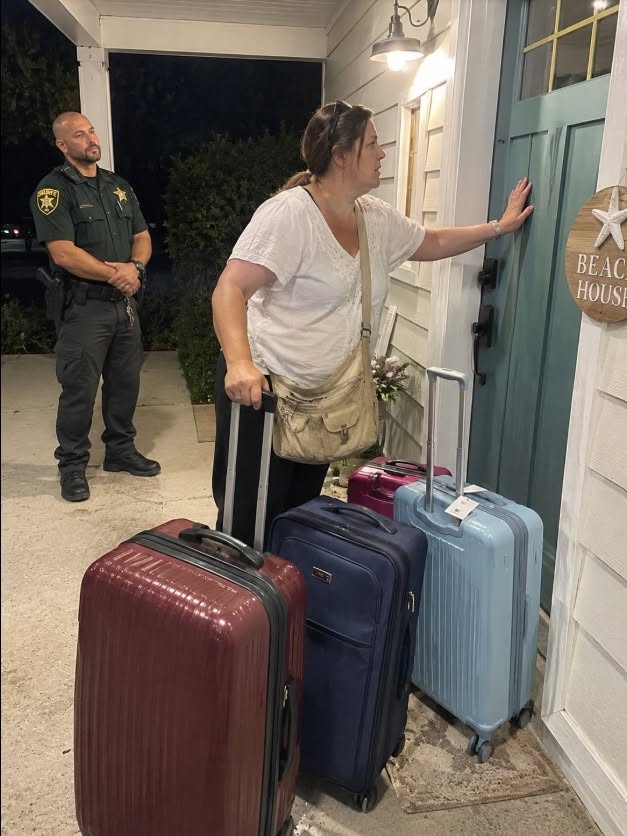
I could hear Lance unloading the trunk. Wheels rolling on the crushed shells. Lorie told me later there were six suitcases. Lance had lined them up neatly beside the porch steps, all in a row, as if they’d arrived for a reservation at a hotel.
“Mom said we could stay,” Reagan said.
Then I heard footsteps on the porch. Lorie stepping out of the shadow by the front door.
“Hi there,” Lorie said, very calmly. “I’m Lorie. I’m the property manager. Cara asked me to tell you three things.”
Reagan let out the impatient sigh I remembered from our childhood. The one she used to make when Mom told her she had to share the bathroom.
“Are you the cleaning lady?” Reagan said. “Can you just open the door?”
“No, ma’am,” Lorie said. “First thing. This house is not available tonight. Or for the next three weeks.”
“My mother said…”
“Second thing,” Lorie said, as if Reagan hadn’t spoken. “Cara has paid for one room at the Sandpiper Inn on Route 1. It’s for tonight only. I’ve texted the address to your husband.”
There was a pause.
Then Lance’s voice. He sounded confused. Genuinely confused.
“Reagan,” he said slowly. “You told me Cara offered us the place. For August. You said she insisted.”
I turned and looked at Brooks across the kitchen table.
He was staring at the phone like it had just answered a question we hadn’t known to ask.
Part Eleven: The Third Thing
Through the speaker, I heard a car pass on the street. Lorie waited until it was gone.
“Third thing,” Lorie said. “Cara said to tell you the lock remembers February.”
There was a long silence.
So long that I thought the call had dropped. I picked up the phone and checked. Still connected.
Then I heard a soft rolling sound, getting faster. One of the suitcases had started rolling down the sloped driveway on its own. I heard a man’s shoe catch it against the gravel.
Lorie told me later that the man was Deputy Ty Wyatt of the Sussex County Sheriff’s Office. He’d arrived ten minutes before Reagan, after Lorie’s call, and had been standing quietly in the dark by his cruiser at the end of the driveway.
Then I heard footsteps on the deck. Walking around the side of the house. Toward the back.
Toward the outdoor shower.
A pause.
Then the scrape of metal against cedar. A dented coffee tin being pulled out of a brass bracket under a bench.
The tin’s lid popping off.
The brass key was gone. Inside, there was only Lorie’s business card. Lorie Esham, Coastal Comfort Rentals, with her cell phone number written underneath in blue ink.
“What is this supposed to mean?” Reagan asked.
Her voice was very quiet.
I stayed sitting at my kitchen table in Baltimore while Lorie explained that she and the deputy would wait there until Reagan and Lance drove away.
For the first time all night, my sister wasn’t asking anybody to give her what she wanted.
She was standing in the dark behind my house, holding my old coffee tin, looking at a locked door. Trying to figure out how much I knew.
Part Twelve: Morning
See more on the next page

