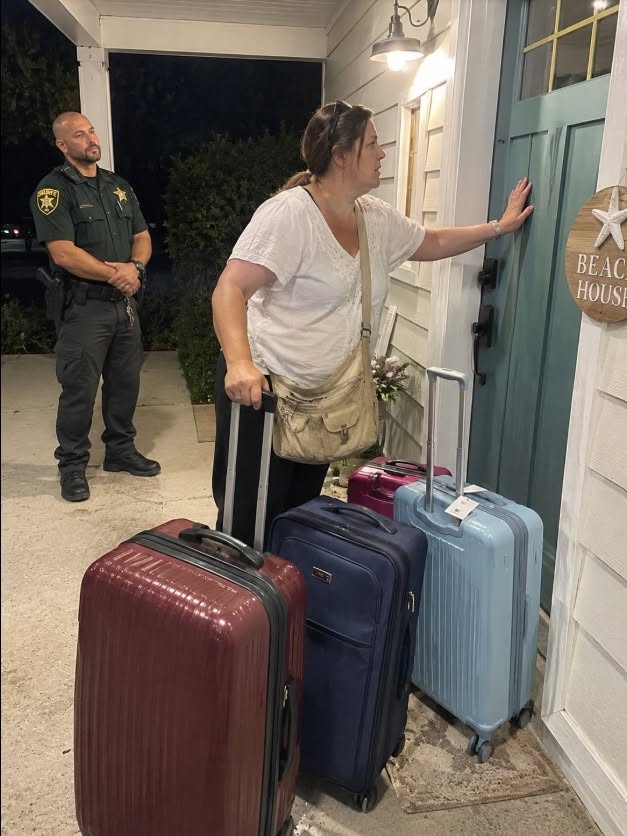
“Why would she do that?” I asked. “Why would she drive down at two in the morning with six suitcases when she knew I’d said no? When she knew the lock had a record?”
Lance didn’t answer for a long time.
“Because she didn’t think the lock had a record,” he said finally. “She didn’t know that. She thought it was just a keypad.” He paused. “And because your mom said she could. And your mom always gets her what she wants. Her whole life. She just figured this time would be the same.”
Part Twenty-One: Reagan
Reagan came to my house in Baltimore on Sunday afternoon.
Alone. Lance had driven her up from Bethany and dropped her off at the curb. He was waiting in the car.
She stood on my front stoop in a wrinkled sundress, her dark curly hair in a messy knot, without any makeup. Holding something.
The coffee tin.
My old, dented Maxwell House coffee tin, with my twelve-year-old handwriting on masking tape on the lid. CARA — CAMP — DO NOT TOUCH.
She’d taken it from under the bench at Bethany. At two in the morning, while Lorie and the deputy watched.
“I brought this back,” Reagan said. Her voice was shaking. “I took it. Last night. I don’t know why. I just grabbed it.”
She held it out.
I took it.
Lorie’s business card was still inside.
“Can I come in?” Reagan asked.
I stepped aside.
Part Twenty-Two: The Kitchen Table
We sat at my kitchen table. The same one where I’d sat at two in the morning with Brooks, listening to Lorie on speakerphone. Brooks went upstairs. He said he had quizzes to finish. He didn’t have quizzes to finish.
Reagan sat across from me with her hands wrapped around a glass of iced tea she didn’t drink.
“I’m sorry, Cara,” she said.
I didn’t say anything.
“I rented your house,” Reagan said. “For sixteen weekends. To strangers. I took seven thousand two hundred dollars.” She looked down at the table. “I told Lance you offered it to us for August. I told Mom I needed somewhere to think. I lied to everybody.”
“Why?” I asked.
Reagan was quiet for a long time.
“I lost my job,” she said. “In October. And I couldn’t tell anybody. Not Lance. Not Mom. Not you.” She laughed, a terrible broken sound. “I’ve never failed at anything in my life, Cara. Not really. Every time something went wrong, Mom fixed it. Called the teacher. Called the coach. Called the landlord. I never had to fix anything myself.”
She wiped her eyes.
“And then I lost my job, and there was nobody to call,” she said. “Mom can’t call a company and tell them they made a misunderstanding. So I panicked. And I looked at your rental listing, and I thought about the house just sitting there. And I thought about how you’d built the whole thing yourself, you and Brooks and Dad. And how you always fix everything. And I thought…” She stopped. “I thought, she can afford to lose a little.”
“I couldn’t afford to lose it, Reagan,” I said quietly. “If one of your renters had slipped on the deck in January, we’d have been sued. Our insurance would have denied the claim because we told them the house was empty. We could have lost the bungalow. And our house in Baltimore.”
Reagan put her hand over her mouth.
“I didn’t think about that,” she said.
“No,” I said. “You didn’t.”
Part Twenty-Three: The Camp Money
Then I picked up the coffee tin from the table. I turned it over in my hands.
“Do you remember this?” I asked.
Reagan looked at it. She shook her head.
“I was twelve,” I said. “You were eight. I saved two hundred and twelve dollars in this for science camp. On Assateague Island. With the wild ponies. I’d wanted to go since I was nine.”
Reagan stared at the tin.
“A week before the money was due,” I said, “Mom took it. For your dance recital. Your costume and the pictures.” I set the tin down. “She said families share.”
Reagan’s face went white.
“I didn’t know that,” she whispered. “I swear I didn’t know that.”
“I know,” I said. “You were eight.”
“The blue costume,” Reagan said slowly. “With the sequins. For Swan Lake. I remember it. I remember Mom saying it was so expensive. I remember…” She stopped. “I remember you crying in your room that night. I didn’t know why.”
She looked at me across the kitchen table. Her eyes were full.
“It’s been like that our whole lives,” she said. “Hasn’t it? Mom taking from you and giving to me.”
“Yes,” I said.
“And I let her,” Reagan said. “I never once said no. I never once asked where it came from.”
Part Twenty-Four: What I Asked For
“So what do you want?” Reagan asked finally. “What do I have to do?”
I’d thought about this all night. And all morning, in my father’s garage, looking at his shoebox full of envelopes.
“You’re going to pay it back,” I said. “All of it. Seven thousand two hundred dollars. Not from Mom. Not from Dad. From you. From your new job. On a schedule. However long it takes.”
Reagan nodded.
“And you’re going to pay the lodging tax to the town of Bethany Beach,” I said. “For sixteen weekends of unlicensed rentals. Lorie’s going to help me file it. It’s about eight hundred dollars. You’ll pay that too.”
She nodded again.
“And you’re going to tell Mom,” I said. “Not me. You. Everything. The job. The lies. The money. That you used her to get Dad’s code.”
Reagan closed her eyes.
“And Reagan,” I said. “You’re going to stop letting her fix things for you. Starting now.”
She sat there for a long time with her hands around the glass of iced tea.
“Okay,” she said finally. “Okay.”
Then she said something I didn’t expect.
“Can I keep the business card?” she asked. “Lorie’s. From the tin.”
I stared at her. “Why?”
Reagan almost smiled.
“So I remember,” she said. “What it felt like. Standing in the dark at two in the morning. Reaching for something that was supposed to be there for me. And finding out it was never mine.”
Part Twenty-Five: Mom’s Kitchen
Reagan told Mom on Monday night. At the kitchen table in Towson. Dad was there. He called me afterward.
“She told her everything,” Dad said. “The job. The rentals. The seven thousand. That she lied to get the code.”
“How did Mom take it?” I asked.
Dad was quiet for a long time.
“She cried,” he said. “For a long time. Then she went upstairs to the bedroom. She came down with something in her hand.”
“What?” I asked.
“A photograph,” Dad said. “From 1971. Your mother and her sister, Aunt Joyce. At Ocean City. Your mother was about eight.”
Part Twenty-Six: Aunt Joyce
My mother grew up in Dundalk, Maryland, the younger of two daughters. Her older sister, Joyce, was beautiful and smart and a straight-A student, and their parents adored her.
My mother was the one who got the hand-me-downs. The one who stayed home when there wasn’t enough money for both girls to go on the church trip. The one who got told, Joyce needs it more. Families share, Patty.
Joyce died of breast cancer when she was forty-four. My mother hasn’t talked about her in twenty years.
“She said she promised herself,” Dad told me on the phone, “when she had two girls of her own, the younger one would never feel the way she felt. Never be the one who did without.” He paused. “So she gave Reagan everything. Every time. And she never once noticed she was turning you into Joyce.”
He was quiet for a moment.
“She said she was so busy making sure Reagan was never the one left behind,” Dad said, “that she left you behind instead. For thirty-three years.”
“She wants to talk to you,” Dad said. “When you’re ready. She said she doesn’t expect you to forgive her.”
“I’m not ready yet, Dad,” I said.
“I know,” he said. “I told her that.”
Part Twenty-Seven: Our Anniversary
Brooks and I went to Bethany Beach on August 2nd. For our tenth anniversary. Three weeks.
Lorie met us at the bungalow with new door codes and a bottle of champagne.
“Happy anniversary,” she said. “The lock’s clean. Just you two. Nobody else.”
It was everything we’d planned in January.
Brooks fished off the jetty at Indian River Inlet every morning at dawn and caught nothing for six days in a row. On the seventh day, he caught a bluefish so big he had to get a stranger to help him land it, and he called me from the jetty shouting so loud I had to hold the phone away from my ear.
I read eleven novels on the beach. I didn’t look at a single spreadsheet. I took naps in the afternoon in the hammock on the back deck with the ocean breeze coming through the dune grass.
In the evenings, we sat on the cedar bench under the outdoor shower, rinsing the sand off our feet, and watched the sky go pink and orange over the salt marsh behind the house.
The coffee tin was back in its brass bracket under the bench. I’d brought it down from Baltimore.
It was empty now. No spare key. No business card.
I didn’t know yet what to put in it.
Part Twenty-Eight: Dad’s Visit
On August 16th, our second-to-last weekend, Dad drove down.
He called first. That was new. He asked if it was okay.
“I want to fix the outdoor shower,” he said. “The drip. Like I promised in May. If you’ll let me.”
“Yes, Dad,” I said. “Come down.”
He arrived on Saturday morning in his old Ford pickup with his toolbox in the back. His bad knees took the porch steps slowly. The ones he built.
He fixed the drip in about twenty minutes. A worn-out washer. Then he sat down on the cedar bench beside me with a cup of coffee.
He looked down at the coffee tin in its bracket under the bench.
“Empty?” he asked.
“Empty,” I said.
Dad reached into the pocket of his work jacket. He took out an envelope. A plain white one.
He held it out to me.
“What’s this?” I asked.
“Open it,” Dad said.
I opened it.
Inside were bills. Ones and fives and a couple of tens. Old ones, soft and creased.
And a note, in his blocky carpenter’s handwriting.
$212. For science camp. 1999. With interest, it’s more, but I wanted it to be the same number. — Dad
I looked at the money for a long time. I counted it. Two hundred and twelve dollars. Ones and fives and a couple of tens. The same bills a twelve-year-old girl would have saved, walking dogs and babysitting and selling lemonade.
“I should have said something,” Dad said quietly. “That day. In the kitchen. When your mother told you families share. I was standing right there. I should have told her to put it back.”
He looked at the ocean.
“I’ve been a quiet man my whole life, Cara,” he said. “I always thought being quiet was the same as being kind. Keeping the peace.” He shook his head. “It’s not. Sometimes being quiet is just being a coward with good manners.”
Part Twenty-Nine: Assateague
I didn’t say anything. I just held the money in my lap.
“There’s one more thing,” Dad said.
He reached into his other pocket. He took out a folded piece of paper. A printout from a website.
Assateague Island Adult Naturalist Weekend. September 19–21. Wild pony observation, salt marsh ecology, birding. Ages 18 and up.
At the bottom, a confirmation number. Paid in full. Registrant: Cara Pratt Hollis.
“It’s not science camp,” Dad said. “You’re thirty-seven, not twelve. But they’ve got the ponies. And the marshes.” He almost smiled. “And there’s a spot for a second person. If you want company.”
He looked at me.
“I’d like to go with you,” he said. “If you’ll let me. I never got to see those ponies either.”
I sat on the cedar bench my father built, beside the outdoor shower he’d just fixed, with two hundred and twelve dollars in my lap and a confirmation printout for a nature camp twenty-five years late.
And I cried. The way I’d cried at twelve, in my bedroom, holding an empty coffee tin. Except this time, my father was sitting right beside me. And he put his arm around my shoulders and didn’t say anything at all.
Part Thirty: What Stays
Before Dad drove home that evening, I bent down and pulled the coffee tin out of its brass bracket under the bench.
I opened the lid.
I folded the two hundred and twelve dollars back into Dad’s envelope, with his note. I put it in the tin. I added the confirmation printout for Assateague.
Then I put the lid back on and slid the tin back into the bracket under the bench. Out of the rain.
Dad watched me do it.
“You’re not going to spend it?” he asked.
“No,” I said. “I’m going to keep it.”
I tapped the lid with one finger. The way he did, three summers ago.
“You told me to put something in here that stays,” I said.
Reagan paid back the first five hundred dollars in September. And five hundred every month after that. She sends it by check, in the mail, to our house in Baltimore, with a sticky note on each one. The first one said 1 of 16.
My mother called me in October. We talked for an hour. It wasn’t easy. It isn’t easy yet. But she asked, at the end, whether Brooks and I would be using the bungalow for Thanksgiving, and whether there might be room for her and Dad, if we wanted them. She asked. She’d never asked before.
I said I’d think about it. I’m still thinking.
And on September 19th, Dad and I drove down to Assateague Island together in his old Ford pickup. We stood at the edge of the salt marsh at dawn with a park ranger and a dozen other adults with binoculars, in the fog, waiting.
The wild ponies came out of the dune grass at six-forty. A whole herd, shaggy and brown and white, wading into the marsh with the sun coming up behind them.
My father, seventy-one years old with two bad knees, stood beside me in the wet grass and didn’t say a word.
He just held my hand. Like he should have when I was twelve.

