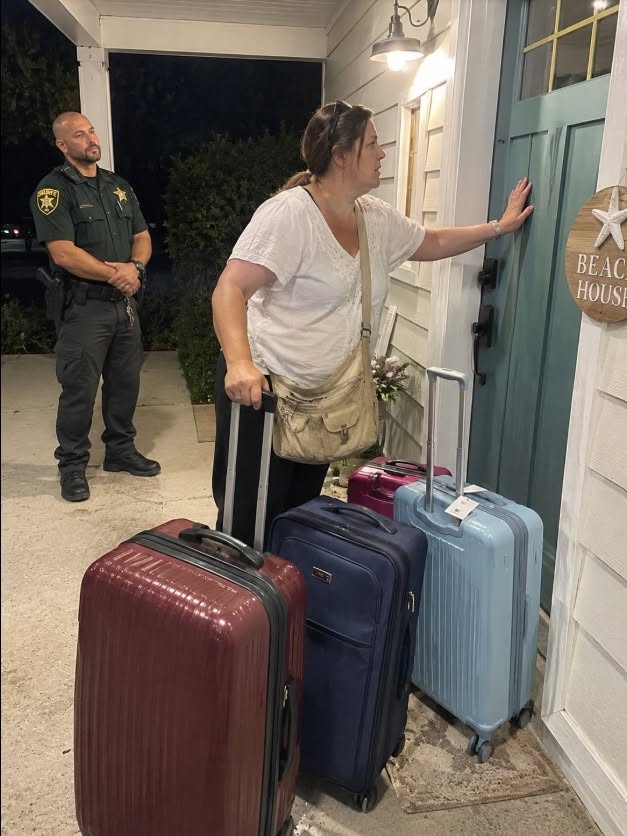
They went to the Sandpiper Inn. Lorie followed them in her car to make sure.
I didn’t sleep. I sat at the kitchen table until the sun came up over the rooftops of our street in Hampden, with my cold chamomile tea and my phone face down.
At seven-thirty, Lorie called again.
“I went back through everything,” she said. “The whole lock history. Every entry since we installed it.” She paused. “Cara, I think you’d better sit down.”
“I’m sitting,” I said.
“Lou’s code,” Lorie said, “was first used on December 5th. A Friday. Then every single Friday through March 27th. Sixteen weekends. Not twelve. I missed four the first time.” She paused again. “And every Sunday morning, the same code was used to leave. Around eleven.”
“Sixteen weekends,” I said.
“That’s not all,” Lorie said. “I called the cleaning crew this morning. Rosa and her daughter. They do the house every Saturday in summer. I asked if they’d noticed anything in April, when they did the spring deep clean.”
She was quiet for a moment.
“Rosa said they found sand in the beds,” Lorie said. “Hair in the shower drain. A wine glass broken in the trash. Somebody’s phone charger left in the outlet by the guest bed. She thought the maintenance guy had been sleeping there. She didn’t want to get him in trouble, so she didn’t say anything.”
“There’s more,” Lorie said. “I did something I probably shouldn’t have done. I searched Facebook Marketplace. And Craigslist. For Bethany Beach winter rental.”
I closed my eyes.
“I found an old listing,” Lorie said. “From last November. Deleted now, but somebody had shared it to a local group, and the share’s still up.” She took a breath. “Charming Bethany Beach bungalow, 3 blocks to the beach, available winter weekends. Fireplace, hot tub, sleeps 6. $225/night. Owner’s family. Message for details.”
“There’s no hot tub,” I said.
“No,” Lorie said. “There isn’t. But there’s a picture of your kitchen. Brooks’s maple cabinets. And your sliding door. And your outdoor shower. With the cedar bench.”
She paused.
“The listing was posted by a Reagan Pratt-Dunn,” she said.
Part Thirteen: The Math
Sixteen weekends. Two nights each. Two hundred and twenty-five dollars a night.
Seven thousand, two hundred dollars.
In my house. In my beds. Under my sheets. With my insurance company not knowing, my mortgage lender not knowing, the town of Bethany Beach not knowing. No rental license for winter weekends. No lodging tax paid. If one of those strangers had slipped on the icy deck in January and broken a hip, they could have sued Brooks and me for everything we owned. And our insurance company could have denied the claim, because we’d told them the house was empty from December through April.
I sat at the kitchen table with my hand over my mouth.
Brooks came into the kitchen in his bathrobe. He looked at my face.
“What?” he said.
I told him.
He sat down slowly across from me. He didn’t say anything for a long time.
“She rented our house,” he said finally. “To strangers. For four months. Using your dad’s code.”
“For seven thousand dollars,” I said.
“Does your dad know?” Brooks asked.
I looked across the kitchen at the photograph on the refrigerator.
“I don’t know,” I said. “I need to find out.”
Part Fourteen: Dad
I drove to my parents’ house in Towson at nine o’clock that morning. Alone. Brooks offered to come. I asked him not to.
Mom’s car wasn’t in the driveway. She’d gone to her Saturday morning water aerobics class at the YMCA. She never misses it.
Dad was in the garage. His workshop. Where he’s spent every Saturday morning since I was born. He was sanding a little wooden birdhouse at his workbench, with the radio tuned to the Orioles pregame show.
He looked up when I walked in. He saw my face.
He turned off the radio.
“Cara,” he said quietly. “I’ve been waiting for you.”
I stood in the doorway of the garage.
“Reagan called me at three in the morning,” Dad said. “From the motel. Crying. She said the lock wouldn’t open. She said the woman told her the lock remembers February.”
He set down the sandpaper.
“She asked me what you knew,” he said. “I told her I didn’t know.”
He looked at me.
“I’d like to know too,” he said. “What do you know?”
So I told him.
Sixteen weekends. His code. The Facebook listing. Sleeps 6. $225/night. Owner’s family. The sand in the beds and the broken wine glass. February 13th at 4:06 p.m., when I’d been sitting beside his hospital bed opening crackers.
I watched my father’s face while I told him.
He didn’t look surprised. He looked like a man who’d been waiting for a heavy box to fall off a high shelf for a long time.
Part Fifteen: What Dad Did
He sat down on the old stool beside his workbench. He put his big, scarred carpenter’s hands on his knees.
“In November,” he said, “your mother came to me. She said Reagan was having a hard time. With Lance. With money. She said Reagan needed somewhere to go on weekends sometimes, to clear her head. Somewhere quiet.” He shook his head. “Your mother asked me for my code to the bungalow. She said you’d never know. She said the place was just sitting there all winter.”
“And you gave it to her,” I said.
“I said no,” Dad said. “The first time. I said, That’s Cara’s house. Ask Cara.”
He looked at the floor.
“Your mother didn’t speak to me for four days,” he said. “Then she started crying at dinner. She said I’d always loved you more than Reagan. She said I’d built you a bench and a shower and the porch steps, and I’d never built Reagan anything.” He rubbed his face. “She said, You’d let your own daughter suffer over a door code.”
“So I gave it to her,” Dad said quietly. “I wrote it on a piece of paper and gave it to your mother. In the kitchen. And I told myself Reagan would go down once or twice, by herself, to sit by the ocean and think. And you’d never know. And it wouldn’t hurt anybody.”
He looked up at me. His eyes were wet.
“I didn’t know she was renting it, Cara,” he said. “I swear to God. I didn’t know about strangers. I didn’t know about Facebook. I didn’t know about seven thousand dollars.”
“But you knew she was using it,” I said.
“Yes,” Dad said. “I knew she was using it.”
Part Sixteen: The Bench
“Why didn’t you tell me?” I asked.
He didn’t answer for a long time.
“Because I was ashamed,” he said finally. “I built that bench for you. With the bracket for the coffee tin. I told you, Put something in this that stays.”
He stood up from the stool. He walked over to the shelf above his workbench. He took something down. An old shoebox.
He opened it.
Inside was a stack of envelopes. Plain white. With dates written on them in his blocky carpenter’s handwriting.
“I’ve been putting money aside,” Dad said. “Every week. Since December. Forty dollars. Fifty. Whatever I had.” He held out the box. “I was going to give it to you. I was going to tell you everything. Pay you for the winter. Like rent. I kept telling myself, next week. Next week I’ll tell her.”
I looked at the envelopes.
“How much?” I asked.
“Fourteen hundred and twenty dollars,” Dad said. “I counted it last night. After Reagan called.”
He looked at me.
“It’s not seven thousand,” he said. “I didn’t know it was seven thousand. I thought she was going down by herself. To sit by the water.”
Part Seventeen: The Coffee Tin
I didn’t take the shoebox.
I stood in my father’s garage and looked at him. Seventy-one years old. A union carpenter for forty years. A man who’d never once in his life cheated anybody on a job. Who’d built porch steps and cedar benches for his daughter and asked for nothing.
And who’d let my mother take what was mine and give it to my sister. Again.
“Dad,” I said. “Do you remember the coffee tin? When I was twelve? The camp money?”
He closed his eyes.
“Mom took it,” I said. “For Reagan’s dance costume. And she said families share. And you didn’t say anything.”
“I know,” Dad said quietly.
“And you found the tin,” I said. “Twenty years later. And you brought it to Bethany and put it under the bench. And you said put something in this that stays.”
I took a breath.
“Nothing stayed, Dad,” I said. “Mom took the code. Same as she took the camp money. And you let her. Same as before.”
My father put his face in his hands. Standing in his garage, beside his workbench, with the unfinished birdhouse and the sandpaper.
“I know,” he said through his hands. “I know, Cara. I’ve known my whole life.”
Part Eighteen: Mom
Mom came home from water aerobics at eleven. Her hair was wet. She had her gym bag over her shoulder.
She saw my car in the driveway. She saw me standing in the garage with Dad.
Her face went tight.
“Cara,” she said. “I suppose you’re here to yell at me. For your sister sleeping in a motel.”
“I’m here to show you something,” I said.
I held out my phone. I’d taken a screenshot of the Facebook listing Lorie found.
Charming Bethany Beach bungalow, 3 blocks to the beach, available winter weekends. Fireplace, hot tub, sleeps 6. $225/night. Owner’s family. Message for details.
With a picture of Brooks’s maple cabinets. And Dad’s cedar bench.
Posted by Reagan Pratt-Dunn.
Mom looked at it.
I watched her read it. I watched her get to $225/night. I watched her get to Owner’s family.
She looked up at me.
“I don’t understand,” she said.
“Reagan rented my house,” I said. “To strangers. Sixteen weekends. December through March. Using Dad’s code. The one you gave her.” I took my phone back. “Seven thousand two hundred dollars, Mom. In cash. And Venmo. To strangers who slept in my beds. With no insurance. With no license. If anybody had gotten hurt, Brooks and I could have lost everything.”
My mother sat down on the step between the garage and the kitchen. Heavily. Her wet gym bag slid off her shoulder onto the concrete.
“She said she needed somewhere to think,” Mom said slowly. “She said she and Lance were fighting. She said she just needed to be by the ocean. Alone.”
“She lied to you,” I said.
Mom didn’t say anything for a long time.
“And to Lance,” I said. “Lance thinks I invited them for August. She told him I insisted.”
Part Nineteen: Lance
Lance called me that afternoon.
I almost didn’t answer. Then I did.
“Cara,” he said. His voice was strange. Flat. “Reagan told me. About the winter. About the rentals.”
I didn’t say anything.
“I didn’t know,” Lance said. “I need you to know that. I didn’t know any of it.”
He told me everything. Sitting in the car in the parking lot of the Sandpiper Inn, while Reagan was inside.
Reagan had lost her job in October. She’d been a marketing coordinator for a medical device company in Columbia, and they’d laid off her whole department. She never told Lance. Every morning, she got dressed and left the house at eight and came home at five. She sat in coffee shops and the public library in Ellicott City, applying for jobs.
They had a mortgage on their townhouse in Columbia. Two car payments. Credit cards. She’d been terrified of telling him.
“She said she couldn’t stand it,” Lance said. “Being the one who failed. She said her whole life, she’d always been the one who got what she wanted. Her mom made sure of it. And then she lost her job, and nobody could fix it for her.”
“So she rented your house,” Lance said. “She said she saw the listing for your summer rentals and did the math. She said it was just sitting there. She said you had so much. The house in Baltimore. The bungalow. Brooks. Everything. She said she was just borrowing it.” He paused. “She used the money to make our mortgage payments. December through March. She told me the paychecks were direct deposit. I never checked.”
His voice cracked.
“She got a new job in April,” he said. “At a hospital in Baltimore. Doing marketing. She stopped renting the house. She thought nobody would ever know.”
Part Twenty: August
“And August?” I asked. “Why this?”
Lance was quiet for a long moment.
“I’ve been begging her to go on vacation for a year,” he said. “We haven’t been anywhere since our honeymoon. Four years ago. I took three weeks off work. I booked a place in Rehoboth in June. Then the week before, she canceled it. She said Cara had offered us the bungalow. For free. She said you insisted.” He swallowed. “I asked why you’d give up your anniversary. She said you and Brooks were going to Europe instead.”
“We’re not going to Europe,” I said.
“I know that now,” Lance said.
See more on the next page

