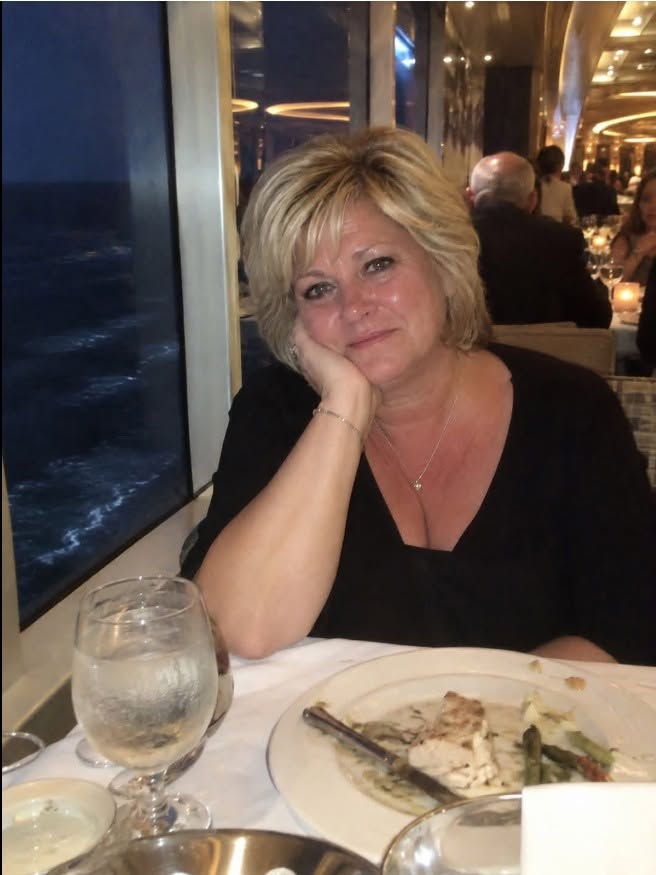
I put my hand flat against the cool linen of the tablecloth, and held on.
I had found out on the fifteenth of June, 1996, in the bathroom of the basement office at St. Luke’s, with a pregnancy test I’d bought at a drugstore on my lunch hour. Two pink lines. I sat on the closed lid of a toilet for forty minutes in a state I’d later describe as a kind of happy terror.
I meant to tell him that Sunday. Pancakes. I’d practiced it in the mirror. Daniel, I have something to say.
The fire was Saturday night.
I was eight weeks along. I didn’t tell his mother. I didn’t tell anyone. For three weeks I carried it like a stone in my pocket, in the numb gray daze after the funeral. And on the nineteenth of July, in the emergency room at St. Luke’s, where I’d worked for four years, I lost it.
I was alone. A nurse I knew, Lorraine, held my hand. A doctor said, “I’m very sorry.” He said it was common. He said grief can do that, though I knew it wasn’t true, and he knew it too.
I went home, and I put the stack of baby books I’d bought in the bottom of the closet, under the box. And I never told a soul.
Not Ruth. Not my mother. Not Paul, when I married him six years later. Not once in twenty-two years of marriage.
I looked at the stranger across the table.
“How,” I whispered, “do you know that?”
“Because he wrote it down.”
“Daniel knew,” said the nephew, gently. “Not about the pregnancy. About the plan.”
“What plan?”
“He’d bought a ring.”
I made a small sound.
“It was in the box. Wrapped in a handkerchief. A thin gold band with a small diamond. His mother found it, along with a letter.” He reached into his jacket again, and I flinched, but this time he drew out a folded piece of paper, creased soft from handling. “He wrote this the week before the fire. He never gave it to you. He was waiting for the right moment.”
He laid it on the table beside the key.
I didn’t touch it.
“He asked you to marry him,” the nephew said, “in writing. He couldn’t get the words out loud. He wrote, ‘Joanie, I’ve rehearsed this for a month, and I sound like a fool. So here it is on paper, where I can’t ruin it.’” His voice cracked, a very little. “Elena read it. And she did something she regretted for twenty-nine years.”
“What?”
“She took it.”
I stared.
“She took the ring and the letter. And she left the key, the ribbon, and the other things. She told herself you’d been through enough. That a proposal that came too late would only hurt you more.” He swallowed. “She was wrong. She knew it by 1998, and by then you’d moved, and you didn’t have a forwarding address, and she was too ashamed.”
“She had the ring for twenty-nine years.”
“In a drawer. Under her scarves.”
I put my hand to my mouth.
“She gave it to me before she died,” Daniel said. “With the letter. And with a second letter, in her own handwriting. For you. Asking your forgiveness.”
My eyes had begun to burn.
“And,” he said, very quietly, “she gave me a name.”
“Whose?”
“Paul’s.”
The wine arrived. The waiter, a young man with a nervous smile, set a glass beside each of us, and withdrew. Neither of us touched it.
“Paul,” I said.
“Elena had heard from a friend that you’d married an engineer. She’d looked him up. Years ago.” He paused. “In March, after she died, I found him. I drove to Duluth. I found his office at the state transportation department. I told him who I was.”
I saw it then, as clearly as if I’d been in the room. A quiet, careful man at a gray metal desk, in a short-sleeved dress shirt, looking up at the face of a ghost.
“I told him about the letter,” said Daniel. “And the ring. And I told him that I thought you deserved to see them.”
“And?”
“He asked me not to.”
I stared.
“He asked me, Joan, to burn them.”
“Why?”
“Because he was afraid.”
I have gone over what Daniel told me next a thousand times. It is the part that hurt, and the part that healed.
Paul had read the letter. He’d taken it from Daniel’s hand, in the hallway outside his office, and read it standing up. A short letter. A tender, clumsy, wonderful letter, from a dead man to a woman he’d loved. When he finished, he’d stood very still.
“He said,” Daniel told me, “that he’d always known.”
“Known what?”
“That you’d loved someone before. That there was a space. He said you’d never talked about it, and that he’d never asked. He said it was like living in a house with a locked room, and loving the house, and never trying the door.” Daniel’s voice wavered. “He said he’d made his peace with it. He’d told himself it was a good room, and that it was yours.”
I began to cry. I hadn’t known I would.
“He said that reading the letter was like opening the door. And finding it wasn’t a room. It was an entire life. One you’d given up. One he’d never been part of.” He paused. “He said he couldn’t stop imagining what you’d been in it.”
“That isn’t…”
“And he said,” Daniel went on, steadily, “that if you saw the letter, he was afraid you’d realize you’d spent twenty-two years with the wrong man.”
I put both hands over my face.
“He said you’d never been unhappy. That’s what he couldn’t stand. He said you were a kind, steady, loyal wife, and that you’d never once complained. And that he’d always, always known, in some small dark corner, that you were making a choice every day to be content.” Daniel’s voice thinned. “He said he’d rather leave you than watch you find out you’d been settling.”
I don’t know how long I sat there.
I know that at some point Daniel came around the table, and sat beside me, and put a handkerchief in my hand. He didn’t touch me. He just sat, a tall, silver-haired stranger with my dead lover’s eyes, in a dining room full of strangers, while a woman in a navy dress sobbed into a linen napkin.
When I could speak, I said, “That’s insane.”
“Yes.”
“He divorced me. He took a rented room across the bridge. For that.”
“Yes.”
“Because he was afraid I’d leave.”
“Yes,” said Daniel. “I told him. In the hallway. I said, ‘You’re an idiot.’ I was rude about it.”
A wet, shocked laugh broke out of me.
“He said he knew.”
“What did you say?”
“I said you deserved to decide for yourself. That a person doesn’t get to take away a woman’s choice by pretending she doesn’t have one.” He rubbed his jaw. “He asked me for a week to think. I gave him a month. He didn’t call.”
“And the box?”
“He drove to Duluth. To your house, while you were at work. He took it.” Daniel glanced at the key. “He mailed me the key. Two weeks ago. No note. I don’t think he knew what else to do with it.”
I looked at the small brass thing, the faded ribbon. A weightless little thing. I picked it up. It was warm from the candle.
“You tracked me down,” I said. “Out here. On a ship.”
“Yes.”
“Why?”
“Because he’s about to do something I think he’ll regret.”
“What?”
Daniel’s face grew grave.
“Sign,” he said. “The papers become final on the fifteenth of August. That’s twelve days. After that, I think he’ll never be able to take it back.”
I took the room key from my purse. I told Daniel I needed to be alone. He nodded, as though he’d expected it, and wrote a cabin number on a napkin. “I’m there,” he said. “If you want to talk. Or yell. I’d understand either.”
I climbed the stairs to the promenade deck, and walked out into the wind.
It was a cold night, black and star-flecked, with the water hissing along the hull. The deck was empty. A few chairs, a rope barrier, a lifeboat swung out on its davits, painted orange. I put my back against a bulkhead and slid down it until I was sitting on the wet planks, in my good navy dress, with my knees up and the key in my fist.
I was fifty-nine years old, and for the first time in twenty-eight years, I said Daniel’s name out loud.
“Daniel.”
The wind took it.
“I’m so sorry,” I said. “I was going to tell you.”
I told him. To the dark, and the stars. I told him about the pancakes and the test and the ER. I told him I’d lost the baby, and that I’d never said it to anyone, that I’d carried it all those years like a coal in a closed hand.
I said, “You’d have been a wonderful father.”
And I wept, out loud, for the first time in my life, for the child I’d never held and the man I’d never married and the long, quiet years I’d walked around the edges of a locked room.
I don’t know how long. Long enough for my hands to go numb. Long enough that, when I finally looked up, the horizon had gone gray.
I thought of Paul.
I thought of him in a rented apartment in Superior, in his short-sleeved shirt, alone at a table with a letter from a dead man. Deciding, in his careful, stubborn, engineer’s way, that the structurally sound thing was to remove the load.
I thought: You fool. You beautiful, careful fool.
I called him at six in the morning, from the ship’s satellite phone, for $9.95 a minute.
He picked up on the sixth ring. His voice was thick with sleep.
“Hello?”
“Paul.”
A silence. A long one. I heard him breathing.
“Joan. Where are you?”
“On a boat. In Alaska. You know that. Ruth told you.”
“I, yes.”
“I met someone.” I let that sit. “His name is Daniel Reyes.”
Nothing. Not even breath.
“Paul?”
“I told him not to,” he said. His voice cracked. “I told him I’d handle it.”
“You didn’t handle it. You left.”
“Joan…”
“You took a box out of my closet. You took my key.”
“I, I wasn’t going to, I thought…”
“You thought you’d decide what I could bear.”
“I thought you’d leave,” he said, and the sound he made was the sound of a bridge giving way. “I read that letter, Joan, and I thought, she’s going to read it, and she’s going to look at me across the kitchen table. And she’s going to see a man who isn’t him.”
“Paul.”
“I’m not him. I’m not a hero. I’m a guy who inspects bridges. I wear the same shirt every Tuesday. I don’t write letters. I don’t run into fires.” He was crying now, openly, the great rough sobs of a man who has not cried in forty years. “I couldn’t stand it, Joan. I couldn’t stand to watch you realize.”
I leaned my forehead against the cold wall of the phone booth.
“Do you know why I married you?” I said.
“I, no. I never…”
“Because you were the only person I’d ever met who checked the locks twice.”
Silence.
“I’d lost someone,” I said. “Suddenly. In a fire. And then I met a man who walked around his house every night and tested every door. Who read the fine print on everything. Who wrote the date on the milk.” I was weeping again. “Do you understand? I chose you because you weren’t him. Because you were slow, and careful, and you’d never go into a burning building. Because you were going to stay.”
A long, shuddering breath.
“I didn’t pick the wrong man, Paul. I picked the one who was going to be there.”
He was quiet for a very long time. I stood in a phone booth on the third deck of a cruise ship, with the dial tone of the satellite crackling, and the light coming up pink over the Gulf of Alaska, and waited.
“Joan,” he said at last. His voice was small. “I’m so sorry.”
“I know.”
“I’ve been such a, I’ve been such a fool.”
“Yes.”
“I signed the papers in March. They’re, they’re filed. I don’t know how to…”
“You don’t un-sign them over the phone, Paul. You do it in front of a judge.”
“Will you, I mean, would you, if I asked…”
“Ask me when I’m home.”
“When?”
“The twelfth. Duluth airport. Ten-fifteen.”
“I’ll be there.”
“You’d better,” I said, and my voice broke. “You’d better be early.”
He laughed, a wet, astonished sound, the laugh of a man who has been handed back something he’d thought lost.
“I’ll be there at nine,” Paul said.
I came off the ship in Seattle on a Saturday, and flew home through Minneapolis. I carried two things in my purse: the brass key, and a folded letter.
I’d read it on the plane. All of it. Daniel’s letter. The one his mother had hidden for twenty-nine years. I read it somewhere over the clouds in Montana, in seat 14C, with a flight attendant offering pretzels. I won’t give you all of it. Some of it belongs to the two of us.
But I’ll tell you the last paragraph.
Joanie, I don’t know how to do this, so I’ll just say it. I think we’re supposed to be old together. I’ve thought so since the Twins game. If you say yes, I’ll learn to cook something besides pancakes. If you say no, I’ll still be at your door on Sunday with the paper. Either way. —D.
I put it down in my lap, and I looked out at the clouds, and I said, quietly, “Yes.”
I’d waited twenty-nine years to say it. I wanted it to be on the record.
Paul was at the airport at nine.
I saw him through the glass of the arrivals gate, standing by the baggage carousel in his one good gray suit, with a bouquet of grocery-store carnations in his fist and the posture of a man awaiting sentencing. He’d lost weight. He’d had a haircut, badly. He saw me, and he went white, and he took a step toward me and stopped, as if the floor had given way.
I walked toward him with my carry-on. We stood three feet apart.
“Joan.”
“Paul.”
He held out the carnations. His hand was shaking so badly that the paper rattled.
“They’re from Cub Foods,” he said.
“I can see that.”
“I didn’t know what else…”
“Paul.” I took the flowers. “Shut up.”
See more on the next page

