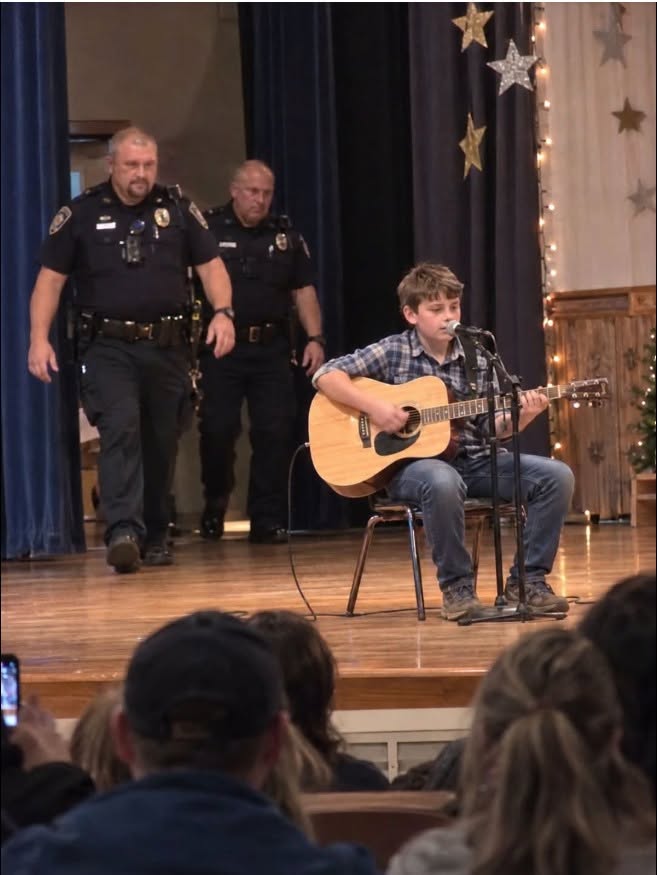
The double doors at the back of the gym hit the wall with a bang that made half the room jump.
My son was in the middle of the second verse. He was standing alone on that little stage with his father’s old guitar, his voice thin and shaking but holding, and every parent in the room was either crying or trying very hard not to.
Then the doors opened, and two police officers walked in.
Full uniform. Dark blue. Belts, radios, badges catching the light from the high gym windows.
I knew that walk. I’d know it anywhere. Slow, heavy, careful. It’s the walk of someone coming to tell you something you don’t want to hear.
My whole body went cold.
I’d spent eleven years of my marriage waiting for that walk. Every night David worked a late shift, I’d lie awake listening for a car in the driveway that wasn’t his. Two officers at the door. Hats in their hands. That was the picture I carried around in my head for over a decade.
And it never came. Not like that. David didn’t die on the job. He died in a hospital bed in our living room, of an illness that took him slowly, one piece at a time, over fourteen months.
But my body didn’t know that. My body only knew the walk.
I stood up so fast my folding chair tipped backward and clattered on the floor.
People turned to look at me. I didn’t care. My eyes went straight to the stage, to Caleb, because he was the only person left in the world they could be coming about.
He’d stopped playing.
His fingers were frozen on the strings. His mouth was still open on the last word he’d sung. He was staring at the back of the gym, and his face had gone white.
The music teacher, Mr. Lowe, half rose from the piano bench. Principal Whitfield stepped away from the wall with her hand already out, like she was going to stop them, or ask them to wait, or ask them what on earth they were doing interrupting a Father’s Day assembly in the middle of a grieving boy’s song.
The officer in front took off his hat.
And I knew him.
Gray at the temples now. Heavier than I remembered. A thick mustache he’d had since before I met him.
Ray Delgado.
My husband’s partner for nine years. The man who’d carried one corner of David’s casket. The man whose phone calls I hadn’t returned in almost three years.
He didn’t look at me. He looked at the stage. At Caleb.
And then he did something I didn’t understand at all.
He nodded at my son. Just once. Slow.
Like he was saying, go on.
Behind him, the doors opened again.
And this time, it wasn’t two officers.
To understand why I couldn’t move, why I just stood there with my chair on the floor behind me and my hand pressed to my mouth, you need to understand how we got there. How my son ended up alone on that stage. And how badly I’d let him down before he ever got there.
My name is Jennifer. My son, Caleb, is twelve.
Three years ago, his father died.
After the funeral, Caleb didn’t cry. Not at the service, not at the cemetery, not at the house afterward when it was full of casseroles and people who didn’t know what to say. He sat on the stairs in his little black suit, the one we’d had to buy two days before because he’d outgrown his church clothes, and he watched everyone.
When the last guest left, I found him still sitting there.
“Do you want to talk, sweetheart?”
He shook his head.
“Do you want to come sit with me?”
He shook his head.
“Caleb. It’s okay to be sad. It’s okay to cry.”
He looked at me with David’s eyes, brown and serious, and said, “I know.” Then he went up to his room and closed the door.
That was the beginning.
He was nine then. Nine year olds are supposed to fall apart. I kept waiting for it. I read the grief books. I bought the workbook for kids with the cartoon bear on the front. I made an appointment with a children’s grief counselor, and he went three times and sat on her couch and answered every question with “I don’t know” until she gently told me maybe we should take a break and try again later.
We never tried again later.
He stopped inviting friends over. His best friend, Tyler, used to be at our house so often I bought his favorite cereal. After the funeral, Tyler came by twice, and both times Caleb said he was tired. The third time, Tyler’s mom called to ask if everything was okay, and I said yes, he just needs time.
He stopped coming down for dinner some nights. I’d call up the stairs, and he’d call back, “Can I eat in my room?” At first I said no. Then I said fine, just tonight. Then I stopped asking.
His teachers called twice.
The first time was in fifth grade. Ms. Barnes, his homeroom teacher, very kind, very careful. “He’s not disruptive at all,” she said. “That’s sort of the problem. He just isn’t there. He sits in the back and he doesn’t raise his hand, and when the other kids are doing group work, he kind of drifts off to the side.”
The second time was this year. Seventh grade. A different teacher, but the same words. Withdrawn. Quiet. Not participating.
“Is anything going on at home?” she asked.
I wanted to laugh. I wanted to say, his father died, what do you think is going on at home? But I just said, “We’re working on it.”
We weren’t working on anything. I didn’t know how. I’d lost my husband, and somehow in the same year, I’d lost my son too, even though he was still right there, eating cereal across the counter from me every morning with his eyes on his phone.
And lately, it had gotten worse.
That spring, there were whole days when he barely said a word to me. Not a fight. No slammed doors. Just nothing. I’d say good morning, and he’d nod. I’d ask how school was, and he’d shrug.
“How are you doing, bud? Really?”
“Fine.”
It was always fine.
Then one afternoon in May, I found the flyer.
It was crumpled at the bottom of his backpack, under a half eaten granola bar and a library book three weeks overdue. I wasn’t snooping. I was looking for the permission slip for his science field trip. But there it was, a sheet of yellow paper, folded into a tight little square.
LINCOLN MIDDLE SCHOOL FATHER’S DAY ASSEMBLY. FRIDAY, JUNE 13. INVITE YOUR DAD, GRANDPA, UNCLE, OR SPECIAL GUY! STUDENT PERFORMANCES AND READINGS. REFRESHMENTS TO FOLLOW.
There was a clip art picture at the bottom of a cartoon father and son holding hands.
I sat down on the edge of the kitchen chair and stared at it for a long time.
Father’s Day had always been hard. The first one after David died, Caleb and I didn’t even mention it. We just got through the day the way you get through a bad storm, inside, with the curtains closed, waiting. The second year, I took him to the movies to distract him. He sat through the whole thing without eating any popcorn, and in the car afterward he said, “You don’t have to do that, Mom.” The third year was last year. He spent the whole day in his room.
But a school assembly was different. An assembly meant a whole gym full of dads. Every kid with someone in the audience. Caleb sitting there with me and an empty chair where his father should have been.
That evening, I put the flyer on the kitchen table, unfolded and smoothed flat, and waited for him to come down.
He saw it immediately. He stopped in the doorway.
“You went in my backpack.”
“I was looking for the field trip form.”
He came over, picked up the flyer, folded it back into its tight little square, and put it in his pocket.
“Caleb, we should talk about this.”
“There’s nothing to talk about.”
“It’s a Father’s Day assembly. That’s going to be hard. For both of us.” I tried to keep my voice gentle. “I was thinking maybe you could stay home that day. I’ll call the school. Nobody will think anything of it. We could do something together. Go to the lake, maybe.”
He was quiet. He was looking at the floor.
“I want to go,” he said.
“Honey…”
“I want to go.”
“You don’t have to prove anything to anybody. If it’s going to hurt…”
“Mom.” He looked up at me, and for once his face wasn’t blank. There was something underneath it. Something tight and determined. “I want to go. Okay? Just let me go.”
“Okay,” I said slowly. “Okay. Do you want me to come?”
He hesitated. Then he nodded.
“Yeah,” he said. “You have to come.”
He went back upstairs without eating. I sat alone at the kitchen table and wondered what I’d just agreed to.
The next few weeks were strange.
Caleb was quieter than ever around me, but something in the house had changed. At night, after I’d gone to bed, I started hearing something through the wall between our rooms.
Guitar.
Very soft. So soft I thought I was imagining it the first time. A few notes, then stopping. Then the same few notes again. Then stopping.
I lay in the dark with my heart pounding.
David had taught Caleb to play when he was seven. They’d sit on the back porch on summer evenings, David with his big old acoustic, Caleb with a cheap little half size one we got at a pawn shop, and David would show him the chords one at a time. G. C. D. Caleb’s fingers were too small and he’d get frustrated, and David would laugh and say, “Everybody’s fingers hurt at first, bud. That’s how you know you’re learning.”
When David got too sick to hold the guitar anymore, he gave it to Caleb. His own guitar. The big one, with a crack near the bottom that David had glued himself years ago, and his initials scratched inside the sound hole.
Caleb put it in the back of his closet the week after the funeral. I hadn’t heard him play it since.
Now, every night, those same few notes through the wall.
One night I got up and stood outside his door. The playing stopped instantly, like he could feel me there. I raised my hand to knock. Then I lowered it and went back to bed.
I told myself I was giving him space. That’s what the books said. Give them space. Let them come to you.
But if I’m honest, I was scared. I was scared that if I opened that door, I’d hear the song I thought I heard. And I wasn’t sure I could stand it.
There were other strange things too.
One Saturday, Caleb asked if he could walk to the library alone. He never went to the library. He came back three hours later, and when I asked what book he got, he said they didn’t have it.
Another evening, I came into the kitchen and he was on the house phone, the old landline we never used anymore. He hung up so fast he almost dropped it.
“Who was that?”
“Nobody. Wrong number.”
“You were talking to a wrong number?”
“They were asking for somebody. I told them they had the wrong number.”
He went upstairs. I looked at the phone for a long time. I almost checked the call history. Then I didn’t.
And about a week before the assembly, my cell phone rang while I was at work.
I looked at the screen.
RAY DELGADO.
I hadn’t deleted his number. I’d thought about it. I’d thought about it a lot. But every time, my thumb just hovered there and I couldn’t make myself do it.
I let it ring.
A minute later, the little voicemail icon popped up.
I didn’t listen to it. I never listened to his voicemails. There were eleven of them in my phone, spread out over three years. Birthdays. Holidays. The anniversary of David’s death. I’d never opened a single one.
I put the phone face down on my desk and went back to work.
If I had listened to that one, everything would have been different. Or maybe not. Maybe it would have been exactly the same, except that I would have known. And I would have taken that moment away from my son.
I’ll never know which.

