“Saturday morning, kitchen’s warm…”
Ray’s voice was so quiet at first that I’m not sure anyone in the front rows heard it.
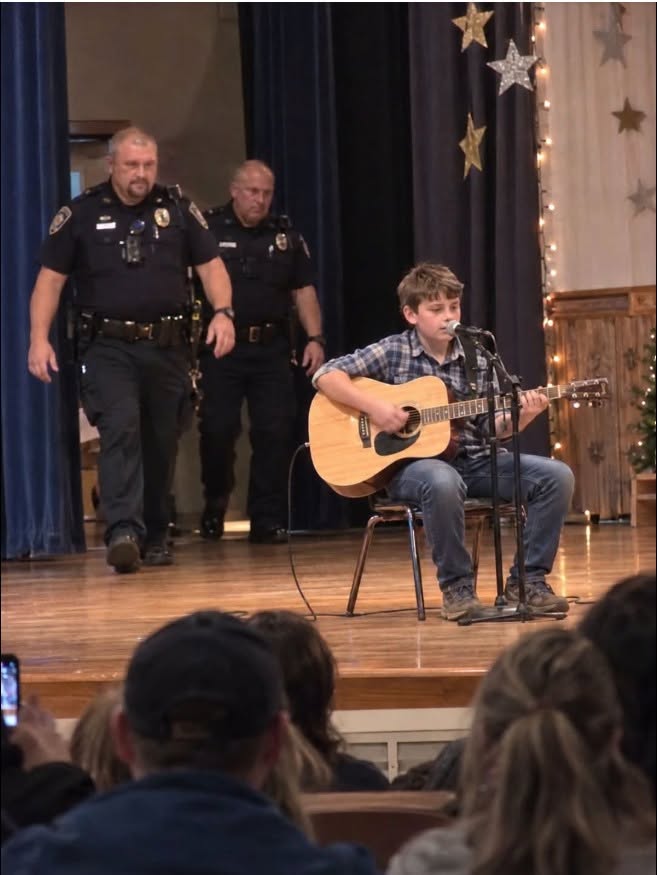
Then the officer beside him joined in. Then the next. Then it was moving along the wall like a current, low and uneven, forty three cops who couldn’t carry a tune between them, singing a silly made up song about pancakes in an elementary school accent of a gym.
“…pancakes burning, here’s the storm.
Little hands upon the pan…”
On the stage, Caleb made a sound I’d never heard from him. Half a laugh, half a sob. He wiped his face with his whole forearm, roughly, the way little boys do.
And then he put his fingers back on the strings, and he found the chord, and he played.
He came back in on the next line. His voice was a wreck now, wet and cracking. He didn’t care. He sang right through it, louder than before, and the voices along the walls got louder with him, as if they were holding him up.
I was still standing. I didn’t know I was still standing until the man beside me, the one with the sunburned neck, quietly set my fallen chair back up behind me. I didn’t sit in it. I couldn’t.
The second chorus came. And this time, the officers didn’t hold back.
Hold the light, hold the light,
I’ll be home before the night.
It filled the whole gym. Rough and out of tune and wonderful. Some of the dads in the audience didn’t know the words, but by the last line, they’d figured it out, and they were singing too. People who had never met my husband. People who had no idea who he was or why forty three police officers had just walked into their kids’ assembly.
If you can’t see me, look up high,
I’m the one who waves goodbye.
Caleb played the last chord. He let it ring.
He looked up at the ceiling one more time. I’ll never know what he saw up there. I’ve never asked him.
Then the gym exploded.
Everybody was on their feet. Every dad, every grandpa, every teacher. The clapping was so loud it hurt my ears. The man with the sunburned neck was clapping with tears running down his face into his collar, the tissue pack forgotten in his lap.
And along the walls, the officers weren’t clapping.
They stood up straight. Every one of them. And they saluted.
Caleb stood on the stage in his father’s shirt with his father’s guitar against his chest and looked at forty three police officers saluting him, and he didn’t know what to do. He looked at Mr. Lowe. Mr. Lowe was crying too hard to help.
So Caleb did the only thing he could think of. He lifted one shaking hand to his forehead and saluted back.
I don’t remember walking up to the stage. I remember being there, at the bottom of the steps, and Caleb coming down them too fast with the guitar banging against his knees. I remember him walking right into me, so hard I stumbled backward.
And I remember that he was crying.
Really crying. For the first time in three years. Big, ugly, gasping sobs, his face pressed into my shoulder, the guitar wedged sideways between us. His whole body shaking with it.
I held on. I didn’t say anything. I didn’t say it’s okay or shh or I’m here. I just held him while three years came pouring out of my son in the middle of a middle school gym.
I don’t know how long we stood there. Principal Whitfield, bless her, quietly called for a short break, and Mr. Lowe started playing something on the piano, and people began drifting toward the donut table. Giving us room.
When Caleb finally pulled back, his face was red and swollen and his nose was running onto David’s shirt. He wiped it with his sleeve.
“Sorry,” he said.
“Don’t you dare be sorry.”
He laughed, wetly. Then he looked over my shoulder, and his face changed.
I turned around.
Ray Delgado was standing a few feet away. Hat in his hands. He looked older up close. Tired. His eyes were red.
“Hey, Jen,” he said.
I opened my mouth. Nothing came out.
“Hey, kid,” Ray said to Caleb. His voice cracked on the second word. “You didn’t tell me you’d gotten that good.”
Caleb went to him. Just walked past me and wrapped his arms around Ray’s middle and held on. Ray put one big hand on the back of my son’s head and closed his eyes.
I stood there and watched, and something in my chest that had been clenched shut for three years started, very slowly, to come undone.
“How?” I finally managed. “Ray. How did you… how did you know?”
Ray looked at me over Caleb’s head.
“He called me,” he said simply.
I stared at him.
“Two weeks ago. On your house phone.” He paused. “I tried to tell you. I called you. I left a message.”
The voicemail. The one I’d let ring on my desk at work and turned face down and never opened. Eleven voicemails in three years, and this was the twelfth.
“I didn’t listen to it,” I whispered.
“Yeah,” Ray said gently. “I figured.”
Caleb let go of Ray and turned around. He was wiping his face again, but he was looking at me straight. No shrug. No fine.
“I asked him not to tell you,” he said. “I knew you’d say no.”
“Caleb…”
“You would have. You said no to everything.” His voice was shaking, but he kept going. “You said no to the barbecue. You said no to the baseball game. You told Uncle Ray to go away. I heard you.”
“Sweetheart…”
“I heard you, Mom.” His eyes filled again. “And I didn’t say anything. Because you were so sad. And I didn’t want to make it worse. But they were Dad’s family. They were our family. And you made them go away.”
The gym was still full of people, and I didn’t care about a single one of them. I was looking at my son, who had finally said the thing he’d been carrying since he was nine years old, sitting at the top of the stairs.
“How did you get his number?” I asked. It was a stupid question. It was the only one I could manage.
Caleb reached into the pocket of his father’s shirt.
He took out a folded piece of paper. Old, soft, the creases worn almost white.
“Dad told me,” he said. “He left me a letter.”
We didn’t go back for the rest of the assembly.
Principal Whitfield found us by the side doors and told us very kindly to take all the time we needed, and that she’d have Caleb’s teacher mark him present for the afternoon. She shook Ray’s hand. She looked at me for a moment like she wanted to say something, and then she just touched my arm and walked away.
Out in the parking lot, most of the officers were standing around their cars. Some of them were in a hurry, called back to shifts they’d traded or swapped to be there. Others were in no hurry at all. They came over one at a time. Officer Hendricks shook Caleb’s hand and told him he’d sung it better than his dad ever did, which made Caleb laugh. The retired man with the cane put his hand on Caleb’s shoulder and didn’t say anything, just nodded. The young woman I didn’t know introduced herself as Officer Reyes, and said she’d joined the department the year David got sick.
“I only worked with him eight months,” she said. “But he sang that song every single night shift. I used to want to strangle him.” She smiled. “I’d give anything to hear him do it again.”
Then they left, one car after another, until it was just me and Caleb and Ray, standing by my car in the June sun.
Caleb handed me the letter.
“You can read it,” he said. “If you want.”
I unfolded it with fingers that wouldn’t stop shaking.
It was David’s handwriting. But not his handwriting from before. It was the shaky, slanting handwriting from the last months, when holding a pen had gotten hard. I knew exactly when he must have written it. Some night when I was asleep, and he couldn’t sleep, and he’d gotten Ray or the night nurse to bring him paper.
Hey, bud.
If you’re reading this, you finally changed the strings on the old guitar. Took you long enough. I hid this in the lining of the case because I figured that’s the one place your mom would never look, and the one place you’d eventually go.
I want to tell you some things I didn’t get to say.
First, I’m sorry I won’t be there. For the games and the concerts and the dumb school stuff. I wanted to be there for all of it. Every single one.
Second, your mom is going to have a hard time. She’s going to try to be strong for you. She’s going to try so hard that she might forget she doesn’t have to do it alone. If that happens, it’s not because she doesn’t love you. It’s because she loves you so much she’s scared. Be patient with her. She’s the bravest person I know, even when she doesn’t feel like it.
Third. And this is the important one.
If there’s ever a day when you need a dad in the room, call Ray. His number is at the bottom. He’ll bring the guys. I already made them promise. All of them. They said yes before I even finished asking.
You’re not alone, bud. You never were. Not for one day.
Hold the light.
Dad
At the bottom of the page was Ray’s phone number, written twice, as if David had worried one wouldn’t be enough.
I read it three times.
Then I sat down on the curb of the parking lot, right there in my good slacks, and I cried harder than I had at the funeral.
Caleb sat down beside me. After a minute, I felt his shoulder lean into mine.
“When did you find it?” I asked, when I could talk again.
“In April. One of the strings broke. I went to get the extra ones from the case, and the lining was coming loose, and it was in there.” He picked at a loose thread on his sleeve. “I read it like a hundred times. I didn’t know what to do. And then the flyer came home. And I thought…” He stopped. “I thought, this is the day. This is the day he meant.”
“So you called.”
“I went to the library and looked up the police station on the computer to make sure it was still the right number. Then I called from the house phone because I didn’t want it to show up on your cell bill.” He glanced at me sideways, a little guilty. “That was the wrong number thing.”
I laughed, despite everything. “I knew that wasn’t a wrong number.”
“You didn’t check, though.”
“No. I didn’t check.”
Ray had been standing quietly by the car the whole time. He came over now and sat down on the curb on Caleb’s other side, groaning a little as his knees bent.
“He called me on a Tuesday night,” Ray said. “I almost didn’t pick up. Didn’t recognize the number. And then I hear this little voice say, ‘Uncle Ray? It’s Caleb. My dad said to call you.’” He shook his head. “I had to pull over. I was driving. I had to pull the car over on Route 9.”
“I told him about the assembly,” Caleb said. “I asked if he could come. Just him. I didn’t think…”
“And I told him,” Ray said, “that his dad made forty three people promise. Not one.” He looked at me over Caleb’s head. “You know what David said to us, Jen? About a month before? He got us all in the living room. You were at the pharmacy. He could barely talk by then. And he said, ‘Don’t let them be alone. Even if she pushes. Especially if she pushes.’”
I closed my eyes.
“And we let you push,” Ray said quietly. “That’s on us. I should have kept coming. I should have kept leaving the casseroles on the porch even if you didn’t open the door. I should have kept calling. When you told me to go, I went, because I thought that’s what you needed. But I don’t think it was.”
“No,” I said. “It wasn’t.”
I opened my eyes and looked at him. Really looked at him, for the first time in three years. Not at the uniform. At him. At Ray, who’d sat by my husband’s bed every night after his shifts. Who’d carried the casket. Who’d left a baseball glove on my porch step and driven away.
“I’m sorry,” I said. “Ray. I’m so sorry. Every time I saw you, I saw the worst year of my life. And I made Caleb pay for it.”
“You didn’t make me pay for anything,” Caleb said.
“Yes, I did, sweetheart. I did.”
He didn’t argue. He just leaned his head on my shoulder.
Ray reached into the inside pocket of his jacket. “Speaking of that,” he said. “I’ve got something that belongs to you, bud.”
He pulled out a baseball glove. Small, a kid’s size, the leather barely broken in. A little dusty.
Caleb stared at it.
“You left it on the porch,” Ray said. “The next morning, I came back to get it, and it was gone. I figured you threw it out. Then about a week later, it showed up in my mailbox at home. No note. Just the glove.” He held it out. “I always figured that was a kid’s way of saying, hang onto this for me. So I did.”
Caleb took it. He turned it over in his hands. Then he put it on. It was too small now. His fingers didn’t fit all the way in.
“I outgrew it,” he said, and his voice cracked.
“Yeah,” Ray said. “Guess we’d better get you a new one.”
That night, after Caleb was asleep, I sat on the edge of my bed with my phone in my hand.
Twelve voicemails from Ray Delgado.
I listened to every one.
The first was from the Christmas after the funeral. Ray’s voice was gruff and awkward. “Hey, Jen. Merry Christmas. Just wanted to say we’re thinking about you. The guys did the song at the party. Didn’t sound right without him. Anyway. Call if you need anything.”
The second was Caleb’s tenth birthday. “Tell the kid happy birthday from his Uncle Ray. Tell him I’ve still got the glove.”
The fourth was the first anniversary. That one was just Ray breathing for a few seconds, and then saying, “I miss him, Jen. I don’t know who else to say that to.” And then he hung up.
I sat on my bed and listened to three years of a man trying to reach us through a door I’d locked from the inside.
The last one was from two weeks ago.
“Jen. It’s Ray. Listen, Caleb called me. He’s okay, nothing’s wrong. But he asked me to come to his school thing on the thirteenth. He asked me not to tell you, but I’m not going to do that to you. I think you should know. And I think… I think you should let him do this. I think David would want him to. Call me back. Please.”
I set the phone down on the bed.
Then I went down the hall to Caleb’s room. The door was open a crack. He was asleep on top of his covers, still in his father’s shirt, with the too small baseball glove on his hand.
I stood in the doorway for a long time.
I’d spent three years believing that if I kept the world out, I could keep us safe. That if nobody came in, nothing else could be taken from us. I thought I was protecting him from the pain.
But all I’d really done was take his whole family away, at the exact moment he needed them most. And he’d sat at the top of the stairs and watched me do it, and never said a word, because he was nine and he was trying to protect me.
We’d both been holding the door shut. From opposite sides.
The next morning was a Saturday.
I woke up early. I didn’t really decide to do it. I just went downstairs, got out the big bowl, and started mixing pancake batter. I hadn’t made pancakes on a Saturday since David died. I’d been avoiding it like the song.
I burned the first one. Badly. Smoke and everything.
I stood there looking at it in the pan, and I started laughing. I don’t know why. I laughed until I had to put the spatula down.
“Mom?”
Caleb was in the doorway in his pajamas, hair sticking up on one side, squinting at the smoke.
“I burned it,” I said, still laughing. “Your dad would be so proud.”
He looked at the pan. Then he looked at me. Then, slowly, he went over to the corner of the kitchen and dragged a chair over to the stove, the way he used to when he was little.
He was way too tall to need it now. He stood on it anyway.
“You have to flip it when the bubbles pop,” he said. “Not before. Dad always said.”
“I know,” I said. “I’m the one who taught him.”
“No you didn’t.”
“No,” I admitted. “I didn’t.”
He took the spatula from me. He waited for the bubbles to pop. He flipped it. It came out perfect.
Then, without looking at me, he started to hum.
I stood beside him in our little yellow kitchen and hummed with him. Neither of us sang the words. We didn’t need to.
Things didn’t fix themselves overnight. I wish I could tell you they did. Grief doesn’t work like that, and neither do twelve year old boys.
But things started to change.
The next week, Ray came over for Sunday dinner. He brought his wife, Lucia, and his two daughters, who were teenagers now and spent the whole meal on their phones, and it was so normal and so loud that at one point I had to go stand in the pantry for a minute just to breathe.
After dinner, Ray took Caleb out to the backyard with a brand new glove, Caleb’s size, and they threw the ball back and forth until it was too dark to see it. I watched from the kitchen window. Caleb was laughing. Missing every other throw. Laughing anyway.
Two weeks later, there was a department barbecue. They’d been inviting us every summer for three years. This time, I said yes.
I almost backed out at the last minute. I sat in the car in the parking lot of the park, looking at all the cops in shorts and T-shirts flipping burgers and chasing their kids, and my hands were shaking on the steering wheel.
Caleb looked at me from the passenger seat.
“You okay?”
“I’m fine,” I said.
He raised his eyebrows. It was David’s exact expression. The one he used to make when he knew I was lying.
“No,” I said. “I’m not fine. I’m scared.”
“Okay,” Caleb said. “Me too.” He unbuckled his seatbelt. “Let’s go anyway.”
So we did.
Officer Reyes found me within five minutes and handed me a lemonade and introduced me to her wife. Sergeant Pruitt told me a story about David getting a raccoon stuck in his patrol car that I’d never heard, and I laughed so hard I snorted lemonade. At the end of the night, when the sun was going down, somebody brought out a guitar.
Everybody turned to look at Caleb.
He shook his head. “No. No way.”
“Come on, kid,” Ray called. “You owe us. We sang backup.”
Caleb looked at me. I didn’t say anything. I just nodded.
He took the guitar.

