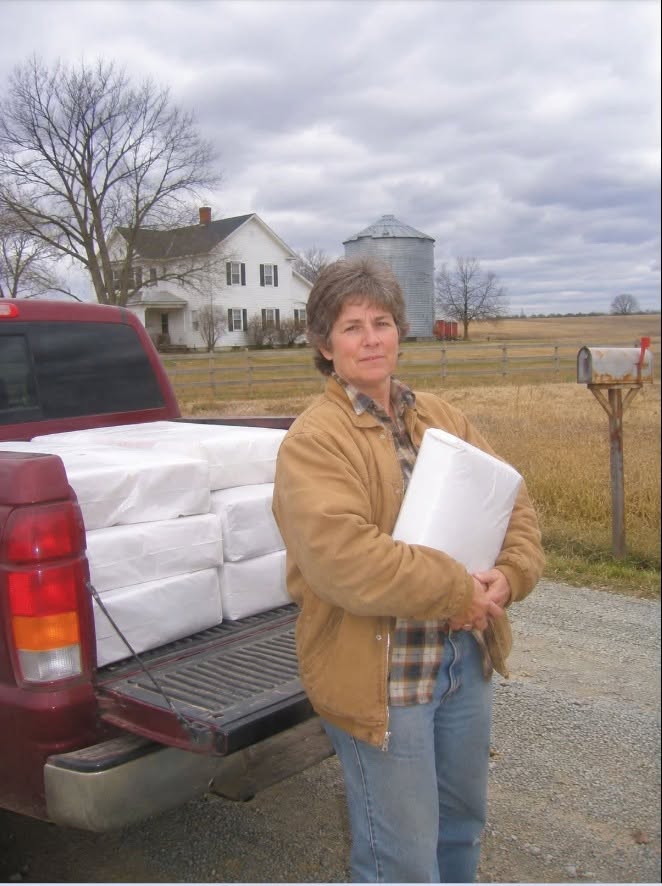
The dock behind Arnold’s locker is a concrete loading platform with a steel roller door. Arnold had the boxes stacked on a hand cart. Seven of them. White and clean.
We backed the pickup up to the dock. Kinley got out and sat on the open tailgate. She had a black Sharpie marker in her hand. She’d brought it from home in her pocket.
Arnold wheeled the boxes out one by one and set them in the truck bed.
As each one came, Kinley turned it over.
She wrote his name on the bottom of every box.
DOMINO.
In her careful sixth-grade handwriting. Big capital letters. Black marker on white wax.
Domino. Six times.
She didn’t write it on ours. Just the six.
I stood there on the dock and watched her do it. One box. Then the next. Then the next. Her tongue sticking out of the corner of her mouth the way it always does when she concentrates.
Arnold stood beside me with his arms crossed. He didn’t say anything.
When she finished the last one, she capped the marker and put it back in her pocket.
“So they know who he was,” she said.
Arnold made a sound. Like something got caught in his throat.
He turned around and went back into the locker. He didn’t come back out for a while. When he did, his eyes were red.
He didn’t charge me for the processing. I tried to pay. I had the checkbook out. He wouldn’t take it.
“Not for this one, Jill,” he said. “Not for Domino.”
Chapter Seven: The Route
Saturday I drove it with the boxes stacked in my pickup.
Hollow Creek Road. Six miles of gravel running north out of Plainview, past cornfields and bean stubble and pasture, to where it dead-ends at the creek. The road I drive five days a week with three hundred and eighty pieces of mail.
Not mail today. Beef.
Our own share rode in the bed behind them.
Our box was in the back, against the cab. The six boxes were stacked in front of it, closest to the tailgate, so I could reach them.
Kinley rode in the passenger seat with her hands folded in her lap.
A box on each porch.
A note in my route-book handwriting.
I’d written them the night before. On index cards. Six of them. The same words on each one.
From Kinley’s steer, Domino. Enjoy him.
I tucked each card under the lid of each box.
The Brennans were first. The young couple with the new baby. Nobody was home. I set the box on their porch next to the stroller and the pumpkins.
The Molinas were second. Rosa Molina came to the door holding a dish towel. I handed her the box. She read the card. She looked at me. Then past me at Kinley in the pickup.
“Domino?” she said. “The cow your girl raised?”
I nodded.
She put her hand on her chest. She didn’t say anything else. She just held the box against her hip and stood in her doorway and watched us drive away.
Old Mr. Thorson was third. He’s blind. I put the box in his hands so he could feel the weight of it. I read him the card out loud.
He held the box for a long time.
“Harold’s granddaughter,” he said. “Raised a steer.”
“Yes, sir.”
“Harold always said that girl had a way with animals.” He smiled. “Tell her I said thank you. Tell her I’ll think of him.”
Marge Hansen opened her door and just lifted her hand.
She’s eighty-four. She’s lived on Hollow Creek Road for sixty-one years. She was standing at her storm door in a housecoat when we pulled up. She’d seen us coming.
I carried the box up her porch steps. I set it down by the door.
She looked at the box. Then at the card. Then out at the pickup, where Kinley was sitting.
She didn’t say anything. She just lifted her hand. Toward the pickup. Toward Kinley. And held it there, up in the air, like a blessing.
Kinley lifted her hand back.
Pete Larson met us by his shed.
He’s seventy-eight. He farmed the quarter across the creek from Harold Nyquist for forty years. He was Harold’s best friend. He was a pallbearer at his funeral. He knows Dale and Vern better than anybody alive.
He was in his machine shed working on a grain auger when we pulled up. He came out wiping his hands on a rag.
He saw the box in my arms. He saw the name on the bottom. DOMINO, in black marker.
He stood there for a long time.
“That steer left his corner two weeks early,” he said.
I looked at him.
He knew. Of course he knew. Everybody on Hollow Creek Road knew. The shot carried. Arnold’s truck was seen. Somebody talked at the café.
“He did,” I said.
Pete took the box from me. He held it against his chest with both arms.
He held that box like it weighed a hundred pounds.
He didn’t ask whose fence.
He didn’t have to.
He just stood there in front of his machine shed, holding that box, looking past me. Up the road. Toward the end. Toward the last mailbox.
“You going up there?” he asked quietly.
“Yes.”
He looked at me for a long moment.
“Harold put that fence in in ‘72,” he said. “I helped him. I held the posts.” He shook his head. “He knew right where the line was. He put it there on purpose.”
“What do you mean?”
But Pete just shook his head again and turned and walked into his shed with Domino against his chest.
Chapter Eight: The Last Mailbox
Five porches.
Kinley stayed in the cab for the last one.
We pulled up at the end of Vern’s lane. The last mailbox on Hollow Creek Road before it dead-ends at the creek.
I put the pickup in park. I looked over at my daughter. She was looking straight ahead through the windshield. Not at Vern’s house. At nothing.
“You want to come?” I asked.
She shook her head.
I opened my door. I started to get out.
“Mom,” she said.
I stopped.
“Tell him his name,” she said as I got out. “Domino. Make sure he knows his name.”
Vern’s mailbox sits on a post at the end of his lane.
A big black rural box on a cedar post. NYQUIST in white reflective letters on the side. The flag’s been broken for two years. It hangs down crooked.
I’ve put mail in it for eleven years.
I know what comes. The Farm Journal. A seed catalog from Pioneer. Bills from MidAmerican Energy and the co-op. A statement from the Farm Credit office in Ames. A letter every month from the Social Security Administration, for Vern’s mother, Lorraine, who lived with him until she died last winter. He never stopped the letters. They kept coming. I kept delivering them.
And for the last eight months, letters from Farm Credit with FINAL NOTICE stamped on the front in red.
I stopped my dark red pickup beside it and dropped the tailgate.
Gray October sky. Low clouds coming in from the west. The wind out of the northwest, cold and wet, smelling like rain. Brown grass in the ditch. The corn on Vern’s side of the road still standing, dry and rattling. He hadn’t combined it yet. It was the end of October and he hadn’t combined.
I turned around and looked south, back down Hollow Creek Road.
Our farmhouse small and far back down the road. A little white house with a red barn, a mile and a half away, at the end of the gravel.
I took Vern’s box out of the bed of the pickup.
The last one. DOMINO written on the bottom in black marker. The card tucked under the lid. From Kinley’s steer, Domino. Enjoy him.
I stood there in my barn coat with his box against my hip.
I meant to walk it up to his porch like the others.
His lane is a quarter mile long. Gravel, with a strip of grass down the middle. The old Lindgren house at the end of it. White, two-story, with a sagging porch and a screen door that never quite shuts.
I took a step. Then another.
Then his front door opened.
Vern came down the lane slowly.
He was in his canvas coat. No rifle. No cap. His gray hair was messy, like he’d been running his hands through it. He walked down that quarter mile of gravel like a man walking to his own sentencing.
He’d been watching the whole road from his yard.
He must have been. He must have stood at his window and watched me stop at every mailbox on Hollow Creek Road. Watched me carry a white box up to every porch. Watched Marge Hansen lift her hand. Watched Pete Larson hold his box against his chest.
He knew what was in them. He knew whose name was on the bottom.
He stopped six feet from me and looked at the box.
He didn’t look at me. Just the box. Against my hip.
“What’s that,” he said.
Not a question. Just two words. Flat.
“Your share,” I said. “It was going on your porch.”
He reached out and took it from me.
He took it slowly. With both hands. Like it might be hot. Like it might bite.
He held it for a second. Then he turned it over.
He looked at the bottom.
DOMINO. In big capital letters. In black marker.
He looked at my daughter’s handwriting for a long time.
A long time. The wind blew. The corn rattled behind him. Somewhere down by the creek, a crow called.
He didn’t move. He just stood there at the end of his lane, holding a box of beef upside down, staring at one word.
Then he looked up at me.
His face had changed. The barn door was open. Everything that had been shut up behind it was standing there in his eyes. Gray and wet and broken.
“She wrote that,” he said.
“Yes.”
“Kinley.”
“Yes.”
He looked back down at it. His hands were shaking. The box trembled.
“His name,” he said. “I didn’t know his name.”
Chapter Nine: What Vern Said
See more on the next page

