A man’s voice.
Thomas.
The new owner had arrived.
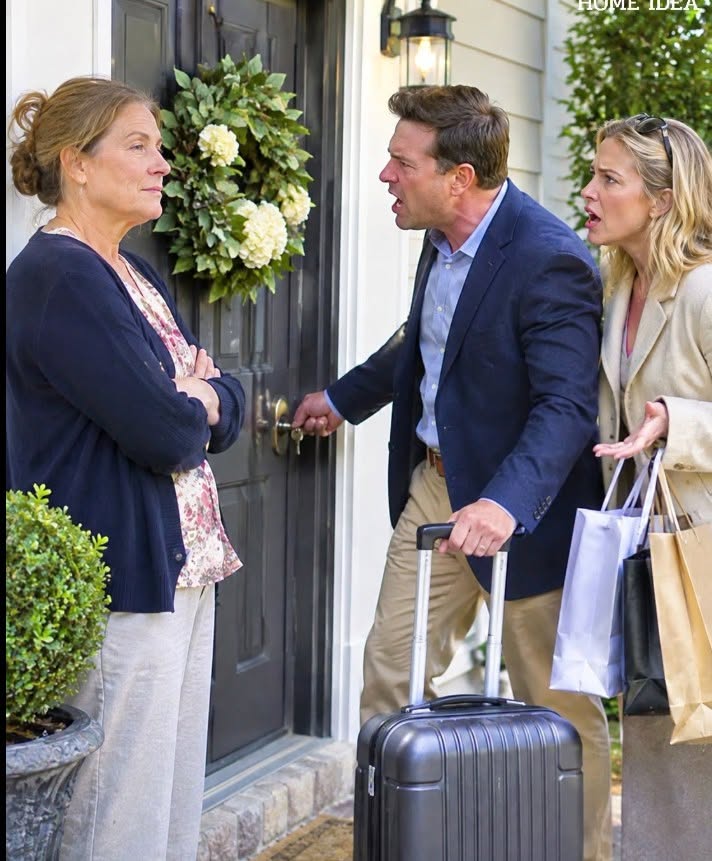
Daniel turned.
Even through the glass, I could see the confrontation beginning.
Thomas pointed toward the door.
Daniel raised both hands.
Melissa started talking quickly.
I heard pieces through my phone.
“My mother owns—”
“Owned,” I corrected quietly.
Daniel stopped.
Thomas repeated something.
Daniel looked toward the street.
For one terrifying second, I thought he had seen me.
He hadn’t.
“Mom,” Daniel said, “there’s some guy here claiming this is his house.”
“It is.”
“What?”
“His house.”
Thomas apparently asked Daniel to leave.
Daniel muttered, “We’re leaving.”
Then he whispered into the phone.
“This is unbelievable.”
“No,” I said. “It’s documented.”
I ended the call.
Daniel and Melissa walked outside minutes later.
The transformation from airport arrival to departure was almost painful to watch.
When they arrived, they looked like people returning to something they believed belonged to them.
When they left, they looked like trespassers.
Because legally, that was exactly what they were.
I drove away before they did.
For two days, Daniel called constantly.
I ignored most of the calls.
Then Martin contacted him directly.
That changed the tone.
Suddenly Daniel’s messages became careful.
Mom, I think emotions are high.
Mom, I don’t want lawyers between us.
Mom, we love you.
Mom, please don’t make permanent decisions because of one misunderstanding.
Permanent decisions.
The irony would have been funny if it didn’t hurt so much.
He and Melissa had been preparing permanent decisions for me.
I eventually agreed to meet Daniel alone.
No Melissa.
No house.
No discussion about money.
We met at a small café.
He arrived ten minutes early.
I saw him through the window before entering.
He looked older.
Not because three weeks had changed him.
Because for the first time, he was sitting with consequences he could not negotiate away.
When I approached, he stood.
“Mom.”
I sat down.
He tried to hug me.
I didn’t move toward him.
He sat.
For several seconds, neither of us spoke.
Then he said, “I’m sorry.”
I waited.
“I shouldn’t have called you a burden.”
“No.”
“I was stressed.”
“So you’ve said.”
“Melissa and I have been dealing with finances. Work. Everything. I wasn’t thinking.”
“You were thinking very clearly.”
He rubbed his forehead.
“I don’t know what you want me to say.”
“The truth would be a start.”
He looked at me.
So I asked the question I had been avoiding.
“When did you start thinking the house was yours?”
His mouth opened.
Closed.
“I never said it was mine.”
“You didn’t need to.”
“Mom—”
“You talked about what would happen after I moved as if my moving had already been decided. You researched power of attorney. You discussed whether I could make rational financial decisions. You calculated the house value.”
“We were preparing.”
“For my death?”
He flinched.
“For the future.”
“My future or yours?”
That hit him.
His eyes dropped.
For a moment, I saw shame.
Real shame.
Then he whispered, “Both.”
I nodded.
At least it was honest.
He told me he and Melissa had debt.
More than I knew.
Home renovation loans.
Credit cards.
Travel expenses.
Investments that had gone badly.
They had assumed that eventually the Cedar Grove house would become part of their financial security.
Not immediately, he insisted.
Someday.
That word again.
Eventually.
Someday.
As though my life were the waiting period before their inheritance.
“And the retirement communities?” I asked.
He looked miserable.
“We thought selling the house would make sense.”
“For whom?”
He didn’t answer.
I leaned back.
“I would have helped you if you had come to me honestly.”
His head lifted.
“You would?”
“Maybe. Depending on what you needed. You’re my son.”
He swallowed.
“But you didn’t ask for help. You tried to arrange my life so my property could become your solution.”
“I’m sorry.”
This time, I believed he understood at least part of it.
But understanding did not rebuild trust instantly.
“I love you,” I said. “But you will never control my finances.”
He nodded.
“You will never receive power of attorney over me simply because you think you should.”
“I understand.”
“And you will stop asking where the money from the house went.”
He hesitated.
That hesitation told me more than words.
“Okay.”
“The sale proceeds are secure. My estate plan has been changed.”
His face tightened.
“Changed how?”
“That is no longer information you are entitled to.”
He looked stunned.
“Mom, I’m your only child.”
“And I am still alive.”
The words sat between us.
Heavy.
Final.
He looked away.
I reached for my purse.
“Are we done?” he asked.
“For today.”
“What about us?”
That question nearly broke me.
Because beneath the entitlement and the greed and the betrayal, he was still my son.
The little boy whose height Frank marked on the laundry-room wall.
The teenager I waited up for.
The young man Frank hugged on graduation day.
I wanted that boy back.
But loving the memory of someone is not the same as trusting the adult they became.
“That depends on what you do next,” I said.
Not what you say.
What you do.
Melissa did not apologize.
Not really.
She sent a long email explaining that her intentions had been misunderstood.
She used words like practical.
Concerned.
Long-term planning.
Family responsibility.
She never used the word greed.
She never used the word manipulation.
And she never once admitted that discussing someone’s property before they are ready to leave it is not care.
I did not respond.
Months passed.
My new life became surprisingly full.
I bought two chairs for the patio.
Joined a walking group near the lake.
Started painting badly.
Very badly.
Frank would have laughed at my first attempt at a sunset.
I placed his photograph near the window.
Sometimes in the morning, sunlight crossed his face.
I still missed him.
That never stopped.
But I stopped confusing grief with an obligation to preserve everything exactly as it had been.
The Cedar Grove house had held our life.
It was not our life.
Daniel began calling once a week.
At first, the conversations were strained.
Then shorter.
Then more honest.
See more on the next page

