He stopped asking about money.
Stopped talking about housing.
He told me about work.
I told him about the lake.
Eventually, I gave him my address.
Not because he demanded it.
Because I decided to.
The first time he came over, he arrived alone.
He stood outside holding a small cardboard box.
“What’s that?”
He handed it to me.
Inside were several things he had removed from the Cedar Grove house years earlier and kept in storage.
Frank’s old pocketknife.
A photograph of the three of us at Yellowstone.
And a small brass keychain engraved:
HOME.
Daniel looked embarrassed.
“Dad gave me that when I left for college.”
I remembered.
Frank had told him:
You can always come home.
Daniel rubbed his thumb across the engraving.
“I think I misunderstood what that meant.”
I looked at him.
He continued.
“I thought it meant the house would always be there for me.”
I waited.
“But Dad meant you.”
That was the first time since the voicemail that I cried in front of him.
Not because everything was fixed.
It wasn’t.
Trust does not grow back because of one sentence.
But it was the first time Daniel seemed to understand what he had nearly destroyed.
A year after I sold the house, Susan sent me a photograph.
Rachel and Thomas had renovated the kitchen.
Their children were standing beneath the maple tree.
The little girl had painted her bedroom blue.
For a moment, I expected jealousy.
Instead, I smiled.
That house was still doing what Frank and I had built it to do.
Holding a family.
Just not ours anymore.
I printed the photograph and placed it inside one of our old albums.
Then I walked out to my patio.
The lake was gold beneath the evening sun.
My phone buzzed.
Daniel.
I answered.
“Hi, Mom.”
“Hi.”
He asked if I wanted dinner on Sunday.
I said yes.
No guilt.
No obligation.
My choice.
After we hung up, I reached into the small bowl beside my door and picked up my new key.
One key.
My key.
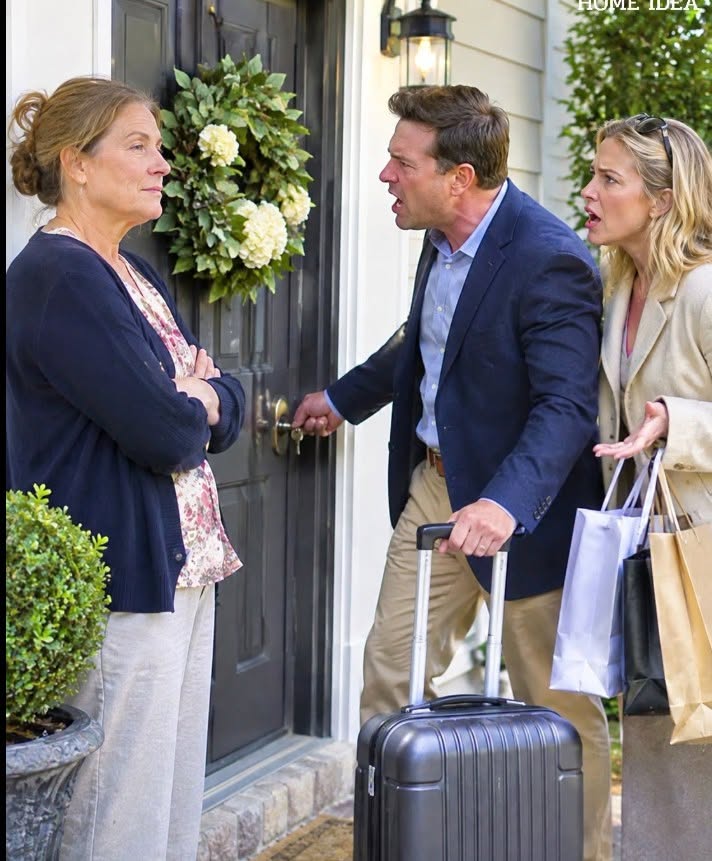
I remembered Daniel standing on the Cedar Grove porch after Europe, twisting the old silver key harder and harder, unable to understand why it would no longer obey him.
For years, I had mistaken access for love.
I thought being a good mother meant keeping every door open, even when people stopped knocking and started assuming they owned what was behind it.
I know better now.
A key is permission.
A home is ownership.
And love is not either one.
Love does not give your children the right to calculate your value before you are gone.
It does not require you to surrender your independence so they can feel secure.
It does not mean handing over the life you built because someone else has already included it in their plans.
Frank and I spent thirty-two years paying off that house.
But the most valuable thing he left me was not the property.
It was the knowledge that I had helped build something with my own hands.
Which meant I could build again.
Daniel once called me a burden.
He thought the cruelest part of that sentence was the word.
It wasn’t.
The cruelest part was believing I would hear it and still remain exactly where he left me.
I didn’t.
While he and Melissa were drinking wine in Italy, walking through Paris, and planning a future that already included my house, I quietly changed mine.
I sold the property.
Protected my money.
Packed my memories.
Locked the door behind me.
And by the time my son came home believing he still had a key to my life, the lock had already changed.
This time, it stayed changed until I decided who was allowed back in.

