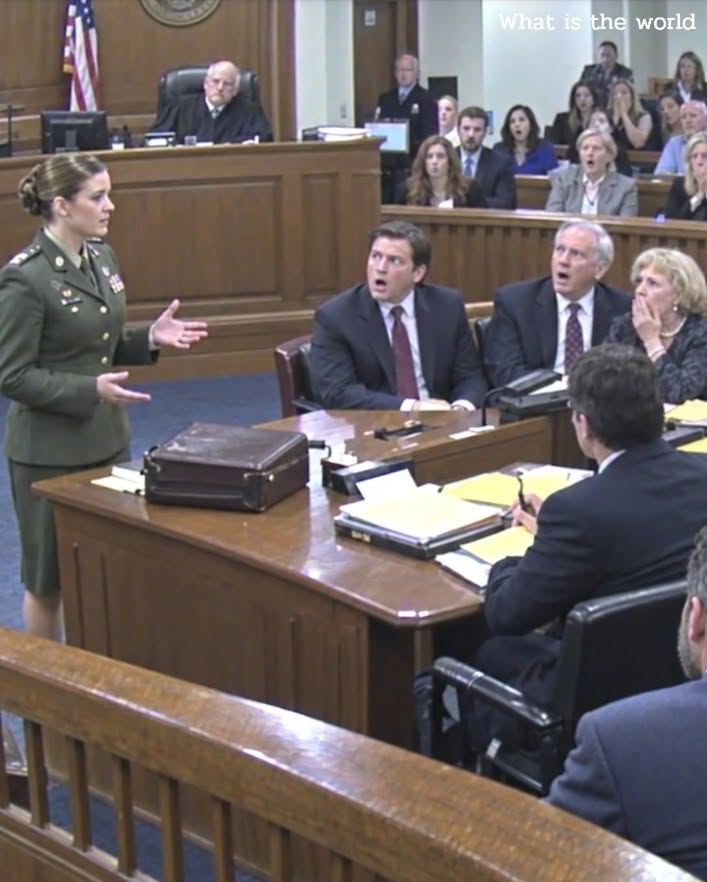
“I knew Richard told you it was for tax planning.”
“It was.”
“Then the documents will demonstrate that.”
Richard suddenly spoke.
“They will.”
I looked at him.
His confidence had returned.
That interested me.
Richard Hale had spent thirty-five years turning a small fabrication company into a sprawling industrial business.
He did not panic easily.
If he was confident, he believed the dangerous records were somewhere I could not reach.
Unfortunately for him, I had spent my career finding the page everyone else overlooked.
Judge Morrison called a brief recess.
The moment she left the bench, the courtroom erupted in whispers.
Vivian came directly toward me.
Her heels struck the floor like tiny hammers.
“You deliberately deceived us.”
I closed my binder.
“About what?”
“Being a lawyer.”
“You never asked.”
“You let us think you filed paperwork.”
“I did file paperwork.”
Her face tightened.
“That is dishonest.”
I looked at her for several seconds.
“Vivian, during seven Christmases you asked me which caterer I preferred, whether I planned to have children, why I wore inexpensive shoes, whether my family understood proper table settings, and why I had not convinced Preston to replace our kitchen.”
She opened her mouth.
I continued.
“You never once asked what I actually did for a living.”
She stared at me.
Behind her, Richard approached.
Unlike Vivian, he was calm.
“Amelia.”
“Richard.”
He glanced toward my briefcase.
“You always were very organized.”
“That used to amuse you.”
“It still does.”
“No, it doesn’t.”
For the first time, his smile looked forced.
“Whatever Preston did, there is no reason to destroy the family over it.”
I almost laughed.
“You filed a sworn declaration saying I contributed nothing.”
“That was Preston’s divorce.”
“Your signature appears on supporting company statements.”
His eyes sharpened.
“You should be careful with accusations.”
“So should anyone signing documents under oath.”
His face hardened.
Then he leaned closer.
“You think because you wore a uniform and passed the bar that you understand how companies like ours operate?”
There it was.
The same contempt.
Just wearing a better suit.
“I understand records,” I said.
“You understand paperwork.”
“Sometimes paperwork is the only witness that doesn’t lie.”
His expression changed.
Only slightly.
But I saw it.
Fear.
Not much.
Enough.
The clerk announced that court was resuming.
Richard returned to his seat.
Martin immediately requested time to review the newly highlighted records.
Judge Morrison allowed fifteen minutes.
During those fifteen minutes, Preston tried to speak to me.
I refused.
He tried again.
“Amelia.”
I kept reading.
“Amelia, look at me.”
I finally did.
He looked exhausted.
“You could have told me.”
“Told you what?”
“That you were an attorney.”
“I told you I worked in military legal services.”
“That is not the same.”
“You never cared enough to ask.”
“That’s unfair.”
“Is it?”
His mouth tightened.
“You wanted me to think you were just administrative staff.”
“No. You wanted to think that.”
He flinched.
I lowered my voice.
“And it suited me to learn what you said when you believed I didn’t understand.”
His face went still.
“What is that supposed to mean?”
I closed the folder.
“You’ll find out.”
When the hearing resumed, Martin changed strategy.
He stopped trying to diminish me.
Instead, he became courteous.
“Mrs. Hale,” he said during questioning, “you testified that you are military counsel.”
“Yes.”
“You are not a specialist in corporate divorce litigation, correct?”
“Correct.”
“You have never been a partner at a private family law firm?”
“No.”
“You do not routinely litigate high-value marital asset disputes?”
“No.”
His confidence grew.
“So despite your legal background, there are substantial areas of this proceeding outside your professional expertise.”
“Certainly.”
He smiled.
“And yet you chose to represent yourself.”
“Yes.”
“Why?”
That was the question he should not have asked.
I looked at Judge Morrison, then back at Martin.
“Because I knew the problem was not the divorce.”
Martin’s smile vanished.
“What problem?”
“The records.”
He stared at me.
I reached into my briefcase.
“This case depends on whether Preston accurately disclosed marital and corporate assets.”
“Correct.”
“And if his records are inaccurate?”
“That would depend on the nature of the discrepancy.”
“And if the discrepancy involves intentionally moving assets?”
“Objection. Hypothetical.”
“Sustained.”
I nodded.
Then I changed direction.
“Mr. Voss, your office produced financial records from Hale Dynamics.”
“Yes.”
“Did you personally review every file?”
“No.”
“Did someone on your team?”
“To the best of my knowledge.”
I lifted a flash drive.
“Did your team review the embedded metadata?”
He said nothing.
The room seemed to tighten around us.
Judge Morrison looked toward him.
“Mr. Voss?”
“I cannot answer without consulting my staff.”
I turned to the judge.
“Your Honor, I request permission to provide the court with a metadata report prepared from the files petitioner produced.”
Martin stood.
“On what basis?”
“Authenticity and chronology.”
He glanced at Preston.
Then Richard.
Richard’s face had gone gray.
That told me I was finally close.
Judge Morrison accepted the report.
I explained that several financial files had been modified shortly before discovery production.
Not merely opened.
Modified.
Ownership labels changed.
Transaction descriptions shortened.
One transfer renamed.
Another removed from a summary sheet but still preserved in the file history.
Martin looked genuinely shocked.
He turned toward his junior attorney.
“When did we receive these?”
“From Hale Dynamics’ finance office.”
“Directly?”
“Yes.”
“Who transmitted them?”
See more on the next page

