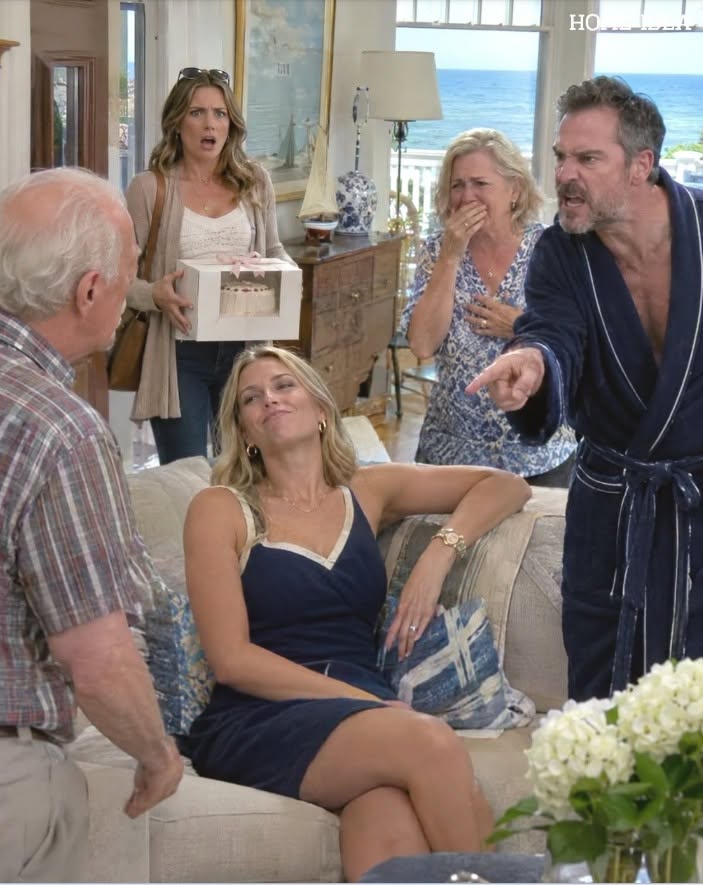
Marcus pointed at my dad.
“This is a family home,” he said. “He needs to accept that.”
My sister’s laugh came from behind me. She was on the couch, feet up on the coffee table, phone in her hand, not bothering to look up properly. The laugh of someone who considers this already resolved.
My mother was at the kitchen sink, gripping the edge of the counter with both hands. Back to the room, still the way she goes still when something has been wrong for long enough that stillness is all she has left.
I set the cake on the counter.
I looked at my father. He met my eyes for one second and looked back at the floor.
In that second, I saw everything. The shame, the helplessness, the exhaustion of a man who spent his whole life trying to hold things together. He wasn’t weak. He was worn down. There’s a difference, and it matters.
I looked at Marcus. He was wearing my father’s bathrobe, the thick cotton one I had bought specifically for a man who was cold in the mornings and deserved something warm after fifty years of managing without it.
Marcus held my gaze, comfortable, settled, the posture of someone who believes the room belongs to him.
“Marcus,” I said, “can you take the kids outside for a few minutes?”
He looked at Dana. She gave him a small nod.
He said something to the kids about the water, and they slid off the couch and followed him out through the back.
When the sliding door closed, the room went quiet.
I sat down across from my sister.
Dana and I sat across from each other and looked at each other the way sisters look at each other when there is nothing left to perform.
“You came to make a scene,” she said.
“I came because Mom was whispering in her own kitchen.”
“She was being considerate. Marcus was sleeping.”
“At nine in the morning.”
She looked at the window.
“You always do this. You make everything into a problem.”
“I found your Airbnb listing,” I said.
The room went very still.
I pulled out my phone and turned it so she could see the screenshot. The lead photo was of the deck, the same deck where my parents had watched their first sunset in this house. Coastal Gem, Quiet Cove, summer rentals available, $325 a night.
She had posted it two days after they arrived.
Dana’s face did the thing it does when she is caught. Not collapsing into contrition, but going still, conserving, calculating the next move before the current one has landed.
“That was Marcus’s idea,” she said. “Your name isn’t even on the listing. He set it up. I just—”
“There were three bookings. Amy next month, Rachel in July, someone named Rook in August. You had the whole summer sold.”
Her jaw tightened.
“We were going to use that money for upkeep. Old houses need—”
“I prepaid the taxes for five years.”
“For other things, then.”
“Where were Mom and Dad going to sleep when Amy was here?”
Pause.
That said everything.
“There’s the guest room,” she said.
“The one your children are currently in. You were going to put our parents in the back bedroom of their own house and rent the rest to your friends.”
“You make everything sound so—”
“I’m describing what the booking calendar shows.”
I kept my voice level, not angry, precise.
“Dana, I’ve given you forty-seven thousand dollars since you and Marcus got together. I added it up. Every transfer, every Venmo, the loan, the deposits, the rent. Forty-seven thousand dollars.”
She stared at me. Her mouth was slightly open. The number surprised her, not because she doubted it, but because she had never counted.
“You don’t count when someone else is always absorbing the cost. I’m not asking for it back,” I said. “I’m bringing it up because I want you to understand what I’ve been doing and why I’m not doing it anymore. Not with the house, not with anything else. I was the cost absorber because I absorbed everything. You never had to change.”
She looked out the window, the kids’ voices bright against the sound of the water.
“So you’re kicking us out?” she said flatly.
“You were never supposed to be here past Saturday lunch.”
I reached into my bag and set two things on the coffee table.
First, the deed. Their names, no one else’s. Second, one page on my attorney’s letterhead.
I watched Dana read it. The trust language, the trustee provisions, the removal authority.
She read it twice. The soft expression she had been holding dissolved.
“You set this up before you even told them about the house.”
“Three weeks before.”
“You were already planning.”
“I was planning for you.”
She set the page down. The look she gave me was not entirely anger and not entirely grief. The specific expression of someone who has been seen doing what they were doing and realizes they’ve been seen for longer than they knew.
I took out my phone.
“I’m calling the locksmith now. He’s already nearby. I need you packed and out before he arrives.” I kept my voice even. “I’m not calling the police. I’m not reporting the listing. I’m asking you to leave now, cleanly.”
“Where are we supposed to go?”
“That’s not something I can solve for you.”
I called Victor. One ring.
“Hey,” he said. “Ready for me?”
“Yes. Come on over.”
Dana was on her feet. The soft voice was gone.
“You think you’re so much better than us? You always have.”
“I think I’m more prepared,” I said. “That’s all.”
She went to the back door. I heard her tell Marcus they were leaving. His voice rising, her voice lower, a silence, then boots on the deck.
I went to find my parents.
My parents were on the deck, my father in the Adirondack chair I had positioned facing the tree line. My mother beside him, not talking, existing in the same space the way my parents always have in hard moments, letting the proximity do the work that words can’t.
When I came through the sliding glass door, my father turned. He looked at me, then past me at the quiet house behind me, and whatever he read in the combination made his expression shift.
“They’re packing,” I said.
My mother turned. “Mara—”
“It’s handled.”
“You didn’t have to.”
“Mom.”
I pulled a chair over and sat level with them, not standing over them.
“I know this is going to feel like I’ve damaged something between you and Dana. I want you to hear me say clearly what I did: I asked people who were occupying your home without permission to leave. That’s all. The rest of it — her anger, Aunt Teresa’s calls, whatever story gets told — none of that changes what actually happened in this house.”
My mother looked at the trees.
“She’s going to say things.”
“She already is,” I said. “And then she’ll need something and she’ll call you and you’ll have to decide what to do. But that’s later. Right now, you’re in your house and they’re leaving it. That’s the only thing that matters right now.”
From inside came the sounds of packing, the thud of bags, Becca crying about something, Marcus’s voice low and simmering.
My mother flinched at each sound.
Marcus came out first, duffel bag over one shoulder, jaw set. He stopped when he saw us. He looked at my father.
“This is messed up,” he said. Not to me, to my dad. “Your own daughter doing this to family.”
My father looked at him, didn’t say anything, just held his gaze without expression. The way a man holds something still when he has decided to be completely still.
Marcus waited five seconds for a response that didn’t come.
His jaw tightened. He picked up the bag and went around the side of the house to the truck.
Dana came out carrying Becca on her hip, Leo behind her with a backpack. She stopped when she saw me.
The look she gave me was not quite hatred. It still had some love in the mix, but it was as close as family gets.
“I want you to know I will not forget this,” she said.
“I know.”
“You humiliated us.”
“I asked you to leave your parents’ home.”
She shifted Becca higher and walked off the deck without looking at my parents.
My mother’s hand lifted slightly. The beginning of reaching out that she didn’t finish.
My father put his hand over hers.
We listened to the truck back out too fast, the way Marcus does everything. Down the gravel lane, onto the road.
Then nothing, just wind in the trees and the distant sound of water.
My mother let out a long, slow breath that was not a sigh. Something releasing.
Victor arrived fifteen minutes later, a compact man in his fifties with a canvas tool bag and the quiet efficiency of someone for whom this kind of job requires no comment.
He shook my hand, nodded at my parents, and went to the front door.
“All exterior locks,” he said. “Front, back, garage, sliding panel on the deck.”
“Forty-five minutes.”
He worked through the house while my parents and I stayed on the deck. We could hear him, the whir of the drill, the click of hardware, the satisfied thunk of a new deadbolt seating.
My father listened to each one without comment, but something in his posture changed as Victor worked. A very gradual unbinding, like a rope going slack.
When Victor finished, he brought me four keys on a simple ring. Two for me, two for my parents. He accepted his fee, added the tip without comment, and drove away.
I stood at the front door for a moment. I turned the new deadbolt, turned it back, the clean mechanical certainty of it. Nothing loose, nothing that would give.
Then I went inside and got a garbage bag from under the sink and got to work.
My mother tried to help. I told her to go sit with my father. She argued. I handed her a glass of water and pointed at the deck. She went.
I stripped the guest room, remade the bed. I scrubbed the muddy floor on my hands and knees. I washed every glass Marcus had touched in water as hot as I could stand. I rolled the ruined entryway rug and dragged it to the curb.
I worked for three hours.
When I was done, the house was clean. It smelled like itself again. The lamp in the living room was on, and through the window you could see the last of the light on the water through the trees.
I sat down on the sofa and did not cry. I thought I might, and I didn’t. I just sat in the quiet house and let it settle around me.
The debt conversation happened after midnight.
My parents had gone to bed at nine. My father stayed up past them in the recliner, reading Steinbeck under the lamp, the good quiet of a man in his own chair in his own house.
Then he put the book down and looked at the ceiling and got up and went to the deck.
I was at the kitchen table with a cup of tea I was no longer drinking.
When I heard the sliding glass door, I got up and followed him.
He was at the railing looking at the dark. The trees were black shapes against a sky holding faint light from the town a few miles down the coast. The water, where you could see it between the branches, had a pewter gleam. Cold. The insistent coastal cold that gets into your collar and stays.
I went back inside and got two blankets from the linen closet. Handed him one.
He took it without turning.
We stood there. This is something my father and I have always been able to do — be quiet together without it being a problem. My mother feels silence. My father inhabits it. I learned from him.
After a while, he said, “I should have handled it.”
“You did handle it.”
“I let them walk in and I didn’t say a word.”
“You called me.”
See more on the next page

