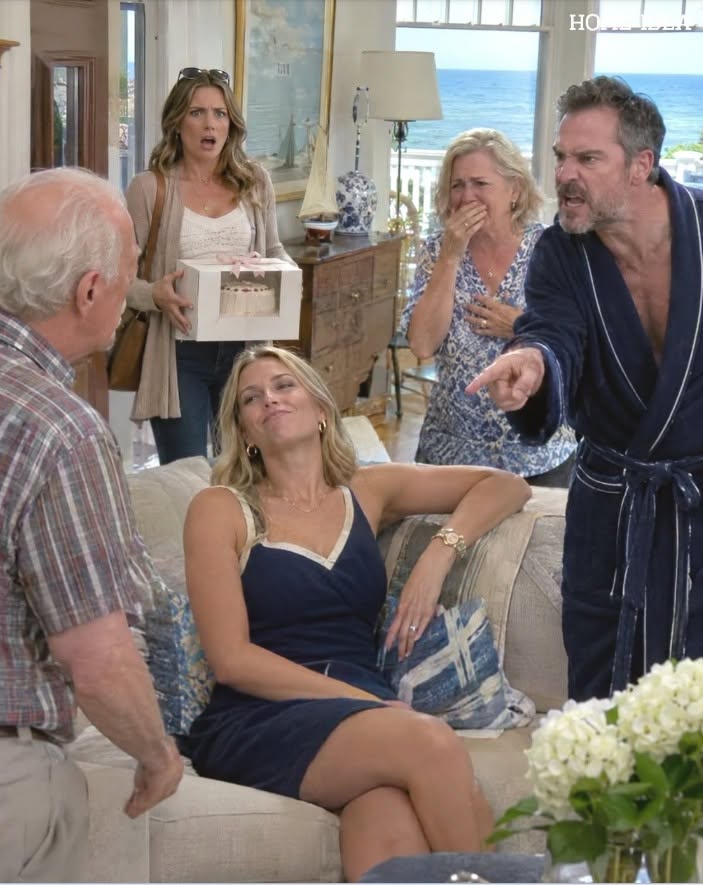
“That’s not the same thing.”
“It is exactly the same thing. When have you ever, in my whole life, called someone and said, ‘I can’t manage this, I need you to help me’? Thirty years of ‘we’ll figure it out,’ even when you couldn’t, even when it cost you. You called me this time. That’s not weakness. That’s the first time you trusted someone else to carry something you couldn’t. For someone like you, that is the hardest thing there is.”
He was quiet.
The water moved in the dark.
“She was my daughter,” he said finally. “I kept thinking, it’s family, you don’t—” He stopped. “I kept waiting for it to resolve itself.”
“It doesn’t resolve on its own,” I said. “That’s the thing about this kind of thing. It just occupies and then expands. And then one day you look up and you’re spending your days on the deck of your own home so you don’t have to be inside it.”
I kept my voice gentle. “She wasn’t going to leave on her own.”
“Was she really going to rent it?” he said.
“Three bookings. The whole summer.”
He took that in. His jaw worked once. Then his face went still the way it goes still when he is choosing not to say the thing he is thinking.
“I’m glad you came,” he said.
“I know.”
“I’m glad you set up the trust.” A pause. “I’m embarrassed.”
“It was necessary. It wasn’t embarrassing. It was practical.”
“She’s my daughter.” Not excusing her, just stating the inescapable biological weight of it. “I’m going to have to figure out what that means now, going forward.”
“You don’t have to figure that out tonight.”
“No.” He adjusted the blanket on his shoulders. “No, I suppose not.”
We stayed at the railing until the cold became unreasonable. Then my father reached out and put his hand on my shoulder. Not a hug — my father rarely initiates those — but a hand on the shoulder that stayed for a moment.
It said what he could not have said in words. It said, I see what you did today. I understand what it cost. I am grateful in a way that doesn’t fit into language, and I am not going to try to put it there.
“Go to bed,” he said.
“You first.”
A sound from him that was almost a laugh.
He went inside. I heard the floor creak under his weight. The third board from the hallway, the one I had noticed my first week and decided not to fix because I liked knowing where people were by sound.
I stayed on the deck a little while longer, just long enough to feel the cold properly. Then I went inside and locked the door.
The noise started before seven the next morning.
Fourteen missed calls, eleven texts.
My aunt Teresa, my mother’s cousin Barbara, a number I didn’t recognize that turned out to be Marcus’s mother. Three from Dana.
I read through the texts the way I read a chart before entering a room, to know what I was walking into.
Aunt Teresa: “Mara, I cannot believe what I’m hearing. Dana is in pieces. Those children spent the night in a parking lot.”
Dana: “You are a controlling monster. I hope you know what you’ve done to this family.”
Dana, forty minutes later: “Mom won’t return my calls. What did you say to her?”
Dana, two in the morning: “I’m sorry. I know things got out of hand. Can we talk, please?”
I set the phone face down.
Lay there looking at the ceiling of the guest room. The off-white I had painted. The east-facing window. Morning light coming in flat and clean.
I was not spiraling. I was doing the thing I do when something external tries to destabilize me. Locate the facts and hold them.
The facts. Dana and Marcus had arrived uninvited and stayed four days past what my mother had agreed to. They had displaced my parents in their own home. They had listed the property on Airbnb and secured three bookings without permission. I had asked them to leave, produced documentation of my authority to do so, and called a locksmith. They had left. My parents had slept in their bed.
Everything in my phone was noise around those facts.
I got up, made coffee, went to the deck.
I spent twenty minutes doing what I should have done before sleep. Taking screenshots of the listing, the bookings, the timestamps, archiving everything with the date.
Then I drafted a brief factual summary and emailed it to my attorney for her records. Not because I expected litigation — Dana and Marcus had no ground. Because documentation is the difference between being believed and being just another voice in a family dispute.
The Facebook post appeared while I was eating breakfast.
Dana had posted a photo of herself and the kids in what appeared to be a rest stop parking lot. Becca asleep in the back seat. Leo looking out the window with the flat expression children get when they are exhausted and being used as visual evidence.
The caption: “Spent last night in a parking lot because my sister decided that legal documents matter more than family. My babies tired and confused and asking me why Auntie Mara doesn’t love us anymore. This is what happens when money becomes more important than people.”
It had been shared forty-seven times.
I read it once, put my phone on the table, finished my coffee, went inside and washed the mug.
I did not respond to the post. I did not explain myself to Aunt Teresa or Barbara or Marcus’s mother.
This was a choice. The part of me that has been saying “I am not the problem, you are the problem” to an audience that wasn’t listening for thirty years wanted to write out the timeline, attach the screenshots, let the facts speak publicly.
I didn’t, because my parents were in the kitchen behind me. My mother was making oatmeal. My father was reading a newspaper. That kitchen was quiet and warm and smelled like coffee and oats.
And I was not going to drag it into a public argument for the sake of being right online. Being right online has never once produced anything worth the cost.
My mother called that afternoon.
“I saw it,” she said immediately. “Are you okay?”
“I’m fine.”
“Your father hasn’t looked at his phone.” A pause. “She called me. I let it go to voicemail.”
“That’s okay.”
“I know what happened in this house,” she said. Her voice had a quality I didn’t quite recognize. Firm, in a way she rarely is. “I was here. I know what I saw. I know what it felt like to stand in my own kitchen and feel like a visitor. I’m not going to argue with her post. I’m not going to call Teresa. I’m just going to be here.”
I didn’t say anything for a moment.
“That’s the right call,” I said.
“I know,” she said. “I’m learning.”
The calls and texts tapered off over the following week. The post collected comments and then stopped.
Dana texted me twice more, once angry, once asking to talk. I sent a single reply to the second. “I love you. I’m not available to discuss this right now.”
She didn’t respond.
I went back to Providence, back to my cardiac unit, my condo, my Subaru. I worked long shifts. I cooked dinner. I slept. I did it again.
My parents called every two or three days. Not long calls. My father’s calls are never long, but they called from somewhere real.
My mother told me she had started baking from scratch again. A honey cake she hadn’t made since I was small. She had made it twice, and it had come out right both times.
My father told me he had walked down to the dock four mornings in a row.
“How’s your back?” I asked.
A pause. The careful pause of a man who doesn’t want to make too much of something good. “It didn’t bother me.”
“Good,” I said.
“The water’s cold,” he said. “But I like looking at it.”
Six weeks after the locksmith, I drove up on a Saturday without calling ahead.
I turned onto the gravel lane and the house was just a house. Lawn clear, deck furniture out.
My father had repositioned the Adirondack chairs, angled a few degrees more toward the water, which I would not have thought to do and was better.
A pot on the front step with a late-season plant, orange and red, still holding color in the November cold.
My father was on the deck with a mug and a piece of paper, writing something.
He looked up when he heard my car door. “Hey,” he said.
“What are you writing?”
“Letter to my brother. He moved to Arizona in 1987 and we still write letters. Never switched to email.” Said without apology. “Your mother’s inside.”
“Is she baking?”
“Since eight this morning.”
I could already smell it from the deck.
My mother was at the counter with flour on her forearms and the look of focused contentment on her face that I had been trying, without quite admitting it, to count backward and remember how long since I had seen it. The expression of a woman who is not bracing for anything, who is just here in this room doing this thing, and the doing of it is enough.
“You didn’t call,” she said.
“I wanted to surprise you.”
She made the small sound that meant she was pleased and wasn’t going to make a production of it.
“Sit down. There’s coffee.”
I sat at the kitchen table and looked out the window over the sink. The light was doing the thing it does on November mornings on the Maine coast. Coming in low through the bare trees, catching the water between the branches in flat silver panels. Not a dramatic view, not a postcard view. The kind you can look at every morning for the rest of your life without tiring of it, which is a different and better thing.
“How is she?” my mother said.
“I don’t know. I haven’t spoken to her.”
“I have. She called last week. She said she was sorry things had gotten to this point, which is different from being sorry for what she did.”
“Yes.”
My mother set the measuring spoon down.
“I told her I knew the difference. She didn’t like that.” A pause. “She asked if she could come visit. I told her I needed to talk to you first.”
I held my mug.
“What do you want to do?”
“I want my daughter back,” she said simply. “I also know that what she did was not all right. And I know that if she comes here and nothing has changed, I don’t have what I’d need to handle it.”
“You don’t have to handle it,” I said. “That’s the point of the trust.”
“I know, but I don’t want every visit to be a legal situation. I don’t want to be afraid of my own daughter coming to my door.”
“That’s reasonable,” I said.
“So what do I do?”
I thought about it. Leo on the deck with his backpack, looking at the boards. The forty-seven thousand dollars and what it had and hadn’t bought.
“Tell her she can come,” I said. “Day visit only, just her, not Marcus. Not yet, until she’s done more than one phone call. Tell her that’s the condition, and that you want to see her and you hope she comes. If it goes sideways, you call me.”
My mother nodded slowly and went back to mixing.
After a moment, she said, “Your grandmother would have liked you. She was practical the same way. Not cold, but clear.”
“I’ll take that,” I said.
“You should. She was the best person I knew.”
I stayed through dinner. My father made soup, butternut squash from a cookbook my mother had found at the farm stand’s book swap. He had been working through it all fall, methodical, adjusting each recipe on the second attempt. There was something in it I couldn’t identify and he wouldn’t tell me.
After dinner, we sat on the deck with blankets until the cold became unreasonable. Then we came inside and talked about nothing significant. The book my father was reading. A bird my mother had seen from the kitchen window. A town meeting they had attended about a proposed stop sign that had apparently gotten quite heated.
Ordinary things. The texture of a life being lived.
I drove home at ten o’clock. The highway was empty. Stars, the particular dense scatter you only get far from city light. I drove with the radio off and felt the specific lightness that comes after a very heavy thing has been set down.
Not resolved. Dana is not resolved. Marcus is not resolved. The full shape of what my family will look like going forward is not resolved. None of that is finished.
But my parents were in their house. The locks were good. The deed was in their names. My mother had flour on her arms and my father was writing letters to his brother. And the soup was good, and the plant on the step was still holding color in the cold.
Some things you fix. Some things you only make room for.
The room my parents needed was a blue cape on the Maine coast with a window over the sink and a deck facing the trees and a lock on the door that only opens for the right people.
I made that room. That was what I could do.

