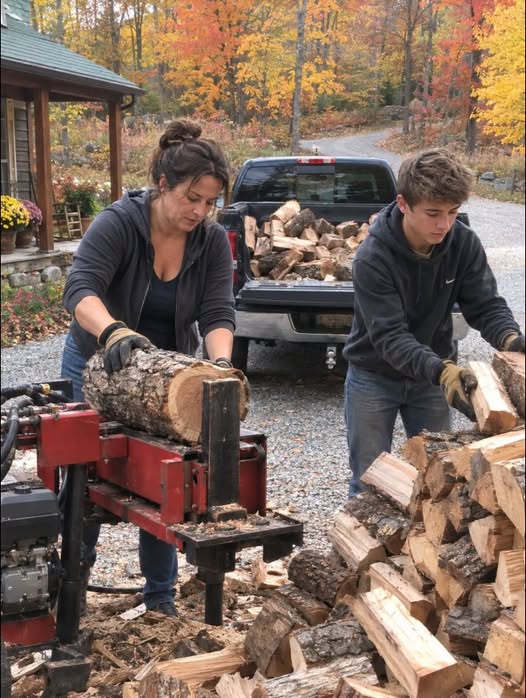
“Forty dollars,” Dale said. “For an afternoon.”
He said it with his hand resting on the splitter. The way a man rests his hand on something that belongs to him.
It did not belong to him.
It was a red twenty-seven-ton log splitter with a Honda engine. My husband bought it at Fleet Farm six years ago for fourteen hundred dollars. He made the last payment on it with money from selling firewood to the cabin people on the lake. Jim’s own handwriting was on the side of the hydraulic tank in white paint marker. I could see it from where I stood in the doorway of Dale’s shed.
“Forty dollars,” I said.
“The rental place in Rhinelander gets ninety a day,” Dale said. “And you’d have to drive all the way up there to get it. Forty’s a family price.”
He was grinning a little.
Not a mean grin, exactly. It was the grin of a man who has practiced a thing in his truck on the way over, and is relieved at how smoothly it came out.
It was a Saturday in the middle of October. Gray. About forty-five degrees. The kind of day up here in the north woods of Wisconsin when you can already smell the snow that’s still two weeks off.
My son was sitting out in the pickup in Dale’s yard with the heater running.
Cole was sixteen. He had his father’s shoulders. And that fall, he had none of his father’s patience. I’d told him to stay in the truck for exactly that reason.
My name is Becky Thorson. I’m forty-four years old. I drive a propane truck for the co-op.
And I need to tell you how that splitter came to be sitting in my brother-in-law’s shed in the first place.
Jim died in April.
He was forty-eight years old. It was ten minutes to five in the morning. He was sitting at the kitchen table lacing up his boots, getting ready to go sit in a log truck he couldn’t drive anywhere, because the spring road bans were still on.
He put his hand down flat on the table.
He said, “Beck.”
That was all he said.
The doctor told me later it was his heart. He said there was nothing I could have done with the four minutes I had before the ambulance came.
I’ve decided to believe him.
The week of the funeral, Dale came by with his truck.
Dale is Jim’s older brother. Three years older. He lives half a mile down Otter Creek Road from us, by himself. He does mechanic work out of the pole shed behind his house.
“I’m going to take the splitter down to my place,” he said, standing in my yard. “For safekeeping. You’re gone on that propane truck all day, and the boy’s at school. Somebody’d have that hooked up and gone in two minutes.”
I said thank you.
I would have said thank you to anybody that week.
Then it was summer, and I didn’t think about firewood at all.
I drive a bobtail for the co-op. Three thousand gallons. I took every single hour of overtime they’d give me all summer long.
Because a widow’s arithmetic isn’t complicated.
There’s one paycheck now. That’s all the arithmetic there is.
By the first of October, I was thinking about firewood.
People think it’s funny that the woman who delivers their propane heats her own house with wood.
It’s not that funny.
I know what propane costs better than anybody on my route. We have a furnace. But we also have a wood stove in the front room that Jim put in the year Cole was born. And that stove is what we live on all winter.
Jim had left about six face cords split and stacked under the lean-to from the year before.
Up here, when we say a cord, that’s usually what we mean. A face cord. A stack four feet high and eight feet long and one stick deep. About a good heaped pickup load.
Six of those would get us to about Christmas.
What I had plenty of was rounds.
Two winters back, Jim dropped nine red oaks along the north line of our property. The oak wilt was coming through, and he wanted to get them down before they died standing.
The fall before he died, he bucked every one of those oaks into sixteen-inch rounds. Then he lined them all up along the fence on pallets.
They’d been down two years now. The ends were checked and gray. They were as dry and ready as oak ever gets.
There was a long, long row of them.
And every single one was too big to fit in my stove.
You can split red oak with a maul. I’ve done it.
But I can’t swing a maul through fifteen cords of oak. Not in the handful of weekends I had left before the ground went white.
So on Friday night, I called Dale and told him I’d be down in the morning to get the splitter.
“Come on down,” he said. “We’ll talk about it.”
Now I knew what there was to talk about.
See more on the next page

