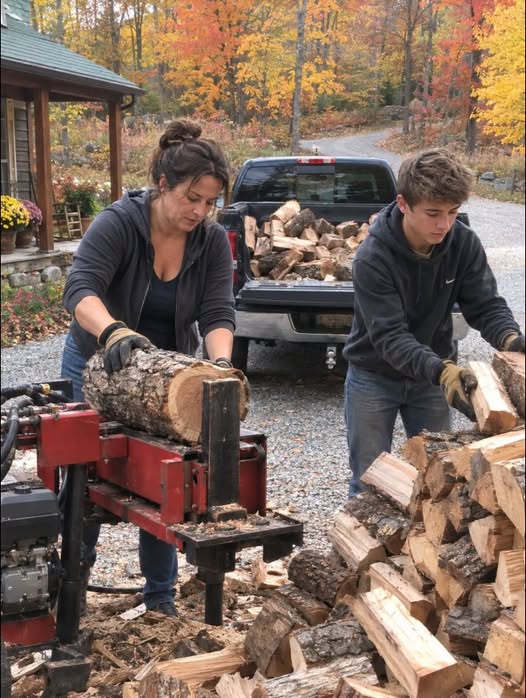
Here’s how it works, if you’ve never done it.
You set a round on the beam, up against the foot plate. You pull the lever. The ram pushes the round slowly into the wedge, with twenty-seven tons of pressure behind it.
The oak groans.
And then it lets go with a crack you can feel in your back teeth.
Red oak splits clean and straight. It smells sour when it opens up. Like vinegar. That night, you smell it in your hair.
One of us fed the rounds and ran the lever. The other one pulled the split pieces away and stacked them.
You don’t talk much, because of the engine.
You just go.
By one-thirty, we had the first face cord split and stacked in the bed of the truck. Heaped up and tight.
By two-thirty, we had the second one stacked on the ground beside it. And my shoulders were starting to talk to me.
Around three o’clock, I went into the lean-to to get the water jug.
And I saw the wall.
I’d seen it a hundred times. I just hadn’t looked at it since April.
On the bare studs inside the lean-to, right next to where the splitting maul hangs on its nail, Jim kept a list. Written in carpenter’s pencil.
He started it the very first fall we lived in that house. And every October, he wrote over it again to make it darker. So now it stood out black against the gray wood.
Mrs. Hartmann, one cord.
Donna Peterson, one cord.
Marlene Olson, one cord.
Three widows on Otter Creek Road.
Mrs. Hartmann lives at the very far end of the road, past the creek. She’s eighty-six. She taught fourth grade at the elementary school in town for thirty-four years.
Donna Peterson’s husband went through the ice on a snowmobile when their kids were small.
Marlene Olson lost her husband, Art, to cancer. Her hip is so bad she can’t carry more than three sticks of wood at a time.
Every October, for as long as Jim and I were married, he split their wood first. And ours second.
He delivered it. He stacked it on their porches. And he wouldn’t take one single dime for it.
He’d take a pie. If the pie was already made.
That was his whole rule.
I stood there in the lean-to holding the water jug. And I counted the daylight.
We had the splitter until dark. Dark was about ten after six.
At the rate we were going, we’d have four cords done by then. If nothing broke, and neither one of us quit.
Four cords wasn’t anywhere close to my winter.
And I thought, I’ll pay forty dollars again next Saturday if I have to.
But there are three old women down this road who’ve been looking out their windows ever since the leaves turned. And not one of them has called me.
Because how do you call a brand-new widow and ask her where your free firewood is?
I came back out with the jug.
“Three of these are going down the road,” I said to Cole. Loud, over the engine.
He looked at the truck. At the pile. At me.
He’d been riding along on those deliveries since he was big enough to carry kindling. He knew exactly which three.
“Dad’s list,” he said.
“Dad’s list.”
He nodded.
He rolled the next round over to the beam.
My son had spent most of that year angry at everything that moved. At school. At me. At the dog. At the whole world, for taking his father.
But he split wood that afternoon like a grown man.
And when we traded off at four o’clock, he said, “I’ve got the lever, Mom. You stack.” Because he could see my arms were shaking. And he didn’t want to say that he could see it.
We finished the fourth cord at twenty minutes to six.
The clouds had come down low over the pines. The light was going blue.
I shut off the Honda.
The quiet came in so fast that both of us just stood there in it.
Four face cords. One in the truck bed. Three on the ground in rows.
My hands wouldn’t close all the way.
“We have to take it back now,” Cole said.
“We do.”
“That is the dumbest thing I’ve ever heard.”
“I know it,” I said. “Hook it up.”
We pulled the splitter back down the road with a cord of oak riding in the truck bed.
Dale came out of his shed wiping his hands on a rag.
He looked at the wood in the truck. I watched him do the figuring in his head. The way any man up here would.
“Got some done,” he said.
“Four cords.”
“Four.”
He looked at Cole. Then back at me.
“In one afternoon. The two of you.”
“Thank you for the use of it,” I said.
He unhooked the splitter himself and rolled it back into his shed by the tongue.
From the shed door, he called out. “Same time next week, if you want it.”
“I’ll let you know,” I said.
Cole had his hand on the door handle. I could see him getting ready to say something.
I put my hand on his arm. He stayed in the truck.
And we drove straight on down the road. Right past our own driveway. Across the creek. All the way to the very last mailbox.
See more on the next page

