I left Mrs. Hartmann standing in his yard. Dale went and brought her a folding chair from the shed.
I drove the half mile home.
I went into the kitchen. I reached up on top of the refrigerator and took down the coffee can.
That was the wood money.
Every fall, Jim sold a few cords of firewood to the cabin people on the lake. Ninety dollars a face cord. And every single dollar of it went into a Folgers can on top of the refrigerator.
I hadn’t touched that can since April.
I couldn’t even make myself take the lid off.
I drove back to Dale’s. And I took the lid off right there on my tailgate. With both of them watching.
There was six hundred and forty dollars inside.
Twenties, mostly. Soft and a little bit sawdusty.
I counted out six hundred dollars onto the tailgate. I squared up the stack.
And I held it out to him.
“I can’t take that,” Dale said.
“You can. And you will.”
I kept my arm out.
“It isn’t mine. It’s his. It’s the wood money. And he’d have brought it down to you himself the day the roads opened. You know he would.”
Dale didn’t move.
“Jim paid what he owed,” I said. “Every time. His whole life. I’m not going to let him be the one man on this road who didn’t.”
He took it.
His hand wasn’t steady.
He didn’t put it in his shirt pocket this time. He just held it.
Then he reached into that shirt pocket with his other hand.
And he took out two twenties. Folded once.
The same two.
“I never spent it,” he said. “I’ve been carrying it around all week. I couldn’t make myself break them.”
I looked at those two bills in his hand.
I could’ve told him to keep it. That it was rent, fair and square, and I had a receipt. A week before, I might have.
I took them.
I put them in the coffee can. And I pressed the lid back down.
“I’m sorry, Becky,” Dale said. “I’m sorry I took it out of your yard. I’m sorry about the forty dollars. Jim would’ve—”
He shook his head.
“I don’t know what Jim would’ve done.”
“He’d have called you a stubborn fool,” I said. “And then he’d have split your wood for you.”
I nodded at the shed.
“Hook it up for me.”
He hooked it up.
He dropped the tongue on the ball. He ran the safety chains.
And this time, he didn’t tell me how fast to drive.
Mrs. Hartmann watched the whole thing from her folding chair. When the hitch pin was in, she stood up on her cane.
“Dale.”
“Yes ma’am.”
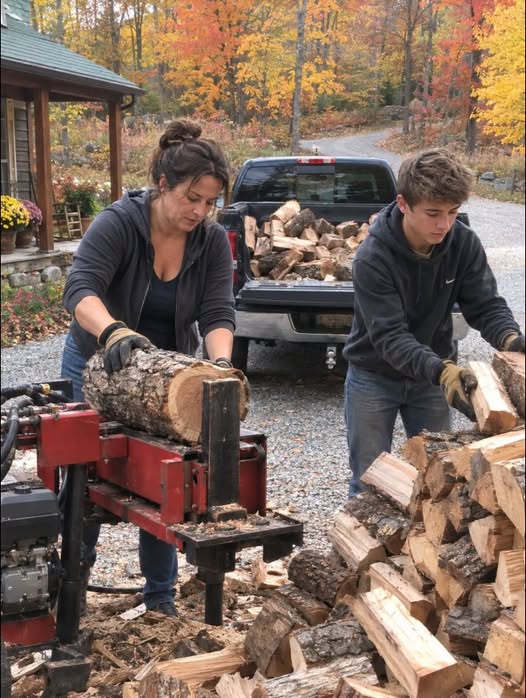
“There are thirteen cords lying in rounds along this girl’s fence. And one boy to help her. You own a chainsaw and a truck.”
“Yes ma’am.”
“I will leave that with you,” she said.
And she let me help her back up into the cab.
I drove Mrs. Hartmann home first.
Then I drove to town, with the red splitter rattling along behind me. And I parked right in front of the feed store.
There were three men at the counter. They all stopped talking when I walked in.
I went over to the bulletin board.
I took the thumbtack out of Dale’s receipt. I folded it up. I put it back in the chest pocket of my flannel shirt and buttoned the pocket.
I left the index card up.
The free oak was still free.
Ray looked out the front window at the splitter hitched to my truck. Then he looked at the empty spot on the board.
“All settled?” he asked.
“All settled,” I said. “It turns out Jim owed Dale for an axle. Back in February. It’s paid now.”
I said it loud enough for the three men at the counter to hear.
They’d carry it all over the county by supper.
That was only fair.
I’d put one truth up on that wall. I owed the town the other one.

