Mrs. Hartmann’s house is a small white house with green shutters and a porch across the front.
There was one lamp on in the front room.
There was a path worn into the grass from her front door to her mailbox. And no other path at all.
I knocked.
It took her a long time to come to the door. She came with her cane in one hand. She had a cardigan buttoned on over another cardigan.
When she opened the inside door, the air that came out of that house was no warmer than the air on the porch.
She looked at me.
Then she looked past me, at the truck with its headlights on. At the oak heaped up in the bed. At Cole, already dropping the tailgate.
“Oh,” she said.
That was all, at first. Just “Oh.” Very small. With her hand coming up to the collar of her sweater.
“It’s late this year,” I said. “I’m sorry, Mrs. Hartmann. I should’ve been here two weeks ago.”
“Rebecca.”
She has never once in her life called me Becky.
“I did not think anyone was coming,” she said.
“I know.”
“I would not have asked you. I want you to know that. I said to myself, Ilse, that girl has just buried her husband. You will buy your wood like everybody else.”
She shook her head.
“But the man in town wants a hundred and ten dollars a cord. And I thought I would wait and see how cold it got.”
“How cold has it gotten?”
“I have been keeping the propane at fifty-eight,” she said. With great dignity. “It is perfectly adequate with a sweater.”
I’m the one who fills Mrs. Hartmann’s propane tank.
I’d been wondering for three weeks why she wasn’t burning any.
“Well,” I said. “We’re going to stack this. And then Cole’s going to lay you a fire. And then you can turn that thermostat down as far as you like.”
She stood in her doorway with the storm door propped open on her hip and watched us carry every single stick.
Cole stacked it on her porch the way his father always had. Bark side up. Tight against the wall under the front window. With the smaller kindling splits on the end nearest her door, so she wouldn’t have to reach.
When he was done, he carried an armload inside and knelt down in front of her wood stove.
She stood right over him and told him exactly how to do it.
And he let her.
When the fire caught, she reached down and put her hand on top of his head.
He’s six feet tall. But he was kneeling. And she could reach.
“You stack like your father,” she said. “He stacked crooked in the fourth grade too. I never could break him of it.”
She patted his head.
“It always held.”
Cole didn’t look up. He just nodded at the stove door for a long while.
On the porch, as we were leaving, Mrs. Hartmann took hold of my sleeve.
“Eleven years he brought it,” she said. “I made him a pie every single time. And every single time he said, ‘Mrs. Hartmann, you didn’t have to do that.’ And then he ate half of it standing up in my kitchen.”
She held onto my sleeve.
“I have not got a pie tonight, Rebecca.”
“You don’t owe me a pie.”
“I owe somebody one,” she said. “I will work out who.”
On Sunday, after church, we loaded the second cord and took it to Donna Peterson.
Donna tried to give Cole a twenty-dollar bill. He wouldn’t take it.
We took the third cord to Marlene Olson. We carried it all the way into her back entry, one wheelbarrow load at a time. So she’d only have to walk ten feet with her bad hip to get to it.
Marlene had a pie already made.
She said she’d baked one every Sunday in October. Just in case. And had been eating them all herself.
We took the pie. Those were the rules.
That left one cord, out of the four, for my own stove.
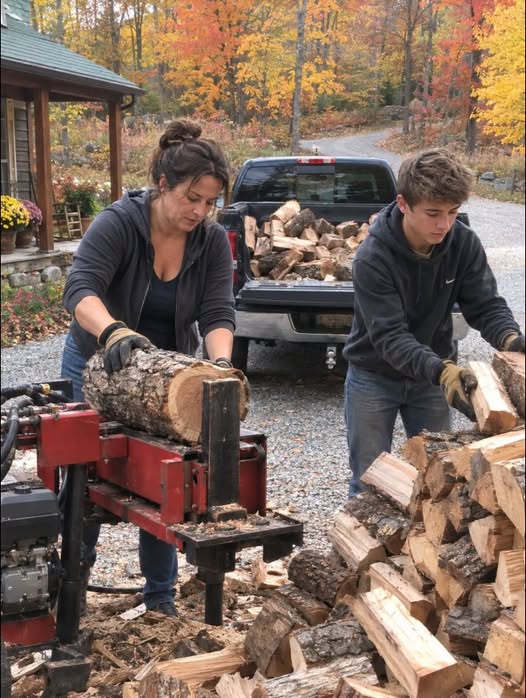
And thirteen or fourteen more cords still lying in rounds along my fence.
Sunday night, I sat at the kitchen table.
In Jim’s chair.
I had Dale’s receipt smoothed out flat in front of me. And an index card from the recipe drawer.
I wrote four different notes. I threw away three of them.
I’m not a spiteful woman. I want that to be true. So I’m careful about it.
I did not write one word about Dale on that index card.
What I wrote was this.
Free split oak for any widow or shut-in on Otter Creek Road who needs it before snow. Split Saturdays on Jim Thorson’s splitter. Call Becky Thorson.
And my phone number.
Every word of it was true. And there wasn’t one word on it I’d have minded reading out loud in church.
Monday morning, I was at the feed store at seven o’clock, right when Ray unlocked the door.
I had to start my route at seven-thirty. So I was already wearing my co-op jacket.
Everybody up here knows that bulletin board at the feed store. It’s by the front counter, next to the coffee pot. It’s where you find out who has hay for sale and who lost a beagle.
I took two thumbtacks out of the corner of the board.
I pinned up my index card.
Then I pinned Dale’s receipt up right next to it.
Just the receipt. On its little parts-store paper. With nothing written on it except what Dale wrote himself.
Ray was behind the counter counting his cash drawer. He looked up when he heard the thumbtacks go in.
He came around the counter and stood next to me. He had his reading glasses pushed up on his forehead.
Then he pulled them down.
He read the card.
He read the receipt.
He read the card again.
“Jim’s splitter,” he said.
“Yes.”
He looked at the receipt for a long time.
He didn’t ask me one single question.
He took his glasses off and folded them.
“You want some coffee, Becky?”
“I’ve got a route,” I said. “Thank you, Ray.”
And I went to work.
I didn’t say another word about it to anybody. I just pinned up two pieces of paper and drove my propane truck.
But you can’t fill a propane tank in this county without somebody coming out on the porch in his slippers to visit.
And by Wednesday, they were coming out with something in particular on their minds.
A man named Larry, out on Pine Road, held the hose for me while I filled his tank. He’d never done that once in six years.
“I’ve got a thirty-ton splitter,” he said. “I could have it in your yard tonight. You could keep it till Easter.”
“That’s good of you, Larry. But I’ve got one.”
“So I read,” he said.
That would’ve been the easy way out. For everybody. Dale included.
But then the red one would’ve sat in Dale’s shed for the next ten years. With Jim’s handwriting on it.
I didn’t want Larry’s splitter. I wanted my husband’s.
Three other men made me the same offer that week.
The phone rang at home too. Two calls were for the free oak. Both from people farther out than Otter Creek Road. One was a widower on Spring Lake. One was a young mother whose husband was deployed.
I wrote their names down.
Cole came home from school Wednesday afternoon and dropped his backpack by the door.
“Everybody at school knows,” he said. “Everybody. Why don’t you say more? You could bury him, Mom. Everybody’s waiting for you to.”
I was standing at the sink peeling potatoes.
I kept peeling.
“Because he’s your dad’s brother,” I said. “He taught your dad to drive. He stood next to me at the grave, and he couldn’t get through the Lord’s Prayer.”
I set down the peeler.
“Whatever this is, it isn’t all he is. I put up the truth. And it was a small truth. In his own handwriting. If there’s more to it than that, I want him to be the one to tell me.”
“And if he doesn’t?”
“Then I pay forty dollars on Saturday,” I said. “And I ask him for another receipt.”
Cole almost smiled.
It was the first time in a long while.
Ray told me later what happened on Thursday.
Dale came into the feed store for hydraulic fittings around ten in the morning. That’s when the counter is the fullest.
Four or five men were standing there with their coffee.
Dale said good morning.
Nobody was rude to him. Somebody said, “Morning, Dale.”
And then nobody said anything else.
And one by one, they looked over at the bulletin board.
And then at the floor.
Dale turned around to see what they’d all been looking at.
Ray said he read it standing very still. A long time.
He could have torn it right off that board. Nobody would’ve stopped him.
He didn’t.
He paid for his fittings. He left a five-dollar bill on the counter for a three-dollar sale. And he walked out without his change.
Friday night, I was doing dishes when I saw headlights come up Otter Creek Road and slow down at the end of my driveway.
The headlights stopped. I watched them sit there on the kitchen wall.
They sat there for most of a minute.
Then they went on.
See more on the next page

