“Forty dollars,” I said again, standing in his shed.
“For the afternoon. Have it back by dark.”
There were a number of things a person could say at a time like that.
It’s Jim’s.
Jim’s is mine.
You took it out of my yard the week I buried him, and I said thank you.
I had every single one of those sentences lined up behind my teeth.
But I looked at Dale’s hand resting on the beam of that splitter. And I looked at his face.
And I understood something.
If I said those things, he’d say something back. And then I’d be a widow standing in a shed in October, arguing about a machine while the daylight burned away. With my son watching the whole thing through a windshield.
And I still wouldn’t have my wood in.
I understood something else, too.
If my husband’s brother was going to charge me rent on my dead husband’s splitter, I wanted it written down. In his own hand. With his own name under it.
“All right,” I said. “Thank you, Dale.”
I took my wallet out of my back pocket. I took out two twenty-dollar bills. I handed them to him.
He took them.
He folded them once and put them in his shirt pocket. And he looked more surprised than I’d seen him look since we were all young.
“I’d like a receipt,” I said.
“A receipt.”
“I keep track of things now. I have to.”
He laughed.
He went over to his workbench and tore a sheet off the little parts-store pad he writes his repair tickets on. He found a pen that worked on the third try. And he wrote it out standing up.
He was still grinning when he handed it to me.
I read it right there in the shed.
Rec’d of Becky Thorson, $40, rent on log splitter, one afternoon. Dale Thorson.
And the date.
“Good enough?” he said.
“That’s just right,” I said.
I folded it and put it in the chest pocket of my flannel shirt. And I buttoned the pocket.
He helped me hook it up. I’ll say that for him.
He dropped the tongue on the trailer ball. He ran the safety chains. He told me to keep it under forty-five on the road because those little tires heat up.
Then he stood in his yard with my forty dollars in his shirt pocket and watched me drive his brother’s splitter half a mile home.
Cole didn’t say a word until we were out on the road.
“Did you just pay him?”
“I did.”
“For Dad’s splitter.”
“Yes.”
“Mom.”
His voice cracked on it.
“It’s ours. It’s Dad’s. You just let him—”
“I didn’t let him do anything,” I said. “I rented a splitter for the afternoon, and I have a receipt. Now we have about six hours of daylight left, and I’d like to know how much oak two people can split in six hours. Get your gloves.”
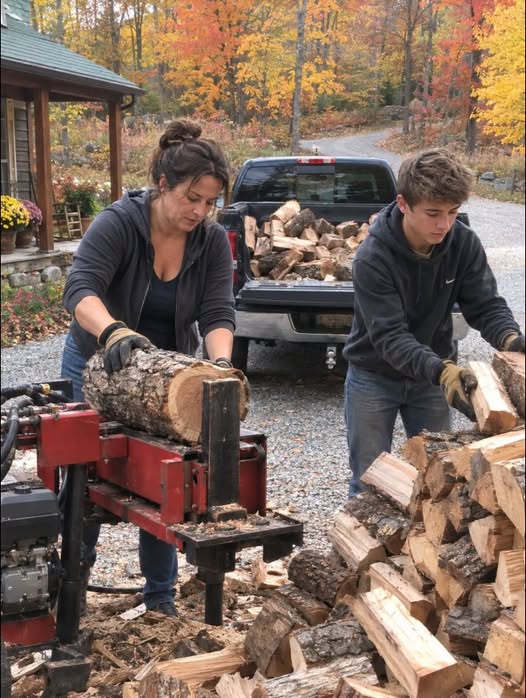
We backed the splitter up to the row of rounds a little after noon.
I braided my hair back out of the way. I put on my work gloves. I checked the hydraulic oil and the engine oil, because Jim always did, and because I didn’t know how the machine had been kept all summer.
Both were full. Both were clean.
Dale is a lot of things. But he doesn’t neglect a machine.
That’s when Cole saw the tank.
He’d crouched down to look for the fuel shutoff. And he stayed crouched down.
I came around to see what was keeping him.
Jim wrote on things.
He wrote on the inside of the kitchen cupboard doors. On the furnace. On the fuse box in the basement.
And on the side of that hydraulic tank, in white paint marker, he’d written down the date every time he changed the oil. A whole column of dates, going back six years. In his square, careful printing.
And underneath that column, set apart by itself, he’d written one more line.
Cole. First cord. Age 11.
Cole put his glove on it.
He just laid his hand there. Flat. The same way his father had laid his hand on the kitchen table that morning in April.
I didn’t say anything.
There are times a mother should talk. And there are times she should go pull the starter rope.
I went and pulled the starter rope.
The Honda caught on the second pull. The way it always had.
When Cole stood up, his eyes were red. His jaw was working.
He rolled the first round over to the beam.
“You run the lever,” he said. “I’ll feed.”
“We’ll trade off,” I said. “Every hour.”
See more on the next page

